

The Air Force Is Revisiting Laser Weapons for Base Defense
The US Air Force is reconsidering high-energy laser weapons for airbase defense at home and abroad after abandoning earlier efforts.


The US Air Force is once again considering high-energy laser weapons to defend bases against the rising threat of low-cost weaponized drones, according to a newly released contracting notice.
In a new request for information (RFI) published on March 6, US Air Combat Command’s new Point Defense Battle Lab (PDBL) — recently established at Grand Forks Air Force Base in North Dakota and tasked with developing counter-drone solutions for US military installations at home and abroad — laid out a range of new technologies of interest for drone defense, including ever-popular Advanced Precision Kill Weapon System (APKWS) kit-enabled Hydra 70 rockets, 30mm guns armed with airburst and proximity rounds, and “drone on drone autonomous kinetic interceptors.”
The PDBL’s wish list also includes high-energy laser weapons “with a 2-20 [kilowatt] power range [and] precision engagement, single target sequential with atmospheric-sensitive [sic],” according to the RFI. Laser weapons in this power class are typically suited to defeating Group 1-3 drones rather than hardened missiles.
While the Air Force’s most high-profile directed energy experiments typically involve airborne laser weapons, the service has increasingly experimented with ground-based systems for airbase defense in recent years. Following successful testing in 2018, the service deployed two of Raytheon’s 10 kw High-Energy Laser Weapon Systems (HELWS) mounted on a Polaris MRZR lightweight tactical vehicles overseas for field assessments in 2020 before subsequently taking delivery of at least two additional systems, including a palletized variant known as ‘H4’. HELWS can purportedly engage targets at ranges of up to 3 kilometers and fire “dozens” of shots on a single charge, according to the Congressional Research Service. In 2023, Raytheon claimed that the system had racked up more than 25,000 operational hours and 400 drone defeats during overseas testing.
The Air Force also began assessing several other ground-based laser systems in 2019, including Boeing’s 5 kw Compact Laser Weapon System (CLaWS) developed for the US Marine Corps, Lockheed Martin’s 30 kw Advanced Test High Energy Asset (ATHENA) laser weapon developed for the US Army, the 20 kw LOCUST Laser Weapon System that was at the time produced by Applied Technology Associates (now part of AV), and the Army’s experimental 5 kw Mobile Expeditionary High Energy Laser (MEHEL). The service’s evaluation of CLaWS in particular culminated with the system successfully protecting a convoy from multiple drone threats from atop a Marine Corps Utility Task Vehicle during a field test of the Air Force’s new Advanced Battle Management System (ABMS) in September 2020. (The Corps continued to test CLaWS through at least 2021.)
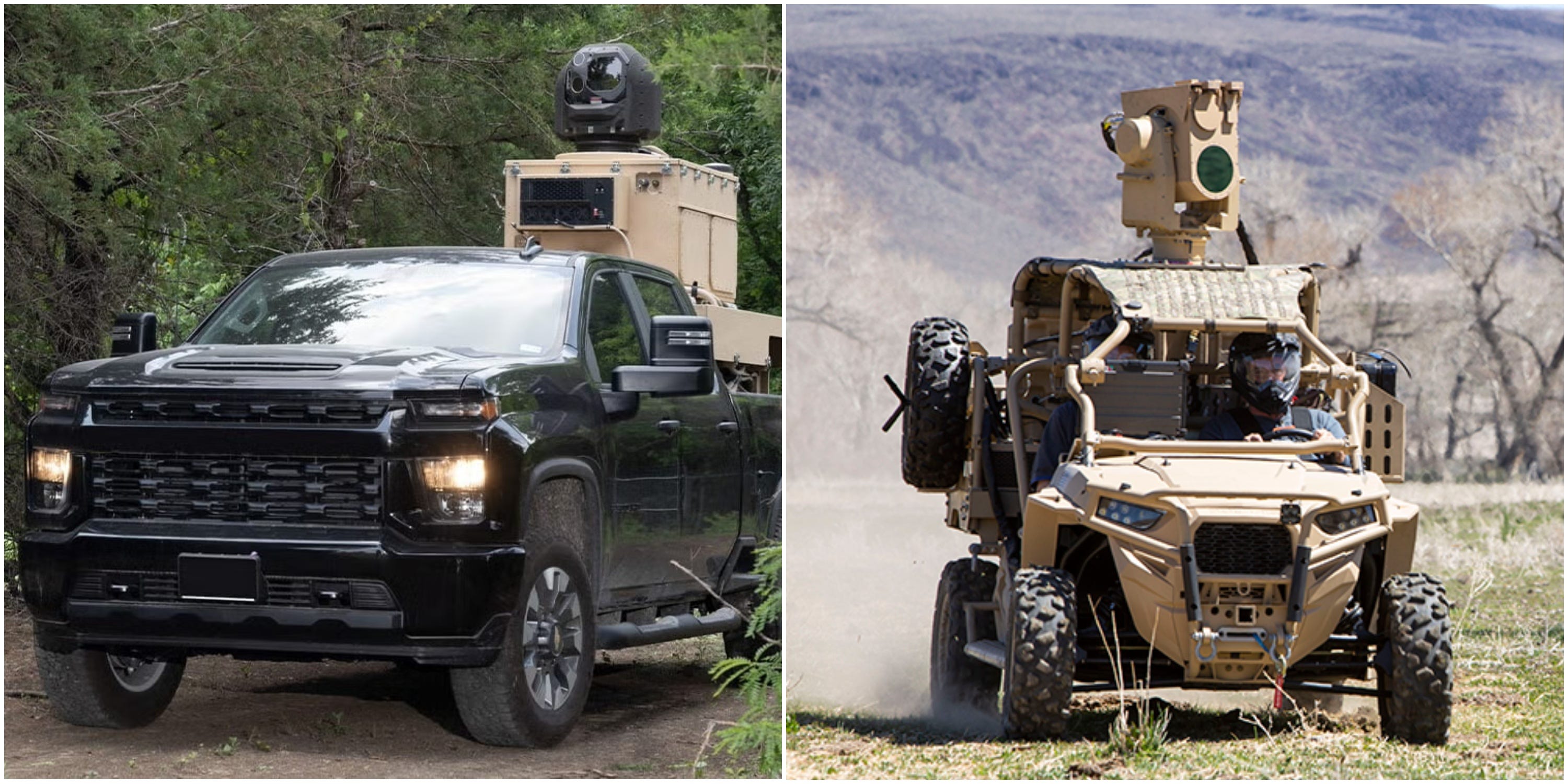
Despite this momentum, efforts to transition these systems to programs of record stalled. According to the Air Force’s fiscal year 2026 budget request, officials determined in 2024 that “there were no further requirements for the counter-UAS prototyping as part of the [Air Force directed energy] program,” adding that existing funding should be redirected to “higher priority [directed energy] transition efforts.” The budget request states that the service subsequently transitioned HELWS efforts to the Army’s Rapid Capabilities and Critical Technologies Office (RCCTO), which assumed responsibility for closing them out the following year.1 As for CLaWS, Laser Wars first reported last year that the Marine Corps had returned its five system to Boeing and “decided to invest in more deliberate programs of record,” according to a service spokesperson.2
These laser weapons failed to transition from research and development to acquisition not necessarily because the technology was immature, but because the Air Force “[had] not consistently taken key steps” to support such transitions, according to an April 2023 assessment of the Pentagon’s directed energy efforts from the US Government Accountability Office. Indeed, one unnamed counter-drone laser weapon prototype (likely HELWS) “was under development and testing for more than 3 years — with the expectation of transitioning into an acquisition program when ready — before a transition partner was identified,” the GAO report stated. This disconnect between R&D and acquisition planning and priorities essentially doomed the service’s laser weapon prototypes to languish in the “valley of death” where many next-generation technologies meet their end.
”Air Force officials said that it was unclear who the transition partner should be, even though a transition partner, PEO Digital, was identified in 2021,” the GAO report said of the unnamed laser system. “However, the prototype did not fully align to program office needs, and the office did not have funding planned — nor transition agreements in place — to support initiating a [directed energy] weapon acquisition.”

The rapidly expanding use of drones on battlefields like Ukraine appears to have dramatically changed the service’s calculus, especially as these systems now increasingly threaten the lives American troops and their allies across the Middle East following the start of Operation Epic Fury, the US-led campaign to dismantle the Iranian regime. These conflicts have underscored how relatively inexpensive and unsophisticated drones can overwhelm traditional air defenses through the judicious application of precise, attritable mass, catalyzing a concerted push for fresh countermeasures among US and allied governments.
The rise of drone warfare abroad has also forced the Pentagon to rethink air defense for military bases and other critical infrastructure at home. Indeed, the United States saw more than 400 drone incursions at bases across the country between September 2024 and September 2025, according to US Northern Command, up more than 82 percent over the previous period. What Air Force security forces used to accomplish with armed patrols and a chain link fence now requires air defenders armed with fresh technologies designed to evolve at the speed of the threat.
Based on the PDBL RFI, lasers have become increasingly appealing option to complement traditional kinetic interceptors given their relatively low cost-per-shot ratio compared to expensive munitions and promise of an “infinite magazine.” This is a significant shift given that, as recently as 2024, NORTHCOM had declared directed energy weapons off the table for domestic drone defense given concerns about safety and the potential for unintended collateral damage.
“I think that we could get to a point where we have approval for that here in the homeland,” then-NORTHCOM Deputy Test Director Jason Mayes told The War Zone of deploying laser weapons domestically in October 2024. “The biggest thing right now is the impact of the laser when it moves beyond its target. You know, how far is it going? What’s that going to do? How long does the laser need to remain on target before it begins to inflict damage and so on, right?”
The US national security apparatus is now grappling with those questions. In February, two separate uses of the LOCUST-based Army Multi-Purpose High Energy Laser (AMP-HEL) system at the US-Mexico border — first by the US Customs and Border Patrol to shoot down a cluster of balloons, then by US service members to down what turned out to be a friendly CBP drone — prompted the Federal Aviation Administration to close airspace above Fort Bliss and Fort Hancock out of an abundance of caution. The Pentagon’s Joint Interagency Task Force 401 counter-drone unit and the FAA subsequently announced plans to test fire a laser weapon (reportedly also an AMP-HEL system) at the White Sands Missile Range in New Mexico in early March as part of ongoing efforts to evaluate how laser weapons might safely protect domestic airspace.
“This is a critical step in making sure our warfighters have the most advanced tools to defend the homeland,” said JIATF-401 chief US Army Brig. Gen. Matt Ross in a statement announcing the new test. “By working hand-in-hand with the FAA and our interagency partners, we are ensuring that these cutting-edge capabilities are safe, effective, and ready to protect Americans from emerging drone threats.”
These border incidents highlight a central challenge facing laser weapons for domestic base defense: while they can destroy small drones cheaply, they also raise complex questions about safety and effective coordination between state, local, and federal authorities. Those concerns are particularly acute in the United States, where military bases often sit near civilian airspace and populated areas.
Low-cost weaponized drones have become one of the defining threats of modern warfare, and traditional defenses built around missiles and other kinetic interceptors can quickly become prohibitively expensive at scale. If the Air Force can overcome both the acquisition valley of death and the operational challenges facing domestic deployments, laser weapons could finally become standard elements of a robust layered air defense architecture — and, in turn, reshape the fight against hostile drones in the US military’s favor.
⚡️Pulse
There’s officially more laser news than I have time to devote individual editions to! To ensure Laser Wars remains up to date, I’m experimenting with a new section to capture other updates from around the directed energy ecosystem:
AV announces laser weapon manufacturing expansion: The maker of the US military’s beloved LOCUST laser weapon is investing more than $30 million to expand its manufacturing operations in Albuquerque, New Mexico with the aim of “enabling scaled domestic production of directed energy systems,” the company announced on March 3. This follows Huntington Ingalls Industries’ September announcement of a new laser integration and test facility to support of the US Army’s Enduring High Energy Laser (E-HEL) effort, nLight’s unveiling of a new 50,000-square-foot laser weapon manufacturing expansion in January, and Australian defense contractor Electro Optic Systems’ opening of a Singapore laser weapon production hub in February.
The New York Post can’t tell the US Navy’s laser weapons apart: In a story on the Arleigh Burke-class guided missile destroyer USS Spruance participating in Operation Epic Fury against Iran, the New York Post misidentified the AN/SEQ-4 Optical Dazzling Interdictor, Navy (ODIN) laser weapon on the warship’s bow as the High Energy Laser with Integrated Optical Dazzler and Surveillance (HELIOS), despite the fact that that the defense news source they cribbed the story from did not make that mistake. Now social media influencers have wrong details (and do not care) and we’re stuck in a recursive loop of directed energy misinformation. What’s that, UNILAD? The US Space Force used lasers during the Iran strikes? Thanks for the scoop!
Congratulations to The Atlantic on discovering that laser weapons are real: Despite the fact that US military lasers have been burning drones out of the sky since 1973, my beloved former newsroom for some reason decided that it was February’s laser incidents on the US-Mexico border that made these systems officially “real.” The moral of this story, among others: hire more veterans in your newsroom.

It would be amazing if one of the services just carried through on something like this for once, without the start-stop pattern...