
America’s Laser Weapons Make World’s Dumbest Domestic Debut
US Customs and Border Protection personnel used a high-energy laser weapon to shoot down party balloons they mistook for Mexican cartel drones, triggering a brief shutdown of El Paso’s airspace.

The domestic debut of America’s high-energy laser weapons for drone defense went off not with a bang, but a whimper — and an airspace shutdown.
US Customs and Border Protection’s use of a laser weapon, on loan from the US Defense Department, without proper coordination with the Federal Aviation Administration triggered an abrupt but temporary closure of the airspace over El Paso, Texas on February 11 to ensure commercial air safety, the New York Times reports.
US government officials quickly claimed that the laser system had been deployed to El Paso in response to sudden incursions of drones from Mexican cartels across the US southern border. But while CBP officials thought they were burning drug-hauling drones out of the sky, their targets turned out to be a handful of mylar party balloons floating in the vicinity of Fort Bliss, according to multiple media sources.
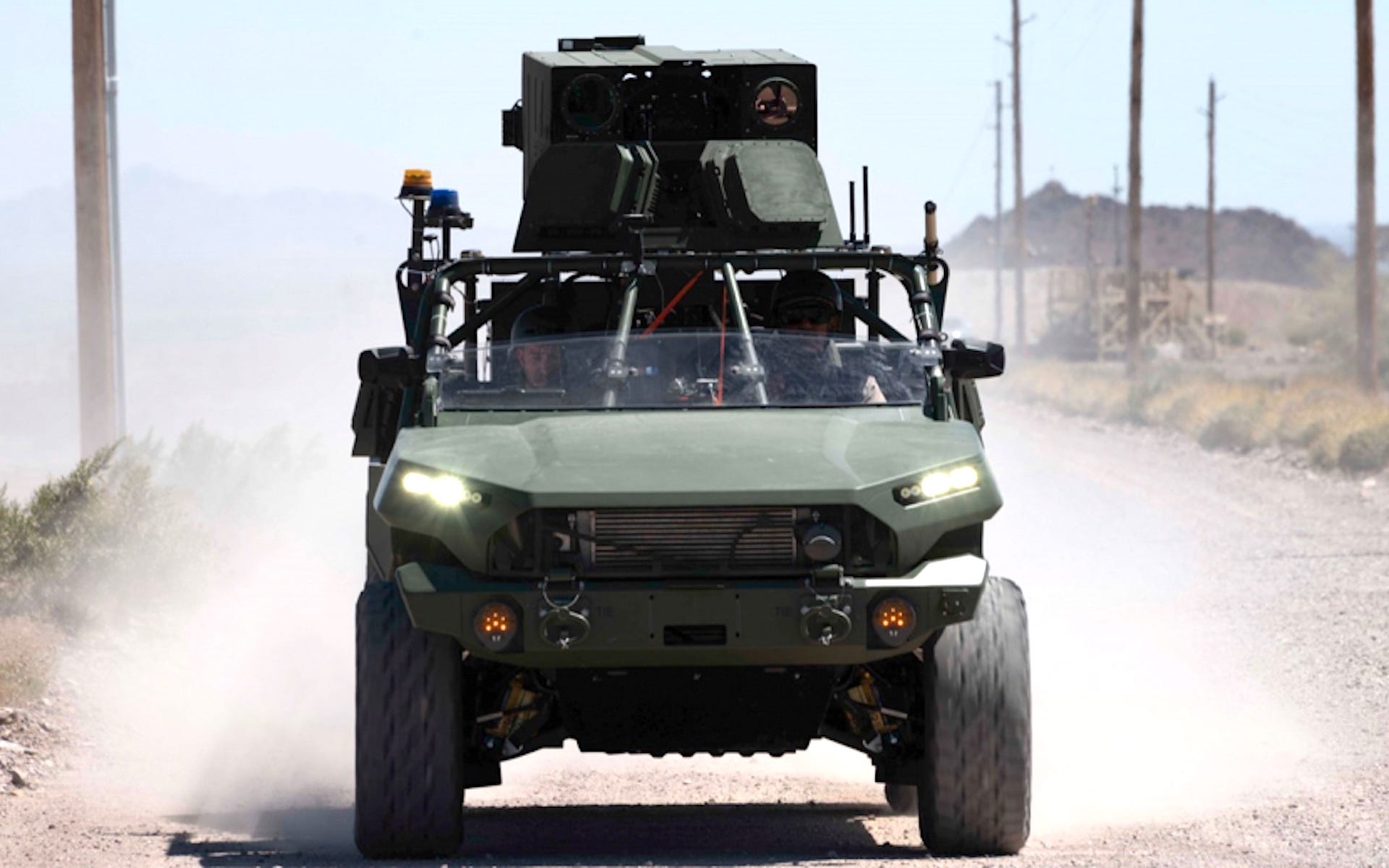
Reuters identified the laser system in question as the 20 kilowatt LOCUST Laser Weapon System, produced by defense contractor AV (formerly AeroVironment and BlueHalo) and mounted on an M1301 Infantry Squad Vehicle. In development since at least 2022 under the service’s Army Multi-Purpose High Energy Laser (AMP-HEL) initiative, Laser Wars spotted the system training at El Paso’s Fort Bliss with soldiers assigned to Joint Task Force Southern Border in late July.

The laser-equipped ISV’s presence near the US-Mexico border isn’t a surprise. As I previously wrote, the Trump administration has increasingly funneled new and novel counter-drone capabilities to US military personnel deployed there amid a steady increase in cartel use of drones to surveil CBP agents and ferry drugs into the United States. And while a US Northern Command spokesman told Laser Wars at the time that the system “is not being used actively at the border,” they declined to speculate “what capabilities or systems will be used in the future.”
Beyond precipitating a dramatic interagency clusterfuck, this bizarre instance of CPB security theater in El Paso actually does reveal a hard truth about laser weapons as a domestic air defense capability: you can’t just unilaterally fire them off into the air without consequence.
As I previously wrote for Wired, a specific subsection of Title 10 of the US Code (known as 130i) governs when and where the US military can deploy counter-drone assets outside of immediate self-defense against an imminent threat. Notably, it requires the Pentagon to coordinate with multiple agencies, including the FAA, regarding any countermeasures that “might affect aviation safety, civilian aviation and aerospace operations, aircraft airworthiness, or the use of airspace.”
This requirement is no arbitrary bureaucratic roadblock. A laser beam does not simply vanish if it misses its intended target: even a relatively modest 20 kw system can pose a hazard to aircraft sensors or pilots if improperly aimed or reflected. Civilian aviation authorities (and CBP, for that matter!) have long treated even handheld laser pointers as serious threats to flight safety; a military-grade directed energy system operating beneath commercial flight corridors raises far more complex risk considerations.
This tension has simmered for years as the Pentagon experiments with high-energy lasers for base defense. It becomes far more acute when those systems are deployed in populated airspace under the auspices of homeland security. The El Paso episode suggests that while the technology has matured enough to be fielded, the interagency choreography required to use it safely has not.
Instead of showcasing a revolutionary counter-drone breakthrough, America’s first known domestic high-energy laser weapon deployment revealed how quickly physics and bureaucracy collide when directed energy moves through public skies. At least it’s cheaper than an AIM-9X Sidewinder.


If you want the lasers to enter the Valley of Death and not emerge keep talking regulation and law. Because that’s why we’re behind on drones and exactly how it was done.