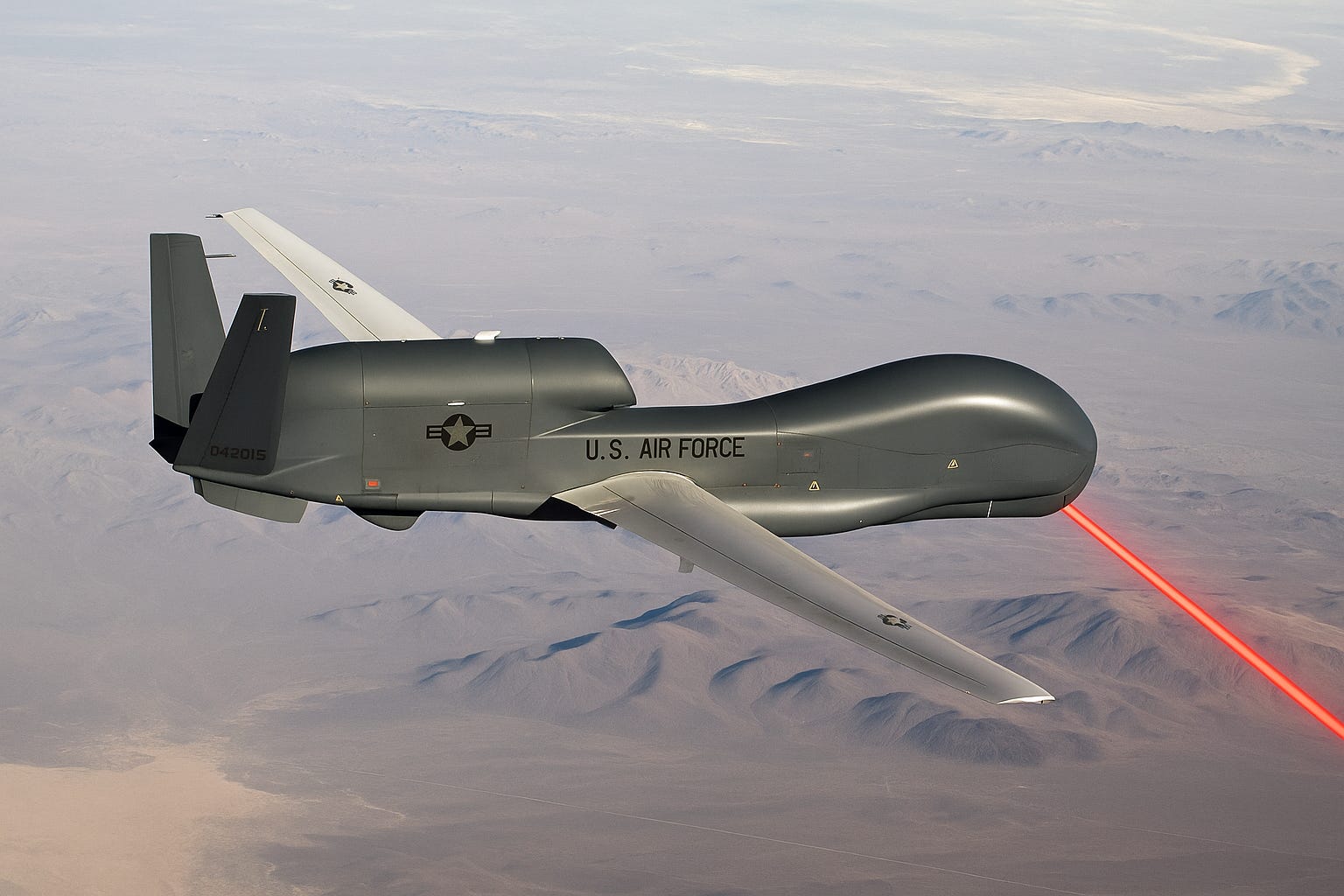
The Air Force Is Taking Another Run at Airborne Laser Weapons
The service is planning a new airborne laser weapon initiative for fiscal year 2027.

When I wrote that the US Air Force appeared to be giving up on airborne high-energy laser weapons back in July, I missed the mark.
Laser Wars previously reported that the Air Force’s fiscal year 2026 budget request zeroed out funding for airborne laser weapon research and development under its High Power Solid State Laser Technology project, with the service stating that it planned to “stop work” on any testing, demonstration, and future planning activities. This budgetary retrenchment followed last year’s conclusion of the service’s Self-Protect High-Energy Laser Demonstrator (SHiELD) project, which aimed to mount laser weapon pods on fighter jets to counter incoming missiles, and the end of Air Force Special Operations Command’s plans to install its Airborne High Energy Laser (AHEL) on an AC-130J Ghostrider gunship.
But further inspection1 of Air Force budget documents reveals $48 million under the service’s Laser Technology project to continue the maturation of critical subsystem technologies for an airborne laser weapon system in preparation for “laser system technology demonstrator development expected to kick off in [fiscal year] 2027.”
And this isn’t the only recent mention of a new airborne laser weapon initiative. In May, the service issued an Small Business Innovative Research (SBIR) solicitation for a so-called Lightweight Optical Turret for Extended Capability HEL (LOTECH) effort, which seeks to develop a “fully functional lightweight 10 centimeter class high energy laser beam director for tactical airborne applications … for use in the Airborne Laser Weapon System Program currently scheduled to start in FY27.”
“The beam director must be capable of propagating a high energy laser from a transsonic (Mach 0.8) airborne platform while effectively compensating all relevant aero-effects in order to maintain low jitter and effective focusing of the beam on a non-cooperative target,” according to the solicitation.
In response to an inquiry from Laser Wars, the Air Force confirmed that the Airborne Laser Weapon System Program is indeed a new initiative slated to kick off in fiscal year 2027, and that the LOTECH efforts “could include, but are not limited to” that program.
“The Air Force continues to invest in the research and development of high-energy laser technologies to ensure our warfighters maintain a technological advantage,” an Air Force official told Laser Wars in an email. “Our process is to leverage the valuable data and lessons learned from all previous research and demonstration efforts, such as SHiELD and AHEL, to inform our path forward.”
While its unclear if this future airborne laser weapon system will involve manned or unmanned aircraft, an additional mention of an “extended capability” system outside the LOTECH SBIR solicitation suggests the latter. A House Armed Services Committee (HASC) report on the fiscal year 2026 National Defense Authorization Act (NDAA) the chamber passed in September contained an item of special interest titled “Extended Capability High-Energy Laser,” which directed Secretary of the Air Force Troy Meink to brief lawmakers by December 1 on any laser technologies “that have transitioned in the past five years or are planned to transition within the next five years to test on airborne platforms, as well as options and associated resourcing requirements for transition effort acceleration.” (It’s unclear if this briefing ever occurred.)
HASC “recognizes the potential for high energy lasers deployed on long-endurance airborne platforms to contribute to the defense of the homeland and close gaps in current missile defense architectures,” lawmakers wrote. ”The committee also notes the need for further maturation of key technologies, particularly beam control capabilities suitable for laser sources above 500 kilowatts.”
“Long-endurance airborne platforms” usually refers to unmanned systems like drones that are designed to stay in the air for extended periods of time. The mention of homeland missile defense appears to be a reference to the Trump administration’s larger “Golden Dome for America” initiative, which envisions a layered air defense architecture to protect the skies above the United States and currently includes ground-based laser weapons to neutralize incoming cruise missiles. (The Air Force declined to provide additional details regarding the special interest item, telling Laser Wars just that the service “is committed to delivering war-winning capabilities to the force and we will continue to keep Congress and the public informed as our programs and budgets are formally established.”)
Taken together, the Air Force budget documents, LOTECH SBIR solicitation, and HASC special interest item send a clear signal: the apparent end of the service’s airborne laser ambitions, it seems, was little more than a temporary pause.

The US military has been pursuing airborne laser weapons on and off since the 1970s, and this cycle of ambition and cancellation is nothing new. As Laser Wars has previously detailed, the Air Force’s Boeing 747-based YAL-1 Airborne Laser Test Bed managed to destroy missiles in flight during testing in 2010 but was canceled the next year due to cost overruns and insurmountable technical limits. Around the same time, the service successfully “defeated” a ground target with a 100 kw chemical-based Advanced Tactical Laser (ATL) mounted on a specialized NC-130H aircraft at a ground target only to discontinue development.2 And the Pentagon’s High Energy Liquid Laser Area Defense System (HELLADS) effort, originally initiated in 2003, sought to develop a 150 kw laser weapon system capable of integrating into a tactical aircraft before R&D efforts eventually tapered off following testing in 2015.
The rise of America’s drone strike apparatus during the Global War on Terrorism helped focus interest in the potential applications of airborne laser weapons beyond manned platforms. The US Missile Defense Agency (MDA) has been exploring the concept of outfitting high-altitude drones with such systems for the last decade, with the agency actively pursuing laser-equipped drones as recently as 2019 as part of the now-defunct Low Power Laser Demonstrator (LPLD) effort. Indeed, the Pentagon's Missile Defense Review released that year posited that “developing scalable, efficient, and compact high energy laser technology holds the potential to provide a future cost-effective capability to destroy boosting missiles in the early part of the trajectory.”
But when it comes to the real-world physics of laser weapons, the sky may be the literal limit. As Laser Wars has previously noted, atmospheric conditions are a problem for high-energy laser weapons in any domain, from sand and dust on land to fog and spray at sea, but they are particularly punishing in the context of high-altitude combat when attached to an airframe moving at hundreds of miles an hour. Under these circumstances, atmospheric turbulence and aircraft vibration mean that every shot is battling physics as much as the actual target.
Beyond that, laser weapons come with power and engineering requirements that make integrating them into large fixed-wing aircraft, let alone smaller drones, a significant technical challenge. As former Pentagon research and engineering chief Mike Griffin put it in 2020, “as a weapon system to equip an airplane with the kinds of lasers we think necessary — in terms of their power level, and all their support requirements, getting the airplane to altitudes where atmospheric turbulence can be mitigated appropriately — that combination of things doesn't go on one platform."
Still, the dream of airborne lasers has clearly persisted in military circles, especially with regard to unmanned platforms. In January, the US Navy released a slick sizzle reel envisioning a future of naval operations where autonomous drone wingmen employ directed energy weapons to defend manned aircraft from incoming missiles during a strike mission. In April, defense prime General Atomics showed off a concept for a podded laser weapon designed to fit under the wing of the company’s MQ-9B SkyGuardian drone (or, based on an October update, the nose of an MQ-20 Avenger), the company’s latest stab at making laser weapons fly after decades of R&D fits and starts. And as of December, even the US Army was actively exploring a potential laser weapon capability for a new class of large drones.
The Air Force’s new airborne laser weapon initiative planned for fiscal year 2027 appears to be just the latest chapter in this decades-long saga, where bold visions and budgetary enthusiasm are followed by technical collapse and, once the threat environment shifts, renewed interest. Whether airborne lasers finally take flight or once again stall out will depend on breakthroughs not just in beam power and optics, but in compact power sources that can actually ride on an airframe. Until then, airborne lasers will remain the Pentagon’s favorite mirage — constantly just a few years away from the battlefield.
I will learn to read one of these days, honest!
In December 2006, the I Marine Expeditionary Force in Iraq approved an “urgent operational need” for an airborne laser weapon dubbed the Precision Airborne Standoff Directed Energy Weapon (PASDEW) that, based on technology in development for the ATL, could create “instantaneous burst-combustion of insurgent clothing, a rapid death through violent trauma, and more probably a morbid combination of both,” as US Marine Corps officials put it in the official request.