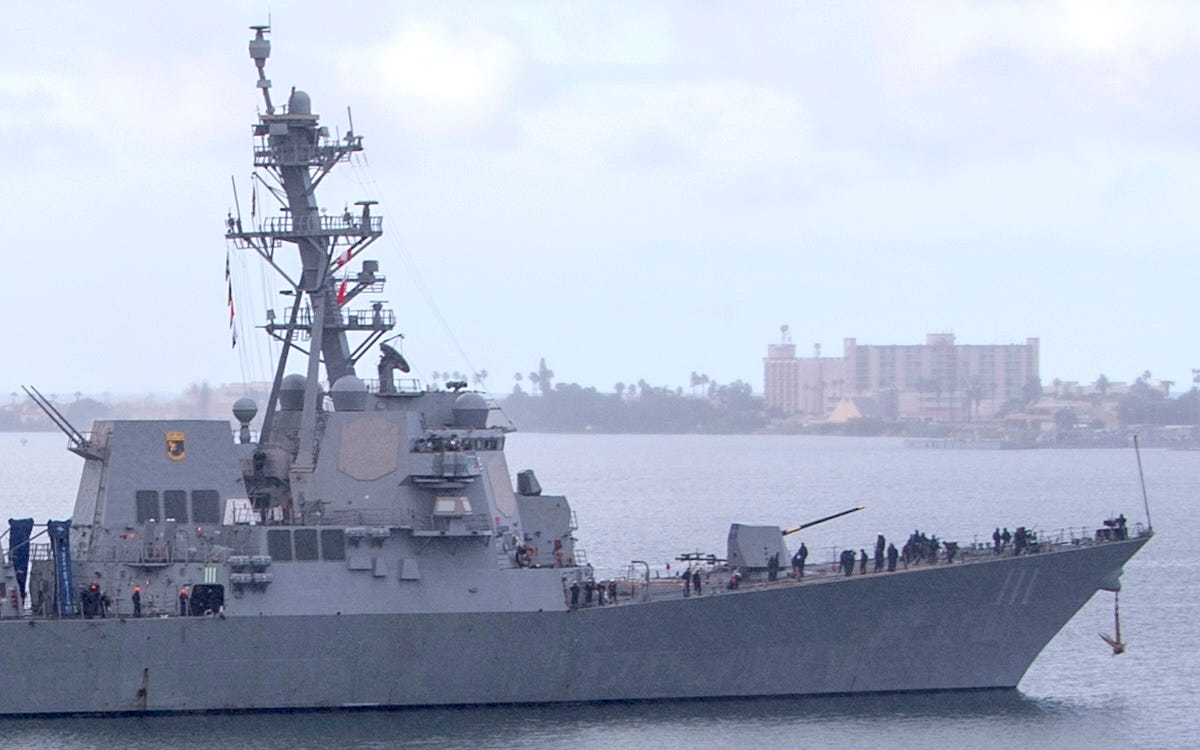
The Laser Weapon Quietly Watching Over the US Strikes on Iran
A US Navy laser weapon is bearing witness to Operation Epic Fury.

A US Navy warship engaged in strikes on Iran deployed with a laser weapon aboard, although defense officials would not reveal if the system has actively engaged targets during combat operations.
The distinctive boxy turret of an AN/SEQ-4 Optical Dazzling Interdictor, Navy (ODIN) laser weapon is clearly visible1 in the foreground of several photos the US Defense Department publicly released on February 28. The images show the Arleigh Burke-class guided missile destroyer USS Spruance launching a Tomahawk land-attack cruise missile from the Arabian Sea at a target in Iran as part of Operation Epic Fury, the US-led campaign to “dismantle the Iranian regime’s security apparatus.”

Developed by the US military starting in 2017 and first installed aboard the USS Dewey in 2019, ODIN is a low-power “soft kill” laser weapon designed to dazzle and disable the sensors on hostile drones rather than destroy them outright like the 60 kilowatt High Energy Laser with Integrated Optical Dazzler and Surveillance (HELIOS) currently installed aboard the USS Preble. If employed during Epic Fury, an ODIN system could potentially blind the electro-optical sensors of the Shahed drones Tehran launched across the Middle East in response to the US-led strikes.
While details regarding ODIN’s capabilities are scarce, the Navy has fielded eight systems across its Arleigh Burke fleet, including aboard the Dewey, Spruance, USS Stockdale, USS John Finn, and USS Gridley, according to photos posted to the Defense Visual Information Distribution Service (DVIDS). The Spruance appears to be the only warship participating in Epic Fury publicly known to be outfitted with an ODIN system.
Laser Wars contacted the Office of the Secretary of Defense, the Navy, and US Central Command regarding whether or not ODIN was actually used during Epic Fury. The Navy referred questions to OSD, which declined to provide any additional information. A CENTCOM spokesman responded with a fact sheet listing military assets employed during Epic Fury which did not include any added details about the system.
Laser dazzlers aren’t a new concept: in some ways, they’re a photonic update to the high-intensity searchlights the German military used to track and disorient enemy aircraft during World War II.2 The UK Royal Navy secretly sent a laser dazzler into the 1982 Falklands conflict with Argentina, although it was never used in combat. Since the start of the Global War on Terrorism, US service members have employed handheld variants to ward off hostile actors both on land and at sea. And in recent years, countries like Russia and China have increasingly used military-grade lasers to harass foreign military personnel.3
Indeed, Epic Fury wasn’t the first US-led military operation where ODIN was present on the battlefield. In November 2024, Iran-backed Houthi rebels in Yemen targeted the Spruance and Stockdale with one-way attack drones and missiles as the warships exited the Red Sea following a five-month deployment there supporting Operation Prosperity Guardian, the US-led response to Houthi attacks on commercial vessels in the region. The Spruance downed seven drones during that deployment, but it’s unclear if any were neutralized using ODIN. (A public affairs officer for the Spruance did not respond to a request for comment from Laser Wars).
A year later, the Stockdale and its ODIN system were operating in Caribbean Sea in support of “Department of War-directed operations” and President Donald Trump’s order “to disrupt illicit drug trafficking and protect the homeland” in the region, according to DVIDS. Whether that system was present during the US military intervention in Venezuela under Operation Absolute Resolve in January is also unclear. (When queried by Laser Wars on the matter, the Navy referred questions to OSD, which did not respond to a request for additional information.)
As a mere dazzler, ODIN is far less exciting than higher-power laser weapons like HELIOS, which the Navy envisions aboard every surface warship. But the system’s appearance aboard the Spruance amid the blaze of Tomahawk fire reflects the quiet arrival of shipboard lasers as a routine layer of defense against low-cost weaponized drones and other sensor-dependent threats. Even if it never fired a shot, ODIN’s presence aboard a destroyer firing missiles during real combat operations offers a glimpse of how laser weapons may finally enter naval combat — not with a flash, but with barely a whisper.
Please don’t yell “OPSEC” at me! We are currently clean on OPSEC!
One the earliest documented instances of a military force deploying searchlight to blind and disorient an adversary occurred during UK Royal Navy maneuvers in 1886.
While the 1995 UN Protocol on Blinding Laser Weapons bans systems designed to induce permanent blindness in humans, most modern dazzlers were built to produce reversible effects.