The Lingering Questions About the Navy’s Chief Laser Weapon Shooting Down Drones at Sea
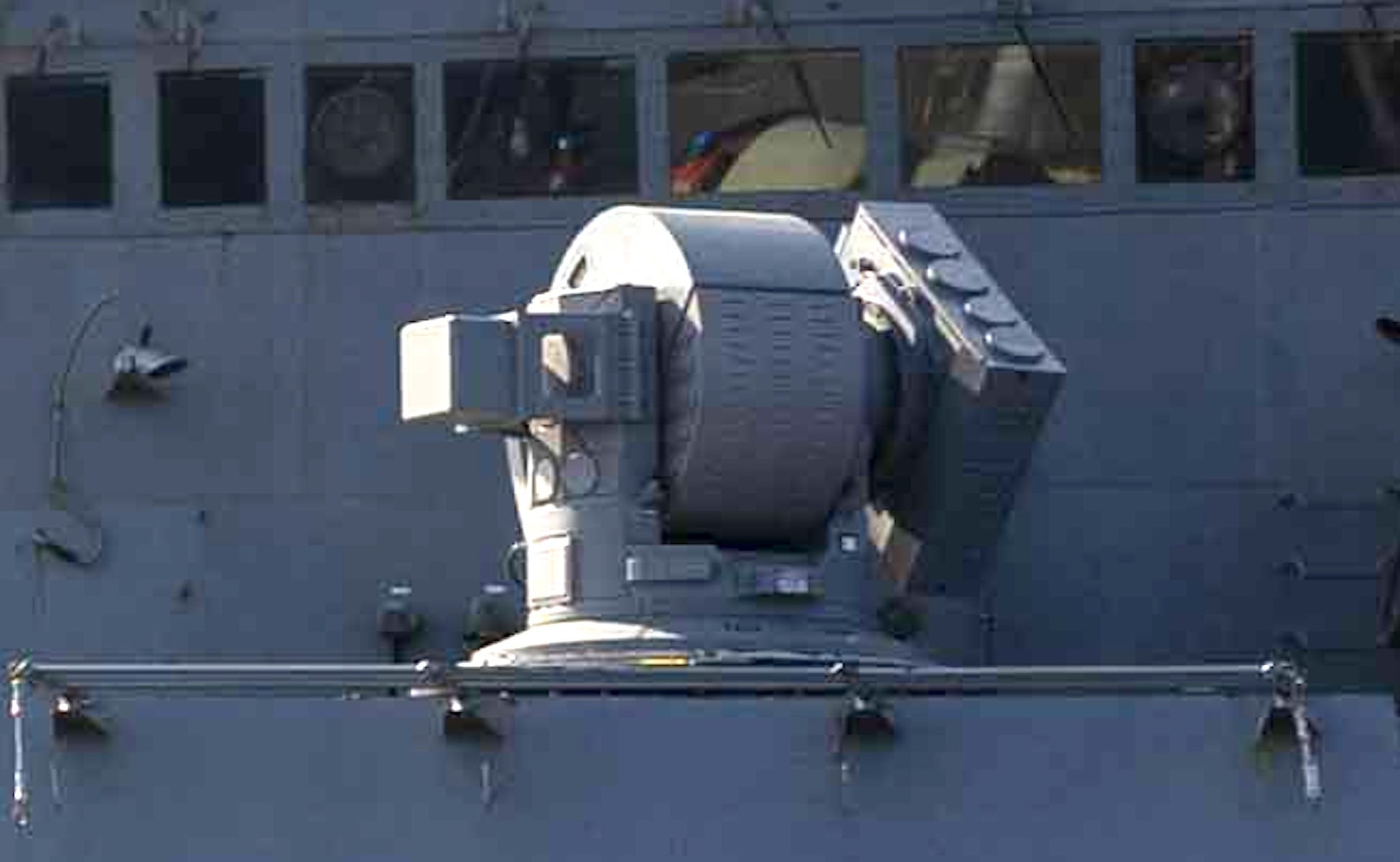
The US Navy's High Energy Laser with Integrated Optical Dazzler and Surveillance (HELIOS) “successfully neutralized” four drones during a recent at-sea demonstration, Lockheed Martin's CEO says.

The US Navy’s primary shipboard high-energy laser weapon is slowly by surely inching towards the battlefield.
Lockheed Martin president and CEO James Taiclet recently revealed that the defense prime’s 60 kilowatt High Energy Laser with Integrated Optical Dazzler and Surveillance (HELIOS) system, currently installed aboard the Arleigh Burke-class guided missile destroyer USS Preble, had “successfully neutralized four drone threats in a US Navy-operated counter-UAS drone demonstration at sea,” according to a transcript of a January 29 earnings call with investors and analysts regarding the company’s Q4 2025 performance.
The demonstration “showcas[ed] an opportunity to eliminate drone attacks using lasers and [save] US and allied air defense missiles for more advanced threats,” Taiclet said. “This development of laser weapon systems is just one example of Lockheed Martin’s support of the Homeland Defense Mission, including Golden Dome for America.”1
HELIOS had previously downed a drone target during testing sometime during fiscal year 2024, an achievement the US Defense Department officially disclosed through a report from the (now-gutted) Director, Operational Test & Evaluation (DOT&E) along with a badass photo of the system in action. But the new demonstration marks the first known instance of the system successfully engaging multiple aerial targets in a single event, a closer analogue to the drone attacks that have threatened commercial vessels and US and allied warships in the Red Sea in recent years.

On its face, the four-drone shootdown appears to resolve residual concerns over whether HELIOS was actually performing as advertised. In May, Vice Chief of Naval Operations (then the acting Chief of Naval Operations) Adm. James Kilby told lawmakers that the system was operating at roughly one-third of its designed 60 kw output due to unspecified “problems” encountered during testing. Lockheed executives have since insisted that HELIOS has been running at full power for some time, a claim that now appears borne out by the successful demonstration.
But despite President Donald Trump’s vision of a laser battleship and the current hype around “a laser on every ship” emanating from top Navy’s leaders, the success of HELIOS in recent testing is far from a resounding validation of the system’s combat readiness. Indeed, there are several lingering questions regarding the laser weapon’s performance:
Atmosphere: As Laser Wars previously noted, atmospheric obscurants like water vapor, salt aerosols, and fog all contribute to bending, diffusing, or bleeding off energy from a laser beam. What were the circumstances of the most recent engagement at sea? Did it take place on the open ocean or in a littoral zone? Was the Preble operating amid precipitation or adverse weather conditions, or the relative ease of calm seas?
Engagement Pattern: While laser weapons purportedly offer an “unlimited magazine,” they are still constrained by the fact that each system can A) only engage one target at a time and B) must stay locked on that target for several seconds to inflict catastrophic damage before moving on to the next one – constraints that can prove potentially disastrous during a saturation attack when even a brief delay can expose a lethal gap in air defenses. Did the drones approach the Preble simultaneously or sequentially? How much dwell time did HELIOS require to neutralize each target before moving on to the next?
Power: Laser weapons are notoriously power-hungry, with the Navy’s Flight III Arleigh Burke destroyers already strapped for juice thanks to their new AN/SPY-6 Air and Missile Defense Radar systems (to say nothing of related thermal management needs). Was HELIOS firing at full power? Did it do so continuously, or did the system require a cooldown period for the magazine to return to a “ready” condition between engagements?
Don’t get me wrong: knocking down multiple drones at sea is real progress for a program that has in recent years struggled to prove basic functionality. But a controlled demonstration, even a successful one, is not the same thing as sustained performance under combat conditions, where unpredictable weather, a chaotic battlespace, and massed threats can all converge to erode laser weapons’ theoretical advantages.
Indeed, the most significant danger in treating this noteworthy test as a major breakthrough is that it risks reinforcing the US military’s favorite laser fantasy: that a working system automatically translates into the aforementioned unlimited magazine. In reality, power generation, thermal limits, atmospheric conditions, and dwell time all impose hard ceilings on how much defensive value a single laser beam can deliver, especially when facing coordinated swarm attacks designed to exploit those limits.
There’s also the matter of money. As Laser Wars previously reported, the Navy’s fiscal year 2026 budget request zeroed out research and development funding for the system under its Surface Navy Laser Weapon System (SNLWS) effort after spending nearly $350 million over more than a decade to develop and deploy shipboard laser weapons. While the service’s fiscal year 2027 budget request may come with renewed investment in HELIOS thanks to fresh enthusiasm from senior leaders, the most recent funding ask suggests institutional confidence in the system still lags well behind public rhetoric.
HELIOS may eventually prove a worthwhile addition to the Navy’s layered approach to air defense, a point-defense capability that can help surface warships conserve their expensive missiles and interceptors for higher-end threats than explosive-laden attack drones. But while the four-drone shootdown suggests that the system may finally cross the threshold from experiment to capability, whether the Navy chooses to build on that progress or simply declare victory just as the hard work begins will determine whether shipboard lasers become a meaningful part of future naval warfare or simply remain a perpetually promising sideshow.
NEW: Pulse
There’s officially more laser news than I have time to devote individual editions to! To ensure Laser Wars remains up to date, I’m experimenting with a new section, ‘Pulse,’ to capture other updates from around the directed energy ecosystem:
Electro Optic Systems to address scathing report on South Korea laser weapon contract: The Australian defense contractor had in mid-December announced a conditional agreement with an unnamed South Korean customer to manufacture and sell laser weapons, but a report from investment research group Grizzly Research published on February 5 accused EOS of an “intentionally misleading and utterly unrealistic” contract announcement and making statements on an investor call “bordering on outright lies.” The report prompted the company to request a trading halt on the Australian Securities Exchange on February 6, with executives expected to respond to the report by February 10. (It’s worth noting that Reuters reported on February 6 that the company planned on opening a laser weapon production center in Singapore.)
nLight cashes in to scale up laser weapons: The Washington state-based defense contractor sold 4 million shares of additional stock (at $44 a share, just below the stock’s all-time high of $49.98) to raise $175 million for the ongoing development and production of laser weapons. That sale came just over a week after the company announced a 50,000 square foot manufacturing expansion in Colorado “to support ongoing and future work for the U.S. Department of War (DoW) and other U.S. agencies.”
The Pakistan Navy is looking for AI-assisted shipboard laser weapons: The Pakistan Armed Forces’ Directorate of Procurement (Navy) published a tender notice on February 4 for the procurement of two 20 kw Laser Weapon System (LWS) for installation aboard Pakistan Navy warships. The systems should be scalable up to 30 kw and “should have Al and ML. functions imbedded (sic) into it to ensure shorter OODA (Observe, Orient, Decide and Act) loops.”
As Laser Wars was first to report, the Navy is working with the US Army on a new laser weapon dubbed the Joint Laser Weapon System (JLWS) to “provide an air defense capability against cruise missile threats” as part of the Golden Dome initiative.


Thanks for the informative update. It's sad what we don't always know when they are wagging their happy tales about the fantasy weapons they can't wait to play with. Getting to see the cost for tax payers is always a slap in the face, no fault of yours, we need to be able to see this information easier than we do. It just hurts a bit. Especially knowing how far those funds have actually gone.