
Trump's Laser Battleship Mirage
"The most sophisticated laser in the world will be on the battleships that we’re building."

President Donald Trump is going all in on high-energy laser weapons for the US Navy’s newest class of warship.
The Navy plans to build a new “Trump-class” of “battleship” as part of the commander-in-chief ‘s larger vision of a “Golden Fleet,” Trump announced on Monday at Mar-a-Lago in Florida, describing the notional warship as “the fastest, the biggest, and by far 100 times more powerful than any battleship1 ever built.”
Trump declared that the future surface combatant — which, at 30,000-40,000 tons, would be more than triple the sizzle of the Navy’s Arleigh Burke-class guided missile destroyer — will come armed to the teeth with advanced weaponry, including hypersonic weapons, electromagnetic railguns, nuclear cruise missiles, and “the high-powered lasers that you’ve been starting to read about.”
“We have lasers where you aim the laser at a target, it just wipes it out,” Trump said on Monday. “We’re going to have … they’ll be the most sophisticated lasers in the world, and the most sophisticated laser in the world will be on the battleships that we’re building.”
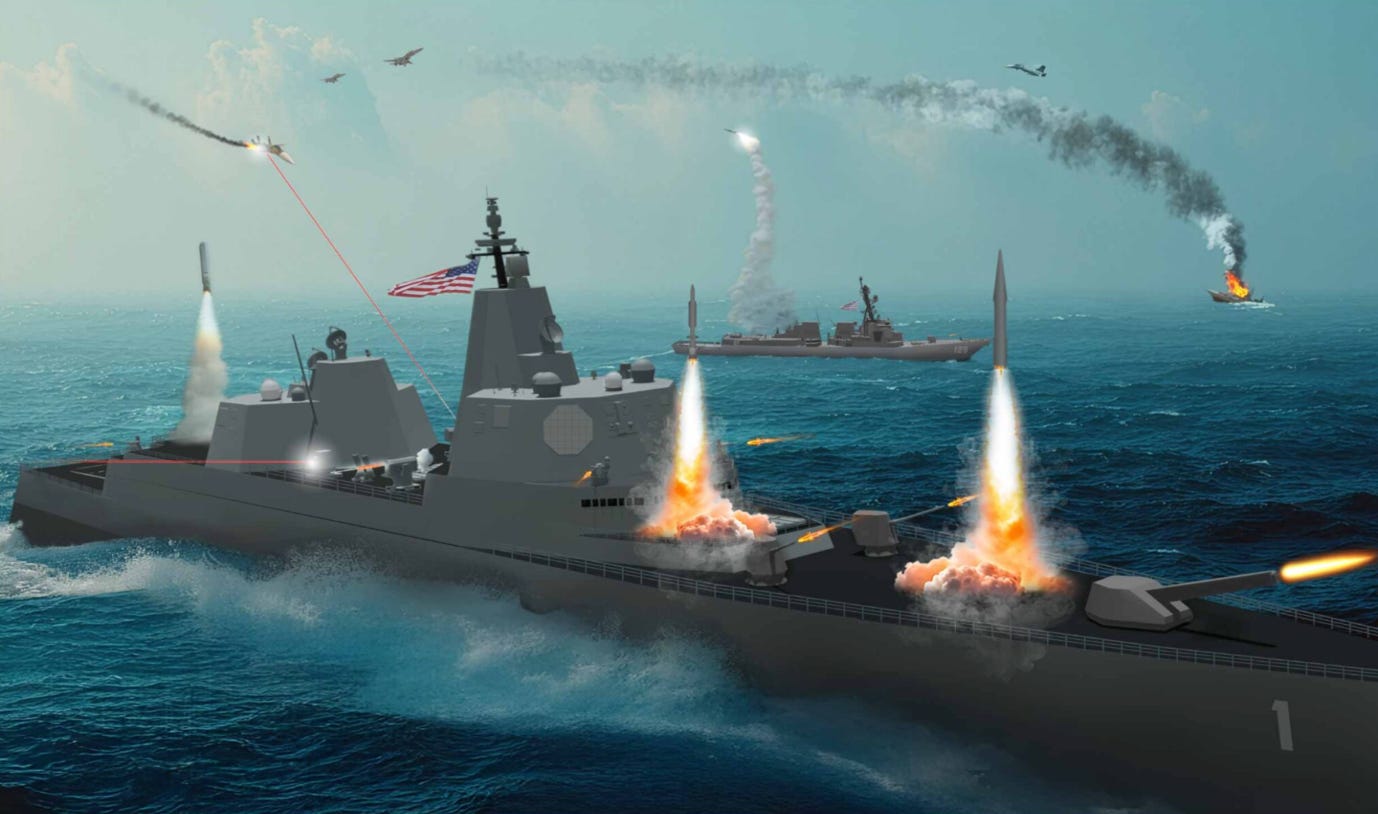
The Navy specifications for the first Trump-class warship published on Monday, dubbed the USS Defiant, detail a proposed directed energy armament of an electromagnetic railgun2 and six individual laser weapons: a pair of 300 or 600 kilowatt systems as part of the ship’s secondary battery, ostensibly for neutralizing incoming missiles and aircraft, and four lower-power Optical Dazzling Interdictor, Navy (ODIN) systems that are primarily designed to dazzle and disable the electro-optical and infrared sensors on drones.
Artist renderings published by the Navy depict the Defiant engaging an adversary aircraft with one shipboard laser weapon mounted amidships while another system fires off a beam at an unseen target from the starboard side.
“As we forge the future of our Navy’s fleet, we need a larger surface combatant and the Trump-class battleships meet that requirement,” said Chief of Naval Operations Adm. Daryl Caudle, a vocal advocate for naval laser weapons, in a statement accompanying the release of the Navy specs and renderings. “We will ensure continuous improvement, intellectually honest assessments about the requirement to effectively deter and win in the 2030s and beyond, and disciplined execution resulting in a fleet unparalleled in lethality, adaptability and strength.”

Let’s set aside the obvious questions surrounding Trump’s proposed warship — the “battleship” moniker, the naming conventions, the insanely overpowered armament that includes nuclear-armed sea-launched cruise missiles and hypersonic weapons, among others — and focus on the high-energy laser weapons for a second. Is such a configuration even possible at this juncture in the history of naval directed energy?
The short answer: no, not really.
First, the “most sophisticated” laser weapons that Trump promised simply don’t exist right now and likely won’t for years. While ODIN laser dazzlers are currently installed aboard at least eight Arleigh Burke destroyers (and integrating four on a decidedly roomy Trump-class battleship might prove relatively easy), the Pentagon is still in the process of researching and developing higher-powered systems through the Navy’s 300 kw High Energy Laser Counter-ASCM Program (HELCAP), the Office of Naval Research’s 400 kw SONBGOW project, and the Office of the Under Secretary of Defense for Research and Engineering’s High 500+ kw High Energy Laser Scaling Initiative (HELSI) — none of which appear close to ready for prime time, according to a March report from the Congressional Research Service. Indeed, the only destructive shipboard laser weapon currently in the Navy’s arsenal is the 60 kw High Energy Laser with Integrated Optical Dazzler and Surveillance (HELIOS) installed on the USS Preble, and that system has seen serious technical challenges in recent months. Perhaps some secret laser weapon like the unnamed system the service and Lockheed Martin recently tested in the Red Sea might get the job done, but at the moment the dream of a dual 600 kw systems knocking missiles and fighter jets out of the sky remains pure fantasy.

Second, the Trump-class battleship will need to generate a shitload of power to keep all of its exotic weapons in the fight, a requirement that may prove a serious challenge given the warship’s overloaded design. Consider the Navy’s experience proliferating HELIOS across the fleet: in 2019, then-surface warfare boss Rear Adm. Ron Boxall declared the fleet “out of Schlitz with regard to power” for laser weapons because the new Flight III Arleigh Burke destroyers, despite their 78 megawatt output, were already strapped for juice powering their new AN/SPY-6 Air and Missile Defense Radar, so far that the warships “don’t have as much extra for additional functions.” While the Navy has long envisioned directed energy as part of its future shipbuilding roadmap for years and has been actively exploring “innovative approaches to power generation” to support “future warfighting needs” like lasers weapons, it seems unlikely that the unspecified gas turbine and diesel power solutions envisioned for the Trump-class battleship will prove sufficient to operate all of these advanced weapons and sensors during a high-intensity conflict.
Third, the ship itself: there’s no credible path to actually build it. The US naval shipbuilding enterprise was already struggling to deliver existing classes at scale, on time, or on budget even before Trump laid out his vision for a behemoth packed with unproven systems. As a recent Center for Strategic & International Studies report documented, the Navy is operating with a fleet roughly half its Cold War peak while China outproduces it in hulls, and US yards are constrained by chronic workforce shortages, aging infrastructure, and a brittle supply chain dominated by single-source suppliers. Construction timelines have ballooned — destroyers now take almost twice as long to build as they did two decades ago — and nearly every major combatant currently under construction is delayed. Programs meant to be low-risk, like the now-canceled Constellation-class frigate, collapsed under design instability and industrial bottlenecks. The idea that the Navy could stand up a brand-new, oversized, battleship class packed with advanced systems (on top of recently announced plans to pursue a fresh frigate class as well) is detached from the industrial reality of a shipbuilding base that can barely execute its current workload.
To be clear, the US military isn’t alone in chasing naval lasers, but even the global picture underscores just how modest these weapons still are. The UK plans to field its first operational shipboard laser, the 50 kw DragonFire, aboard a Type 45 destroyer by 2027. France has tested the HELMA-P demonstrator on the air-defense destroyer Forbin. Germany claims its MBDA-Rheinmetall system might be operational by 2029. China has reportedly begun installing its LY-1 laser weapon on Type 071 amphibious ships. Israel is preparing a navalized version of the combat-tested Iron Beam for trials aboard corvettes. Australian defense firm EOS is planning a maritime variant of its 100 kilowatt Apollo laser. Japan recently showcased a palletized shipboard laser weapon concepts. Collectively, these efforts point to a cautious, incremental race toward low-hundreds-kilowatt defensive lasers, not a leap to the fully integrated aircraft-killing weapons Trump is promising.
But even beyond the immaturity of shipboard laser weapons alone, the decision to resurrect the “battleship” label only reinforces the fundamental incoherence of the entire concept. Modern naval warfare has spent decades moving away from single, exquisite platforms toward distributed lethality precisely because large surface combatants — like, say, massive ships bristling with exposed sensors and laser apertures — make irresistible targets. In a future conflict defined by long-range missiles, saturation attacks, and electronic warfare, a floating monument to technological ambition is more of a liability than a deterrent.
Construction of the first Trump-class battleship is scheduled to begin in 2030, with the goal of eventually building a total of 20 to 25 warships — an idea that will collapse the moment it encounters engineering, industry, or war.
The US Navy last used battleships in combat during the 1991 Gulf War, when Iowa-class battleships USS Missouri and USS Wisconsin provided naval gunfire support against Iraqi targets along the coast of Kuwait. As USNI News points out, the US defense industrial base hasn’t delivered a battleship to the US military since 1944.
The US military spent nearly $1 billion over more than 15 years developing an electromagnetic railgun before scrapping the effort in 2021 without ever actually mounting it on a warship for testing.


This is a clean “physics and industry” reality check on the Trump-class idea: the story runs far ahead of what lasers can reliably do at sea, far ahead of the power margins ships actually have, and far ahead of what the shipbuilding base can deliver on time and at scale. The result is a big narrative promise with a long, predictable gap between headline and hull, which becomes its own strategic liability.
To begin; Trump is always negotiating.
Trump understands the history he lived through very well.
Trump remembers Star Wars/High Frontier/Brilliant Pebbles convinced Gorbachev to really come to the negotiating table with RR and really deal because Gorbachev realized they couldn’t keep up.
Trump may or not know the history of the Washington Naval Treaty (1922) and everyone who signed did because the previous American plan under Wilson was to outbuild every other Navy including the British *and that the Americans absolutely could* … hence the stick behind the carrot, bringing us to the last point… OH YES WE CAN and these Admirals are morons to cross him. OF COURSE we can build it, the question is can the others afford even the R&D to keep up? If the lasers are lesser that misses the point, if the power is inadequate we build an enormous reactor.
Trump says to the naysayers thanks for taking the bait on something that doesn’t exist. You’ll never learn.
“The surest way to get an American to do something is to tell him it can’t be done.”
- Hermann Balck .