EXCLUSIVE: US Military Awards Joint Laser Weapon System Contracts
The Pentagon has tapped Lockheed Martin and nLight to build cruise missile-killing high-energy laser weapons for the “Golden Dome for America” domestic missile defense shield.

The US Defense Department has awarded a combined $86 million to Lockheed Martin and nLight under the Joint Laser Weapons System (JLWS) program to develop high-energy laser weapons capable of defeating cruise missiles, Laser Wars has learned, a major step toward integrating directed energy capabilities into the Trump administration’s “Golden Dome for America” domestic missile defense shield.
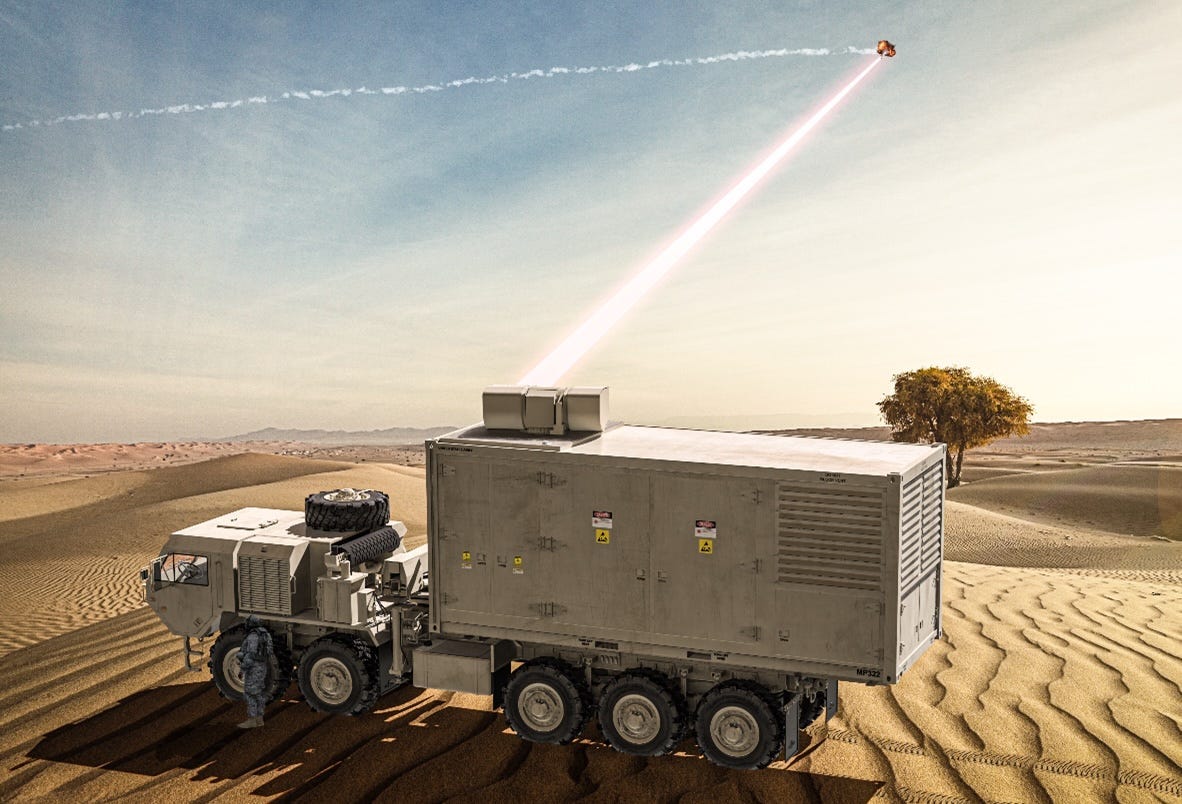
The Other Transaction Authority (OTA) agreements call for the concurrent development of two distinct JLWS prototypes, the Pentagon told Laser Wars in a statement: an initial 150 kilowatt version that will subsequently scale to 300-500 kw levels “required for robust cruise missile defense,” and a 500 kw “integrated” system that will leverage a laser source developed under the Pentagon’s High Energy Laser Scaling Initiative (HELSI). Both systems will be containerized to enable rapid fielding across both land and naval platforms.
The total program ceiling for JLWS is $847 million, the Pentagon said. The department’s fiscal year 2027 budget documents previously included $675.93 million in research and development funding for JLWS over the next five years.
Lockheed Martin and nLight were among the participants in a historic directed energy weapon demonstration conducted for Defense Secretary Pete Hegseth and Undersecretary of Defense for Research and Engineering Emil Michael at White Sands Missile Range in New Mexico on June 23. Hegseth later said he witnessed laser weapons “stop incoming drones and cruise missiles dead in their tracks.”
“We must actively defend the homeland against emerging threats,” Michael told Laser Wars in a statement. “We are partnering with industry to rapidly deliver deep magazine directed energy capabilities to the Joint Force that can be seamlessly deployed across multiple domains.”
Originally described as a joint Army-Navy initiative, JLWS is now being led by Michael’s office in order to “transition directed energy capabilities from demonstration prototypes into field-ready, production-oriented platforms,” the Pentagon said. A senior defense official previously told Laser Wars that the office is “taking a more active role moving directed energy forward” through the program.
The JLWS effort plans on leveraging R&D lessons from the Navy’s 60 kw High Energy Laser with Integrated Optical-Dazzler and Surveillance (HELIOS) system, which is currently installed on the Arleigh Burke-class guided missile destroyer USS Preble, as well as the Army’s 300 kw Indirect Fire Protection Capability-High Energy Laser (IFPC-HEL) prototype, according to budget documents. Lockheed Martin is the prime contractor on both systems, the latter of which was featured at the White Sands demonstration.
nLight was previously selected to develop a 300 kw laser weapon based on its coherent beam combining (CBC) architecture for HELSI in 2019. After “exceeding” HELSI objectives, the company was awarded an $86 million contract (subsequently expanded to $171 million) in 2023 under the initiative’s second phase to scale a laser source power to more than a megawatt. According to the Navy’s fiscal year budget request, the service also plans on conducting “upgrades” to its High Energy Laser Counter Anti-Ship Cruise Missile Project (HELCAP) testbed, which is based on nLight’s initial HELSI system, in support of future JLWS testing.
While the Pentagon has accelerated the development of laser weapons primarily in response to the threat of weaponized drones, land-attack cruise missiles remain a persistent and dangerous threat to US and allied forces abroad, from Russian strikes on critical infrastructure in Ukraine to Iranian-supplied weapons used across the Middle East. This danger looms over the homeland as well: the US Defense Intelligence Agency stated in 2025 that cruise missiles launched from Russian aircraft or Chinese naval assets represent a significant gap in America’s current domestic missile defenses.
The effectiveness of laser weapons in a counter-cruise missile role is an open question. Unlike most drones, cruise missiles are often designed with hardened nose cones and reinforced casings so they can survive significant atmospheric friction as they race towards their targets at hundreds of miles an hour, a punishing combination that poses a major challenge for continuous wave laser weapons that must a stable uninterrupted beam on a single point for several seconds to inflict catastrophic damage. (One possible solution to this problem is pulsed laser technology, which delivers energy in high-intensity bursts rather than a sustained beam to disrupt targets without requiring prolonged dwell time.)
The Pentagon will find out soon if nLight and Lockheed’s new crop of laser weapons are up to the challenge of knocking cruise missiles out of the sky: Michael testified before lawmakers in May that his office had made a commitment to President Donald Trump that the US military would conduct a major demonstration of Golden Dome’s directed energy capabilities by summer 2028.
“There’s never been more effort in the department on this particular capability,” Michael said at the time. “There [are] several companies that are emerging that have developed it, and several companies that are taking what they’ve already built and making it cheaper and better.”
Edited by Justin Miller