What We Know About the US Military’s New Joint Laser Weapon System
The Army-Navy effort aims to produce a containerized 150 kilowatt high-energy laser weapon to counter incoming cruise missiles.

The cruise missile-killing high-energy laser weapon the US Defense Department envisions as part of its ‘Golden Dome for America’ domestic missile defense shield is beginning to take shape.
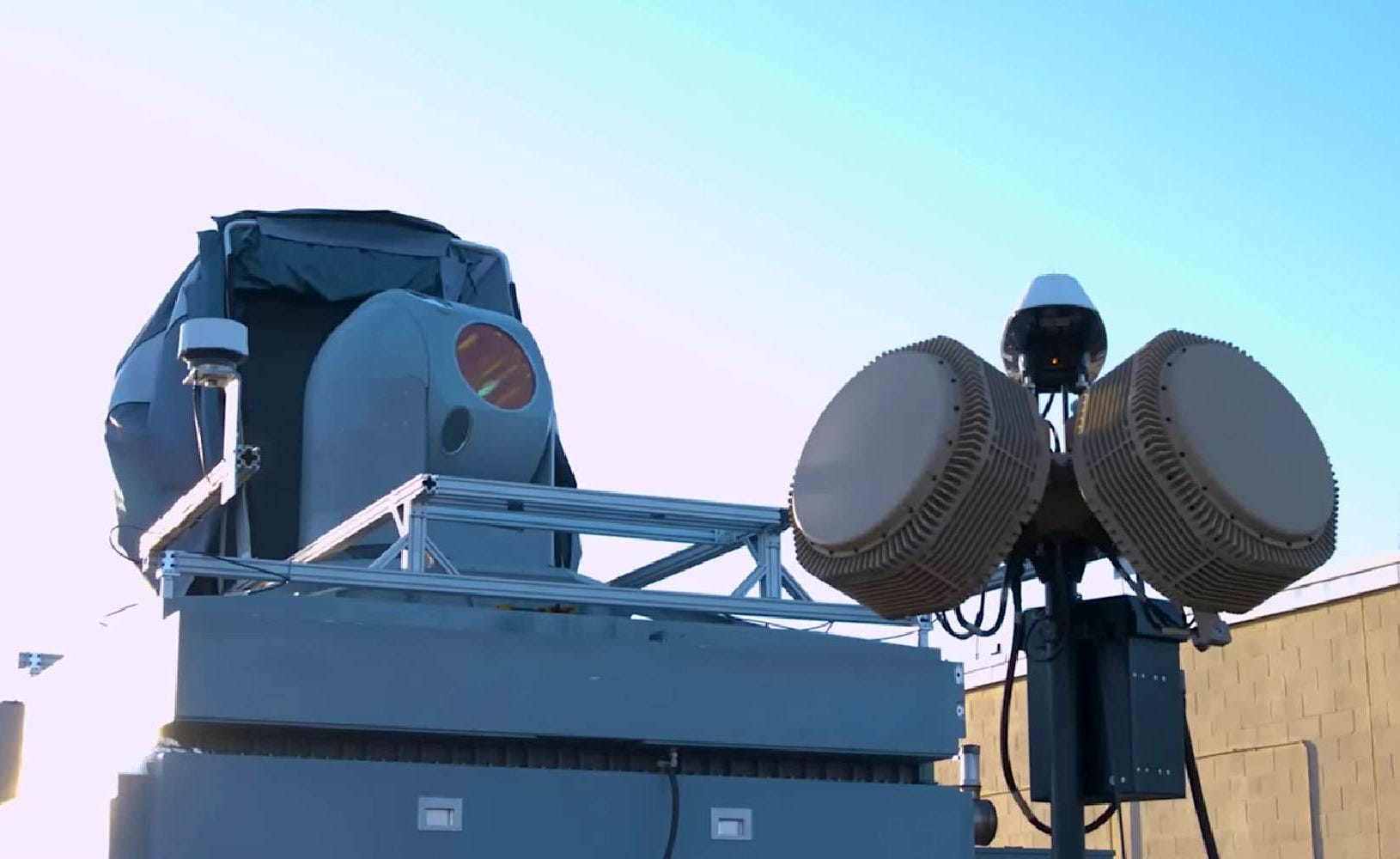
The new Joint Laser Weapon System (JLWS) — a collaboration between the US Army and US Navy whose existence Laser Wars first reported in June 2025 — will initially consist of a containerized 150 kilowatt system with potential to scale to at least 300 kw to defeat incoming cruise missile threats, according to the Navy’s fiscal year 2027 budget request. The system will also include Joint Beam Control System (JBCS) “capable of supporting” a 300-500 kw laser weapon, the documents say.
The JLWS effort will leverage research and development lessons from the Navy’s 60 kw High Energy Laser with Integrated Optical-Dazzler and Surveillance (HELIOS) system, which is currently installed on the Arleigh Burke-class guided missile destroyer USS Preble, and the Army’s 300 kw Indirect Fire Protection Capability-High Energy Laser (IFPC-HEL) system, the first prototype of which the service plans on taking delivery of of later this year. The Navy will also “conduct upgrades” to its High Energy Laser Counter Anti-Ship Cruise Missile Project (HELCAP) testbed “as appropriate” in support of future JLWS testing.
While last year’s Army budget request detailed $51 million in mandatory funding for JLWS through the “One Big Beautiful Bill Act” reconciliation bill under its ‘Expanded Mission Area Missile’ program element, this year’s request does not contain any R&D funding for fiscal year 2027 but details plans for $337.8 million in spending starting in fiscal year 2028 and running through fiscal year 2031. Based on the budget documents, it looks as though the service plans on closing out its IFPC-HEL activities first before kicking off its part of the JLWS effort.
The Navy, however, isn’t waiting around. The service requested $94.825 million under its ‘Directed Energy and Electric Weapon Systems’ program element in fiscal year 2027 (up from just $14.5 million in fiscal year 2026, as Laser Wars previously reported) that includes $79.84 million under its Surface Navy Laser Weapon System (SNLWS) effort to jumpstart JLWS R&D, sustain the service’s lone HELIOS system for future testing activities, and upgrade the HELCAP testbed (which is also receiving a separate $14.978 injection), according to the service’s budget request. The service plans on investing an additional $243.3 million into JLWS R&D under that program element through fiscal year 2031.
Together, the Army and Navy requests total a vision of $675.93 million in R&D spending for the JLWS through fiscal year 2031. The Navy plans on awarding $31.7 million in contracts for JBCS development as soon as the fourth quarter of 2026 and the $30 million in contracts for the procurement and testing of containerized JLWS by March 2027, according to budget documents. It seems likely that Lockheed Martin will receive those contract: not only is the defense prime the technical lead on both the HELIOS and IFPC-HEL efforts that will inform the JLWS, but it’s also already developing a containerized version of the former, a company executive revealed in August 2025.
It’s worth noting that while the Pentagon’s fiscal year 2027 budget request also contains $452 million in R&D spending for the “development, integration, and assessment” of directed energy weapons in support of Golden Dome, the exact relationship with the Army and Navy’s JLWS efforts is unclear. The Navy budget documents state that the $79.84 million allocated under SNLWS also includes funds to “begin development of a consolidated implementation plan” for all Golden Dome-related directed energy projects, “leveraging synergy and common weapon architectures between these efforts where possible” in coordination with the US Missile Defense Agency.
The dream of a laser weapon capable of shooting down cruise missiles is nearly as old as the laser itself. The Pentagon first demonstrated the concept in the 1970s with the Navy ARPA Chemical Laser (NACL), a deuterium fluoride system developed by the Defense Advanced Research Projects Agency (DARPA) that successfully engaged small missile targets but proved far too large and complex for practical deployments. Those same challenges would befall its successor, the megawatt-class Mid-Infrared Advanced Chemical Laser (MIRACL), despite the system successfully neutralizing a supersonic MQM-8 Vandal missile during testing in 1989. The Gulf War briefly revived this dream in the US Air Force’s ill-fated Airborne Laser (ABL) program, which consumed more than $5 billion over nearly two decades before its cancellation in 2012. More recently, the Navy’s Layered Laser Defense (LLD) system, developed by Lockheed Martin in conjunction with the Office of Naval Research, successfully downed a target drone simulating a subsonic cruise missile in a 2022 demonstration at White Sands Missile Range in New Mexico in the military’s latest attempt to validate the concept under realistic conditions.
The Pentagon clearly hopes that the JLWS will finally push its laser-based cruise missile defense efforts over the finish line. But as Laser Wars previously reported when the JLWS first became public in June 2025, such threats pose a far more complex challenge for directed energy weapons than the low-cost weaponized drones that are reshaping warfare on battlefields from Ukraine to the Middle East. Cruise missiles fly low and fast, hug terrain, and execute evasive maneuvers that compress reaction time, while their hardened casings require far more sustained energy to defeat than the soft-bodied drones that current tactical lasers are optimized for. Compounding the challenge, atmospheric interference can scatter or absorb beam energy before it reaches the target; even at 300 kw power levels, laser weapons demand a degree of beam control and aim-point precision that no known system has yet demonstrated against a realistic cruise missile threat.
After years attempting to scale laser weapons to power levels suitable for cruise missile defense, the Pentagon’s push for a containerized solution also represents a departure from past vehicle-mounted or warship-integrated systems. For the Navy in particular, Chief of Naval Operations (and noted laser weapon champion) Adm. Daryl Caudle has explicitly emphasized the pursuit of modular capabilities that the service can rapidly swap across its surface fleet for particular missions without lengthy and expensive stays in shipyards. Look no further than the service’s October 2025 live-fire test of the Army’s 20 kw Palletized High Energy Laser (P-HEL) system, based on the LOCUST Laser Weapon System from defense contractor AV, from the flight deck of the Nimitz-class aircraft carrier USS George HW Bush.
Indeed, the JLWS isn’t the only modular laser weapon the Navy is exploring. The aforementioned Directed Energy and Electric Weapon Systems program element also includes $4.82 million in funding to support the “development, integration and marinization” of the Army’s Enduring High Energy Laser (E-HEL) systems — the modular, 30 kw laser weapon based on lessons from P-HEL and the aborted Stryker-mounted 50 kw Directed Energy Maneuver-Short Range Air Defense (DE M-SHORAD) system that the service envisions as its first directed energy program of record. The Army planned on procuring two E-HEL units in fiscal year 2026 and another pair the following year, according to the service’s budget request, with plans to “produce and rapidly field” up to 24 systems total in the coming years. With its LOCUST system proven as a counter-drone capability both abroad and at home, AV appears the leading contender to clinch that contract in the coming years.
With institutional support for developing and fielding directed energy weapons at scale at a historic high, JLWS may prove a significant opportunity for the Pentagon to finally make its dream of missile-killing laser weapons a reality. But the history of counter-cruise missile laser development is littered with programs that cleared every bureaucratic hurdle only to stumble on the physics and operational realities. A containerized 150 kw system may be a more modest and achievable goal than the behemoths that came before it, but whether JLWS can survive contact with both the budget process and real-world complexities of blasting cruise missiles out of the sky remains the open question.