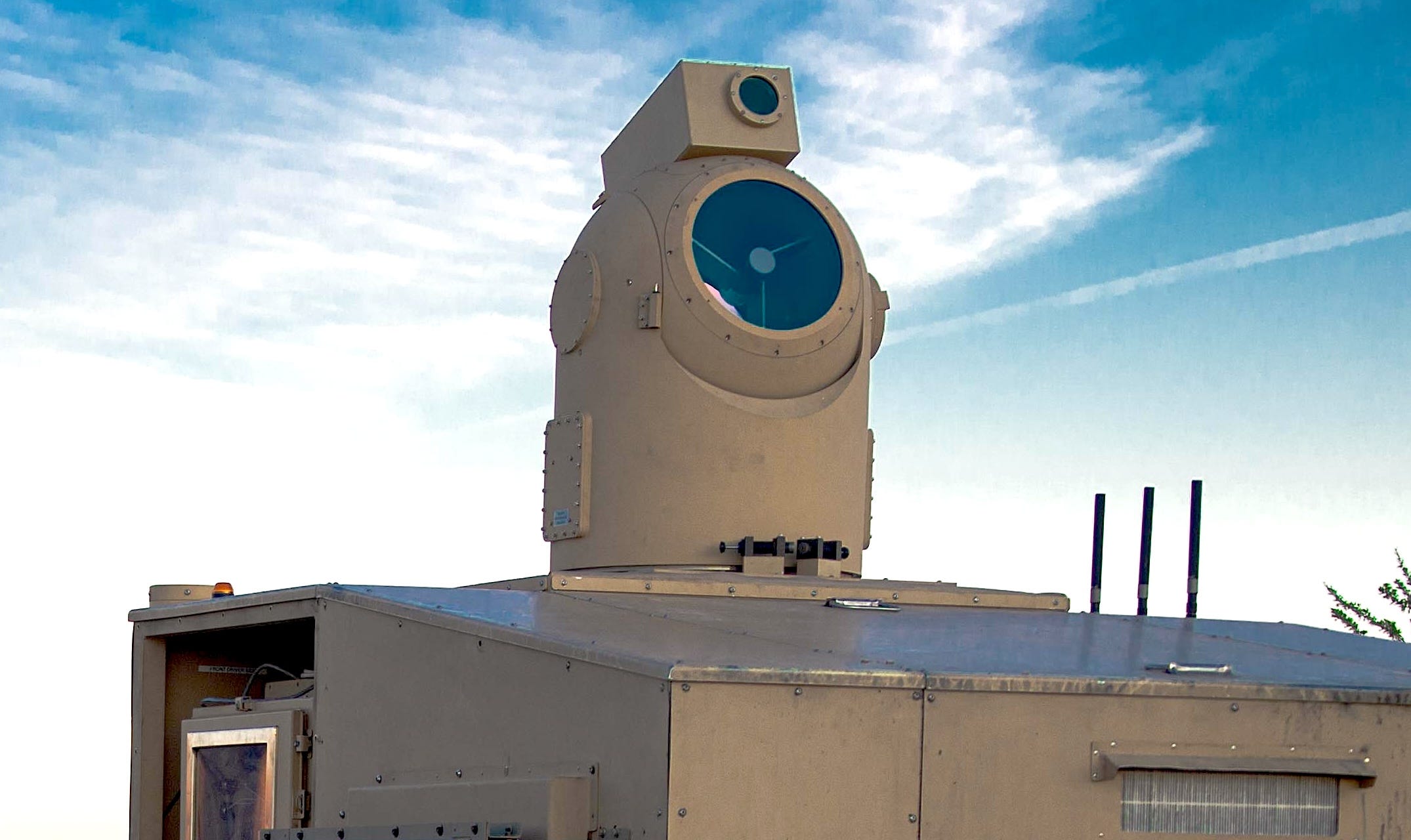
The US Military Wants to Demonstrate Battle-Ready Laser Weapons in 2 Years
“We now have a suite of directed energy products that go from low-end to high-end, and now we have to scale production of those.”

The US military is pushing to demonstrate high-energy laser weapons engineered for fielding at scale in the next two years, according to the US Defense Department’s top science and technology official.
Testifying before the Senate Armed Services Committee’s Emerging Threats and Capabilities Subcommittee on May 19th, Undersecretary of Defense for Research and Engineering (USD(R&E)) Emil Michael told lawmakers that the science of laser weapons “is largely done,” and the Pentagon is now focused on addressing the engineering challenges that come with transforming exquisite prototypes into mass-producible capabilities — the “scaled” element of the department’s “scaled directed energy” critical technology area.
“We now have a suite of directed energy products that go from low-end to high-end, and now we have to scale production of those,” Michael said.1
When questioned by Sen. Gary Peters (D-Mich.) about the three-year timeline for fielding laser weapon at scale that defense officials previously publicized in March, Michael stated that President Donald Trump’s planned ‘Golden Dome for America’ domestic missile shield would accelerate those research and development efforts due to the initiative’s “big reliance” on directed energy, adding that “our experience in Iran has also doubled our interest in these systems.”
“A lot of the money allocated to Golden Dome is going to go to the fundamental engineering of these systems so that we can make them cheaper, smaller, and more proliferated,” Michael said. “And because the commitment was made to the President that we’re going to have a demonstration that includes directed energy in our Golden Dome architecture, there’s a lot of energy going into that.”
The directed energy demonstration is expected to occur during the summer of 2028, Michael said, part of a series of planned Golden Dome-related events.
“There’s never been more effort in the department on this particular capability,” Michael said. “There [are] several companies that are emerging that have developed it, and several companies that are taking what they’ve already built and making it cheaper and better.”
Watch Undersecretary Emil Michael’s relevant testimony below:
Michael comments effectively tie the future of US military laser weapons to a presidential priority with serious money and a hard deadline behind it. The Pentagon’s fiscal year 2027 budget request contains $452 million in proposed R&D spending for the “development, integration, and assessment” of directed energy weapons in support of Golden Dome alone, more than triple the $142 million enacted under the ‘One Big Beautiful Bill Act’ reconciliation package Trump signed into law in July 2025. In addition, the US Army and US Navy together have laid out plans to spent $675.93 million over the next five years on a containerized 150-300 kilowatt Joint Laser Weapon System (JLWS) as part of the military’s broader Golden Dome architecture. In addition, Michael’s mention of Iran as having “doubled” the Pentagon’s interest in directed energy adds an operational urgency that budget numbers alone don’t capture.
But there’s a problem with Michael’s declaration that the science of laser weapons is “largely done” and the engineering is what remains: engineering is exactly what has sunk US military programs in the past. Building effective laser weapons means ensuring they can be operated and maintained across a range of tactical environments by soldiers who aren’t laser specialists. Consider the Army’s 50 kilowatt Stryker-mounted Directed Energy Maneuver-Short Range Air Defense (DE M-SHORAD), which the service determined was “not mature enough” to become a program of record after rocky operational testing in the Middle East in 2024 exposed issues with the system’s heat dissipation and reliability in its vehicle-mounted configuration. (Retired Army Lt. Gen. Robert Rasch summed up the problem with real-world directed energy weapon deployments in August 2025: “We can’t get by with the thought of having clean rooms out in combat.”) The Pentagon has been burning drones out of the sky with lasers since 1973, but it has yet to consistently translate demonstrators into battle-ready weapons that American service members can actually rely on outside of a controlled environment.
Indeed, the last decade has proven a graveyard of promising laser weapon programs. Beyond DE M-SHORAD, the Army has also abandoned its 300 kw Indirect Fire Protection Capability-High Energy Laser (IFPC-HEL) project after downshifting from an eventual program of record to a single testbed that will inform future JLWS efforts. The Navy’s 60 kw High Energy Laser with Integrated Optical Dazzler and Surveillance (HELIOS) system, which only recently began testing at full power and successfully engaged drone targets aboard the Arleigh Burke-class guided missile destroyer USS Preble after years of delays, has effectively disappeared from the service’s fiscal year 2027 budget request outside a handful of sustainment dollars. The Marine Corps returned its five much-hyped Compact Laser Weapon System (CLaWS) units to Boeing without a replacement program in sight. The Air Force spent years testing Raytheon’s High-Energy Laser Weapon System (HELWS) before abandoning it without a program of record.
These failures share a common pattern diagnosed in a detailed 2023 Government Accountability Office (GAO) report: promising laser weapons advanced through prototyping without ever securing formal transition partners or drafting agreements that would bind developers and the acquisition community to shared requirements, timelines, and funding responsibilities, dooming them to obsolescence simply because the bureaucratic will to fight for them across budget cycles and shifting service priorities didn’t exist. In his posture statement to the House Armed Services Committee in April, Secretary of Defense Pete Hegseth called it “institutional inertia.” While Michael pointed to the Pentagon’s Joint Interagency Task Force 401 (JIATF) counter-drone group as a demand signal aggregator alongside and Golden Dome as a political forcing function, neither of those things solves the transition problem on its own.
Two efforts — likely Michael’s “suite of directed energy products that go from low-end to high-end” — will serve as the clearest early indicators as to whether the Pentagon’s current engineering confidence is warranted. The first is the Enduring High Energy Laser (E-HEL), the Army’s modular 30 kw system explicitly envisioned as the service’s first directed energy program of record — and it appears to be moving faster than almost any laser effort before it. Based on Army documents, E-HEL’s design philosophy looks like a direct response to DE M-SHORAD’s shortcomings, with the system decoupled from a specific vehicle platform and built for soldier-performable sustainment using line-replaceable units. The service plans to “produce and rapidly field” 24 E-HEL systems over a five-year period, with the first prototype expected no later than the second quarter of fiscal year 2026 and initial procurement units slated for delivery by the end of fiscal year 2027. If this timeline holds, E-HEL would mark the first time the US military service has successfully transitioned a laser weapon to a genuine program of record.
The second is the aforementioned JLWS. The Navy plans on awarding $31.7 million in contracts for the development of a Joint Beam Control System (JBCS) – a critical component “capable of supporting” a 300-500 kw laser weapon system, according to the Navy’s fiscal year 2027 budget request – as soon as the fourth quarter of 2026, with another $30 million in contracts for the procurement and testing of containerized hardware expected by March 2027. That timeline makes a Golden Dome demonstration in the summer of 2028 plausible, but it also means whatever system appears will likely be an early-stage weapon rather than a mature one. The current JLWS R&D roadmap runs through fiscal year 2031, and while a successful demonstration in two years would be a genuine milestone, it would still represent the early stages of a fielding process.
Whether the US defense industrial base is ready to answer either program’s call remains an open question. Manufacturing expansions from defense contractors like Huntington Ingalls Industries, AV, IPG Photonics, and nLight are encouraging signs, but the industrial building blocks for laser weapons – from specialized optics with 12-to-18-month lead times to critical materials and rare earth elements sourced from Chinese-dominated supply chains — do not yet appear in place to enable the production systems at the scale Michael is describing.
The development of laser weapons has been defined for decades by a seemingly inescapable cycle of enthusiasm and disappointment. Retired Air Force Gen. Ellen Pawlikowski, former program manager for the service’s legendary YAL-1 Airborne Laser effort, perfectly captured the longstanding Pentagon consensus around directed energy in an interview for the 2018 book Lasers, Death Rays, and the Long, Strange Quest for the Ultimate Weapon: “I’m tough on laser people these days. It’s because they have a reputation of overpromising and underdelivering.” With institutional support at a historic high, the Golden Dome-driven demonstration planned for summer 2028 may end up proving a moment of truth for the engineering challenges that have imperiled laser weapon programs past — or, at worst, yet another setback for the US military’s long pursuit of directed energy.
Michael was clearly referring primarily to high-energy laser weapons and not high-powered microwaves when he mentioned directed energy in his testimony. From his comments (emphasis mine): “The things that are helping that are Golden Dome, because they have a big reliance on directed energy. Certainly, our experience in Iran has also doubled our interest in these systems. Same thing with high-powered microwave, although it has a different sort of mechanism of action than lasers.”


Lasers for at sea and mobile Army applications are the biggest waste of money I’ve ever seen. The combination of short range, a required dwell time on target, and susceptibility to sea spray and dust is going to render them useless in combat environments.