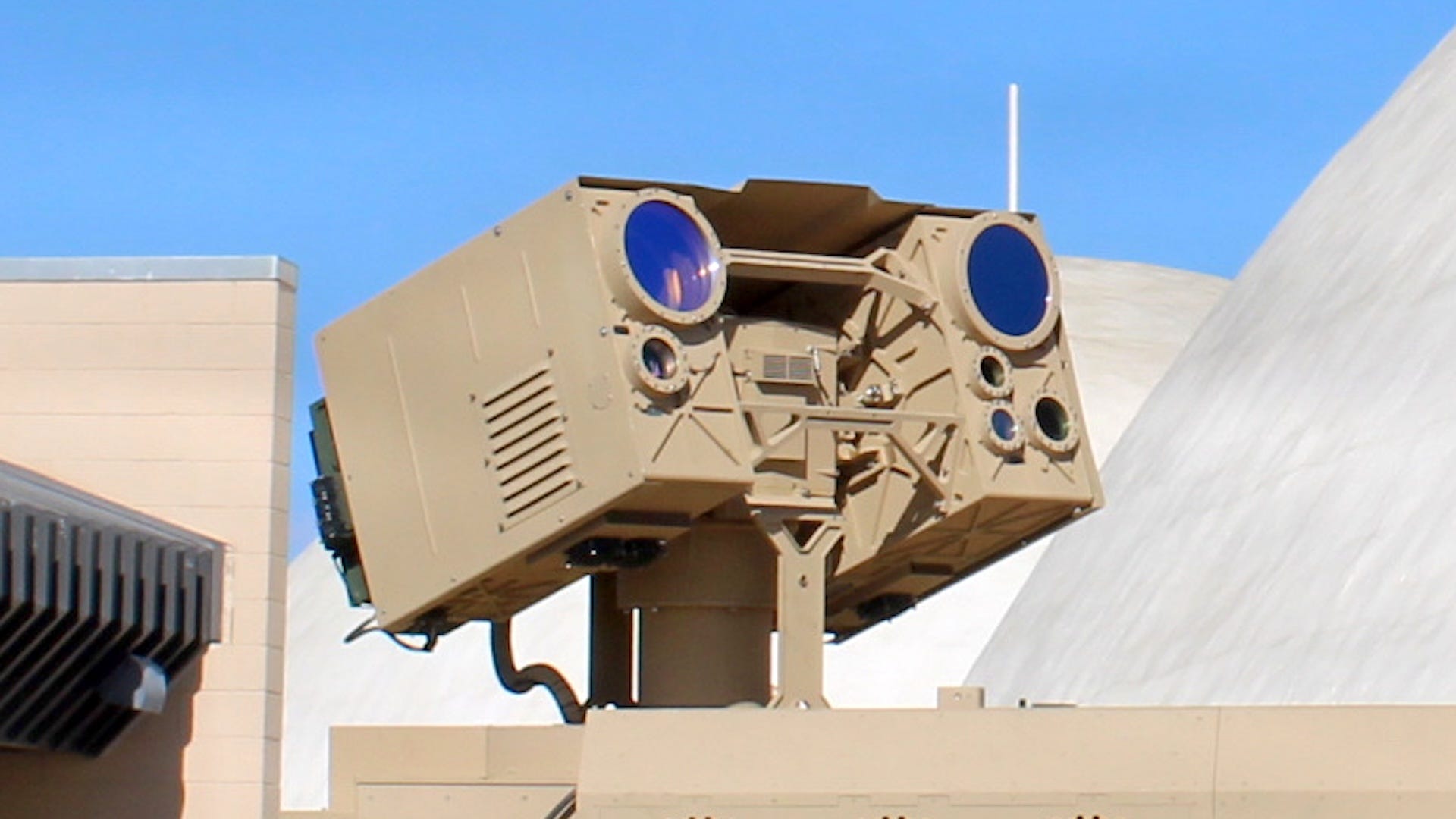
The Pentagon Wants to Field Laser Weapons at Scale Within 3 Years
Amid waves of Iranian drone attacks, the US Defense Department is pushing to finally field high-energy laser weapons in the next 36 months.

For decades, the US military’s dream of high-energy laser weapons has been perpetually “five years away.” Now the Pentagon says it wants to finally make them an operational reality within the next three.
Speaking on a panel at the National Defense Industrial Association’s annual Pacific Operational Science and Technology conference in Honolulu, Hawaii on March 9, Assistant Secretary of Defense for Critical Technologies Michael Dodd stated that the US Defense Department plans on fielding directed energy weapons such as lasers and high-powered microwaves at scale within the next 36 months to defend US service members from the threat of hostile drones, National Defense magazine reports.
While the Pentagon has deployed a handful of laser weapons overseas in recent years for operational testing and officially designated “scaled directed energy” as a critical technology area in November, this accelerated push for widespread fielding comes as US forces engaged in the Operation Epic Fury struggle to counter waves of Iranian Shahed drones raining down across the Middle East, according to fellow panelist Deputy Under Secretary of Defense for Research and Engineering James Mazol.
“We need to be able to deal with mass, and we need to be able to defeat mass that’s coming at us,” Mazol said, per National Defense.
These ambitions appear to have support at the highest levels of the US government. Speaking at a White House press conference on Epic Fury on March 9, President Donald Trump touted the potential of laser weapons as a cheaper alternative to the pricey interceptor missiles US forces currently rely on to counter drones and other aerial threats.
“The laser technology that we have now is incredible,” Trump, who previously declared laser weapons a key feature of his proposed ‘Trump-class’ battleship, said. “It’s coming out pretty soon. Where literally lasers will do the work of, at a lot less cost, what the Patriots are doing and what other things are doing.”
That cost difference is at the heart of the Pentagon’s growing interest in directed energy. A single Patriot PAC-3 interceptor can cost more than $3 million, while the Iranian Shahed drones pummeling battlefields across the Middle East often runs between $20,000 and $50,000 — a punishing asymmetry for conventional militaries. Directed energy weapons like high-energy lasers promise to invert this equation, with each shot requiring little more than the electricity required to generate the beam. And while laser weapons have clear limitations, they offer a potentially attractive complement to traditional missiles and other kinetic interceptors for countering the threat of low-cost weaponized drones.
This Pentagon-level push to field directed energy weapons comes as the military services have also accelerated their own laser programs. Senior US Navy leaders recently trumpeted their vision of “a laser on every ship” in the surface fleet, a notable shift from the caution that previously defined the service’s approach to directed energy. The US Army has laid out draft requirements to “produce and rapidly field” up to 24 new Enduring High Energy Laser (E-HEL) systems in what might finally become the service’s first program of record. The Air Force is taking another run at both airborne laser weapons and ground-based systems for base defense after years of disappointment. The Marine Corps says it plans on investing in a “more deliberate program of record” for laser weapons, as a service spokesman previously told Laser Wars. The Army and Navy are even teaming up on a brand new laser weapon system as part of Trump’s ambition ‘Golden Dome for America’ missile shield. All of this is occurring against the backdrop of $250 million infusion of funding for directed energy research and development included in the “One Big Beautiful Bill” reconciliation package the president signed into law in July 2025.
Taken together, these efforts may represent the Pentagon’s most serious attempt to transition laser weapons from experimental prototypes to routine military capabilities since President Ronald Reagan announced the Strategic Defense Initiative in 1983. But while the R&D breakthroughs required for the orbital laser weapons envisioned by Reagan’s “Star Wars” never materialized, the technology has now advanced to the point where they are burning drones out of the sky in active conflict zones — and, occasionally, at home. Adaptive optics, more efficient power systems, improved thermal management, and AI-assisted targeting have now converged to make laser weapons reliable and compact enough for real-world operations.
Transitioning laser weapons into fully funded military programs is as much a matter of institutional will as technological maturity. Many next-generation defense technologies end up languishing in the “valley of death” between R&D and acquisition because of shifting priorities or a lack of political support from stakeholders in the Pentagon or Congress; just look at the Navy’s experience with its electromagnetic railgun, which the service abandoned in 2021 after spending nearly $1 billion over two decades. With senior military leaders, service secretaries, and the commander-in-chief extolling the virtues of laser weapons, the chances of these systems actually watching over combat formations downrange have rarely been higher.
The most significant challenge facing the Pentagon’s scaled directed energy ambitions is the “scale” part. As Laser Wars previously reported, the essential components of laser weapons require rare earth elements and other critical minerals, the global production and processing of which China dominates. And even if those inputs were abundant, advanced manufacturing capacity is not: US defense contractors like AV and nLight, as well as Australia’s Electro Optic Systems (EOS), have all announced plans to boost production of laser weapons in recent months, but those manufacturing expansions will take months to ramp up and outputs will likely remain modest at perhaps a handful of systems a year (five to 10 annually at EOS’s new hub in Singapore, for example). This pales in comparison to, say, the hundreds of FIM-91 Stinger missiles and Coyote interceptors that defense prime Raytheon can churn out in the same period. Scaling laser weapons from prototypes to scores of systems will require a defense industrial base that largely does not yet exist.
Scaled directed energy is not a standalone solution for the US military’s air defense woes. Laser weapons, after all, aren’t magic: they can be extremely effective against drones and other targets, but they still require precious seconds of dwell time to inflict catastrophic damage and their performance can degrade depending on atmospheric conditions. This makes them best suited as one segment of a broader layered air defense architecture rather than a wholesale replacement for missiles and guns. In practice, this means pairing lasers with kinetic interceptors, electronic warfare systems, and other specialized countermeasures, all coordinated through a unified command-and-control system that can assign the right weapon to the right target at the right moment. Lasers and other exotic directed energy systems may help solve the cost problem posed by drone attacks, but only by working as part of a larger air defense ecosystem designed to handle the full spectrum of aerial threats.
After decades of laser weapons promises, the Pentagon has given itself a deadline. Now it has to prove that it can deliver — fast.
⚡️Pulse
There’s officially more laser news than I have time to devote individual editions to! To ensure Laser Wars remains up to date, I’m experimenting with a new section to capture updates from around the directed energy ecosystem:
No, Israel isn’t using the Iron Beam in the war with Iran: Despite viral footage purporting to show Israel’s chief laser weapon swatting down Hezbollah rockets in the opening weeks of the US-led war with Iran, the Israeli Defense Forces confirmed to the Jerusalem Post on March 12 that the Iron Beam “has not been used by Israel and is not ready for regular use during the current war.” Given that Semafor first reported on March 14 that Israel is “running critically low on ballistic missile interceptors,” perhaps Iron Beam will make an appearance on the battlefield so the IDF can preserve its kinetic arsenal for higher-end threats.
Laser Wars in the New York Times: I’m quoted in a new article from New York Times reporter Farah Stockman about military laser weapons and Operation Epic Fury, mostly dumping on the New York Post for misidentifying an AN/SEQ-4 Optical Dazzling Interdictor, Navy (ODIN) system photographed on the USS Spruance as the 60 kilowatt High Energy Laser with Integrated Optical Dazzler and Surveillance (HELIOS). I’m grateful Stockman for her time and her editors for keeping this line:
Here comes another laser rifle: Laser technology company NUBURU announced on March 9 that subsidiary Lyocon has “completed the proof of concept” of a “portable directed-energy laser dazzler platform” — in other words, a laser rifle. While the US military has fielded handheld laser dazzlers for years, the new drone countermeasure joins a wave of similar systems from France, Russia, Indonesia, and Belarus released over the last year.
The US Navy’s electromagnetic railgun is back from the dead: The Navy resumed testing of its electromagnetic railgun in February 2025 at the White Sands Missile Range in New Mexico, according to a ‘year in review’ publication from Naval Sea Systems Command released in January. The service had previously abandoned its railgun efforts in 2021 due to “fiscal constraints, combat system integration challenges and the prospective technology maturation of other weapon concepts” — a decision I had predicted back in 2017. Needless to say, I’m amped to see what comes next for my beloved supergun.

The US Navy test fires its electromagnetic railgun at White Sands Missile Range, New Mexico in February 2025. (US Navy photo)