


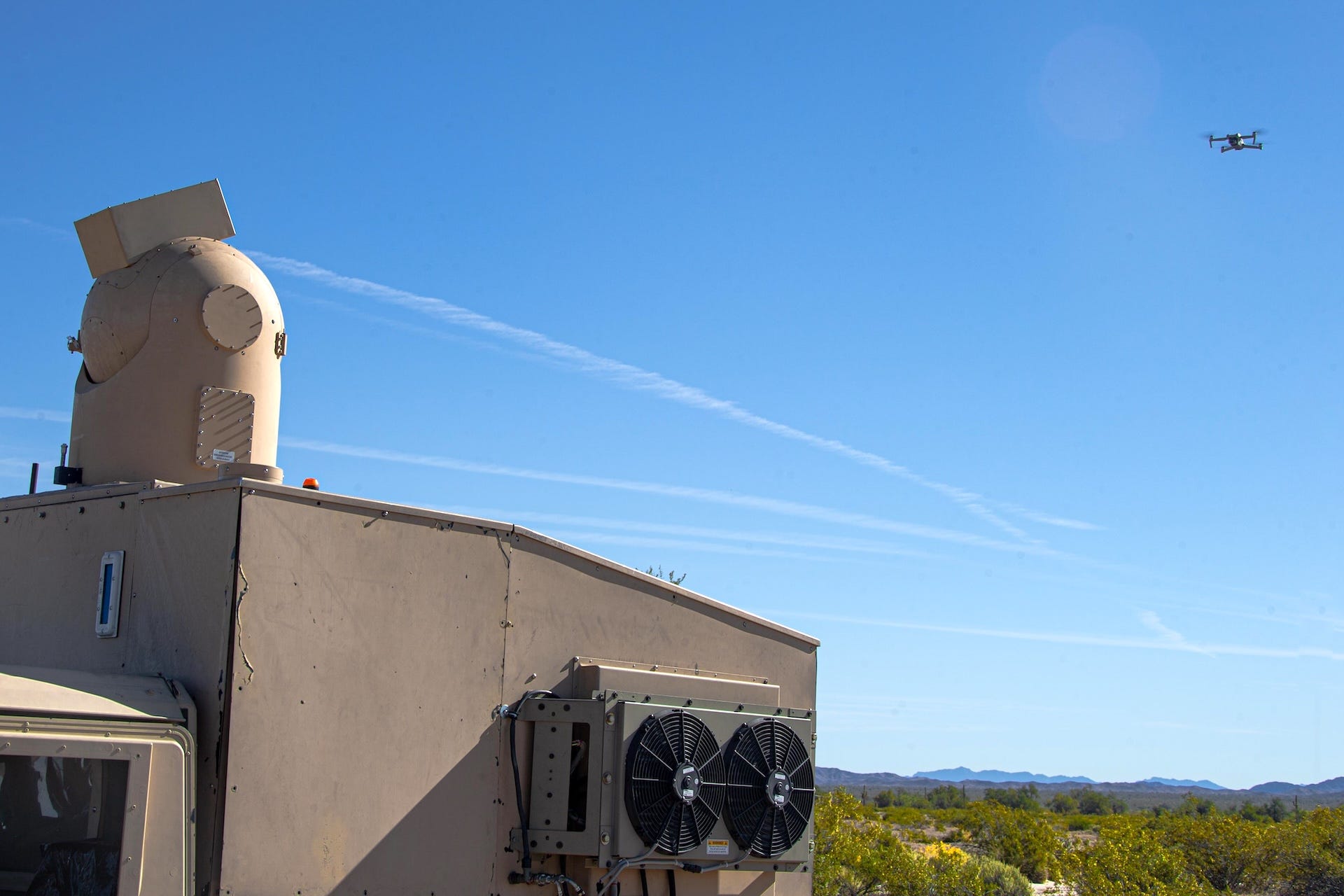
Since late August, the US military’s Joint Interagency Task Force (JIATF) 401 has been touting a December “directed energy shoot-off” as a key milestone in its effort to field such capabilities to defend domestic installations and critical infrastructure against drone threats. Now we finally have an idea of what the shoot-off actually entails.
During a Joint Directed Energy Consortium (JDEC) engagement with members of the defense industry on October 6, officials from JIATF and the US Defense Department’s Scaled Directed Energy (SCADE) team laid out what they envision for the shoot-off, which will take place from November 30 through December 11 at the US Army’s Dugway Proving Ground in Utah. Here are the important details:
The goal: JIATF 401 isn’t looking for a single winner to down-select for a specific program. Instead, officials want to identify “a series of vendors who meet the criteria” for a follow-on operational assessment starting in the first quarter of fiscal year 2028.
The buy: While an earlier JDEC notice stated that the Pentagon was prepared to award up to a total of $200 million in contracts to top performers, officials stated that they could request up to 10 systems apiece from qualified contractors for the 2028 assessment.
The participants: Officials were explicit that the shoot-off was an entirely separate effort from JIATF 401’s ongoing directed energy pilot program at five domestic military installations, although those contractors are still welcome to recompete at the shoot-off and participate in the follow-on assessment.
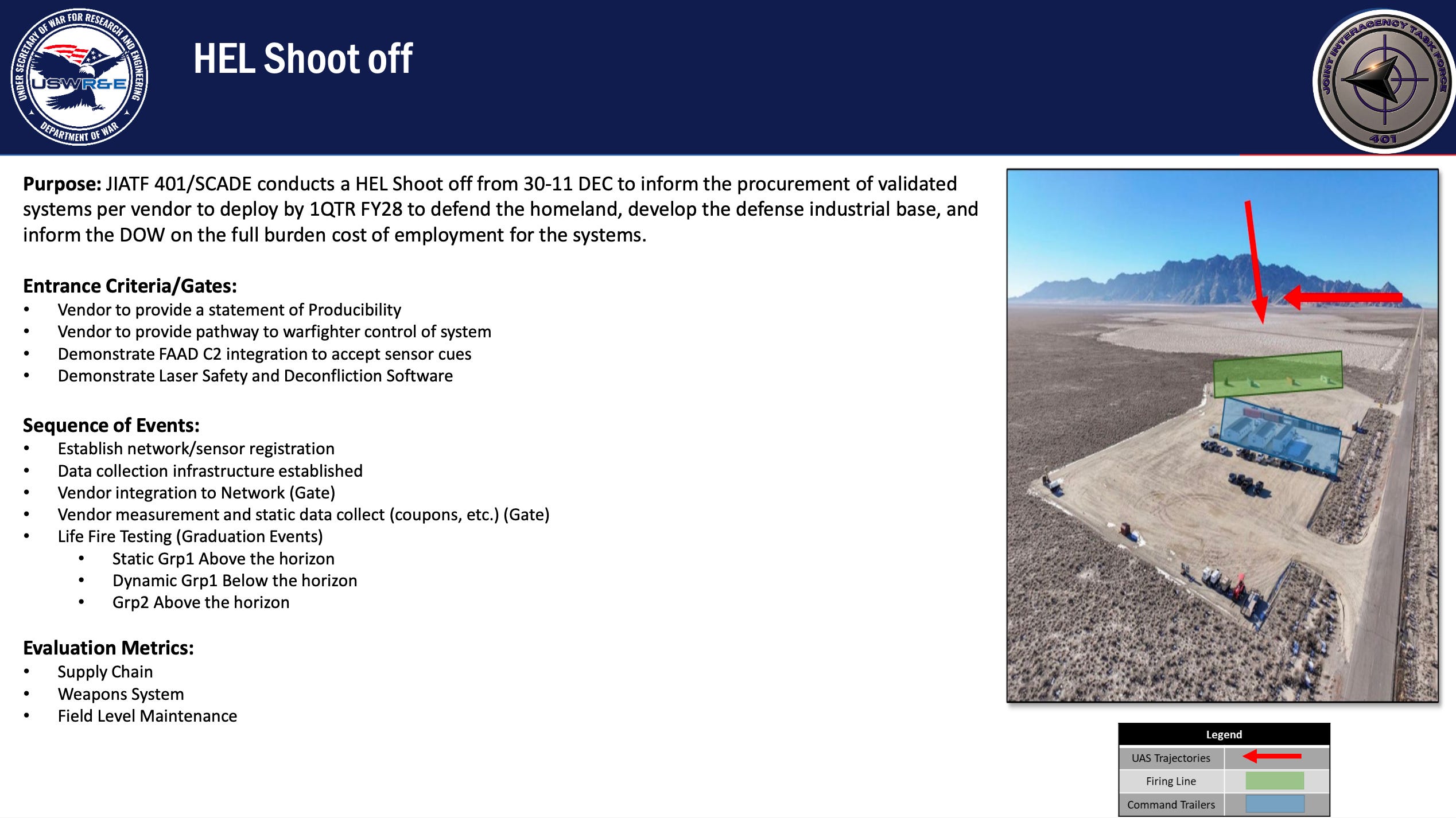
The weapons: Only high-energy lasers capable of hard kills will be in the mix at Dugway — dazzlers and sub-kilowatt systems are out. Ground-based and airborne lasers are both welcome, and there are no requirements regarding power classes. “We’re evaluating the effects, not the stated power of the system,” as one official put it.
The threat: Participating systems will engage Group 1 and 2 drones only. During the JDEC call, officials repeatedly declined to evaluate performance against larger Group 3 drones even when industry participants asked.
The static tests: Lasers will fire at target boards at 500 and 1,000 meters and at steel coupons. Evaluators will measure spot size, tracking bias and jitter, and steel penetration time.
The drone tests: Each contractor will fly seven to 10 vignettes in three events. The first is stationary Group 1 drones above the horizon. The second is moving DJI quadcopters below the horizon. The third is small foam-bodied, fixed-wing Group 2 drones of under 20 pounds flying head-on above the horizon. Crossing shots at 45, 30 and 15 degrees are also under consideration, and both day and night engagements are possible.
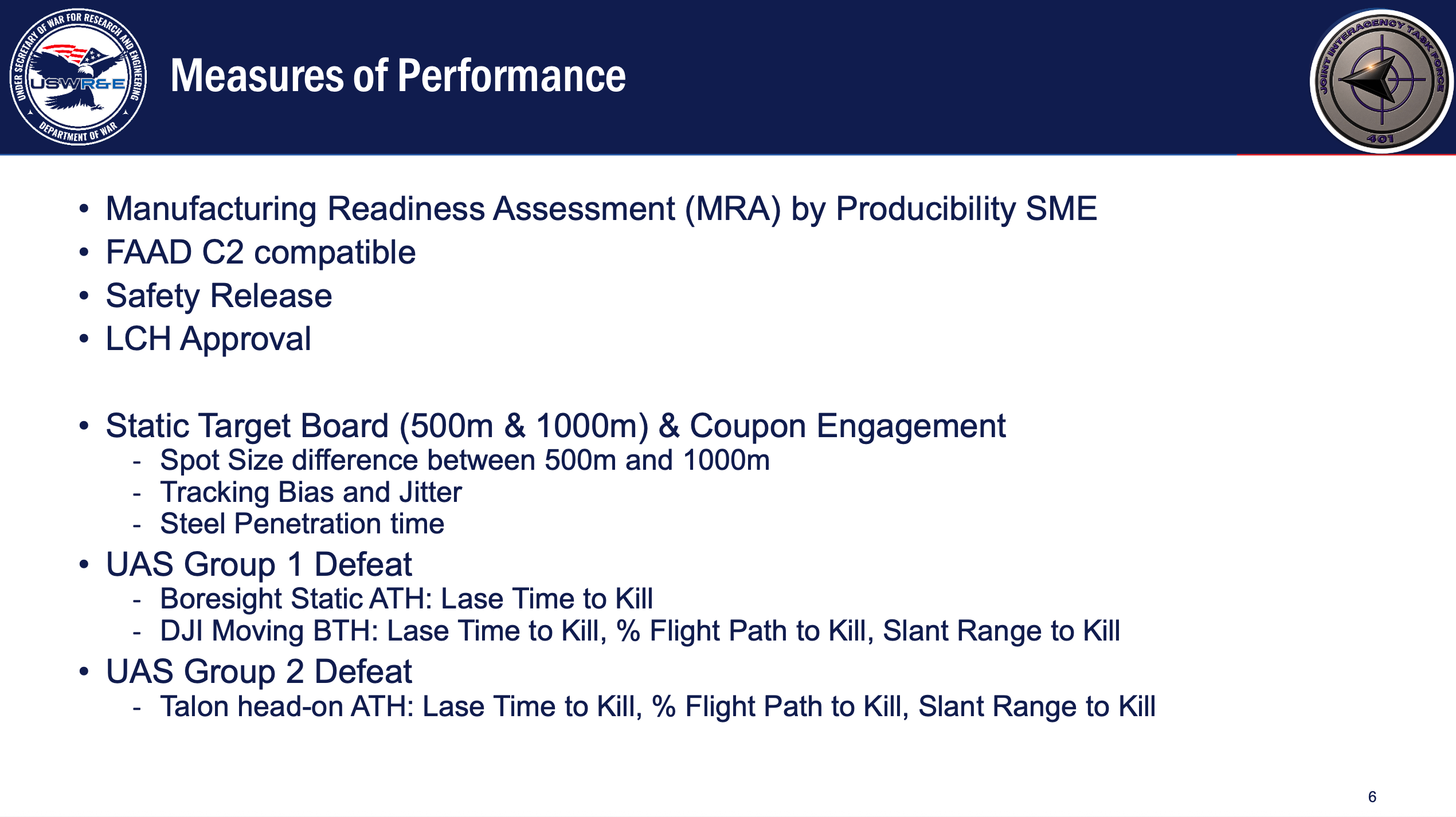
The gates: Before firing a shot at a drone, each laser must clear a range safety release, Laser Clearinghouse approval, and integration with the Army’s Forward Area Air Defense Command and Control (FAAD C2) system to accept sensor cues. Integration with Anduril’s Lattice doesn’t count, per officials.
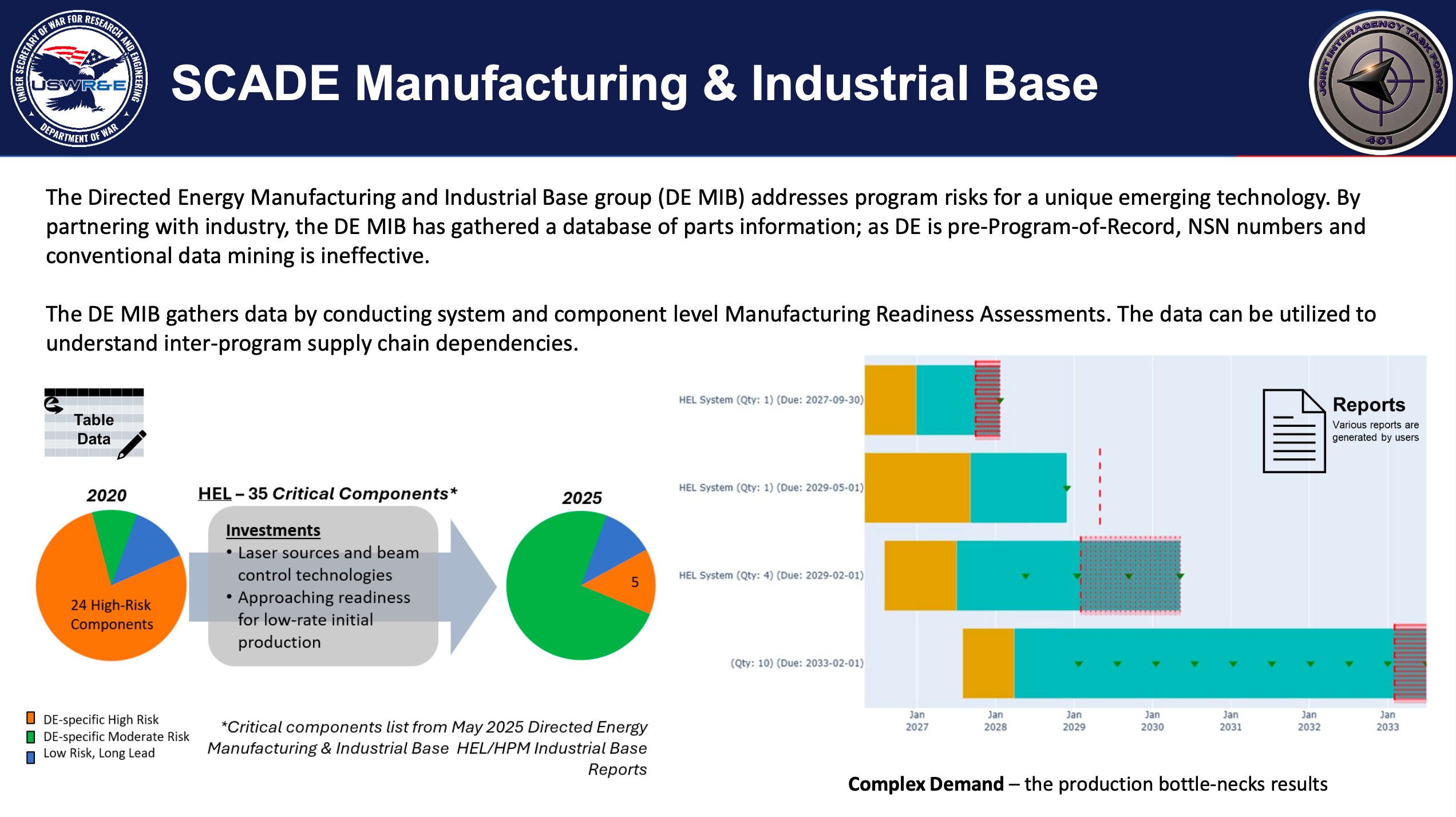
The production test: A successful performance in the shoot-off is not enough: SCADE plans on putting each contractor through a manufacturing readiness assessment modeling annual production rates and supply chain choke points that may stymie fielding at scale.
The cost question: Contractor must state a “practical number of engagements” that their lasers can sustain under heat and power limits – results meant to give the Pentagon the “fully burdened cost” of fielding directed energy weapons at home.
The fine print: Contractors pay their own way, while the government supplies the targets and range. Participation is limited to JDEC members with a US CAGE code, and foreign nationals can’t attend because of FAAD C2 security rules. Federal Aviation Administration officials will also observe.
The shoot-off is the latest step in the Pentagon’s push to field laser weapons at scale for both overseas operations and domestic air defense. Established by the Army in August 2025 at the direction of Secretary of Defense Pete Hegseth, JIATF 401 on October 5 named four directed energy systems — AV’s P-HEL, Boeing’s CLaWS, and Kord’s Firefly, plus Epirus’s Leonidas high-power microwave weapon — for a congressionally mandated pilot program at domestic installations. The shoot-off is meant to cast a wider net, and success at the event will “immediately [result] in a purchase order,” as JIATF 401 director Brig. Gen. Matt Ross said in August.
Based on the new details from defense officials, the December shoot-off is less a contest of champions and more an assessment of the directed energy industry’s broader readiness. Shooting down drones is only one of three evaluation areas JIATF 401 has laid out for the event — supply chain integrity and field-level maintenance are just as critical, and no contractor will be allowed to fire on a drone until it has cleared a series of safety, network and command-and-control gates.
The emphasis on producibility is overdue. Hegseth previously told lawmakers in April that the US directed energy industrial base was currently positioned to build just a limited number of prototypes, and supply chain bottlenecks have haunted the Pentagon’s laser ambitions for years. SCADE’s industrial base team says that this situation is improving: According to a one JDEC briefing slide presented to industry, the number of high-risk components among the 35 parts it considers critical to high-energy lasers fell from 24 in 2020 to just five in 2025. But the same slide also modeled production bottlenecks that could push delivery of a 10-unit lot out as far as 2033.
Funding is also an open question. That $200 million pool of contracts won’t stretch far: the Army’s fiscal year 2027 budget request priced each of its Enduring High Energy Laser (E-HEL) systems, for example, at around $17.4 million, which comes out to around 11 systems total. Either JIATF 401 expects significantly cheaper systems (Ross said in August he wants “something that looks more like a commercial laser with a more robust supply chain”) or most qualified contractors will only deliver a handful of units each.
Then there’s the cost equation. By demanding a “practical number of engagements” even from systems marketed as having an “infinite magazine,” the Pentagon is forcing contractors to assign firm numbers to their products’ heat and power limits. Paired with officials’ insistence on “evaluating the effects, not the stated power,” the criteria suggests the Pentagon is attempting to determine what a laser weapon’s true cost-per-kill actually looks like in practice.
JIATF 401’s emphasis on Group 1 and 2 also reflects a focus on the cheap quadcopters over bases and cartel drones along the southern border rather than the Shahed-style one-way attack drones that have dominated battlefields from Ukraine to the Middle East, leaving the higher-power lasers the Pentagon is pursuing under its Joint Laser Weapon System (JLWS) effort to handle larger drones and missiles. Interestingly, officials didn’t appear fully aligned on that line during the October 6 JDEC call: one SCADE official invited contractors to submit systems built for Group 1 through 3 drones before a JIATF 401 official reiterated that the scope of the shoot-off was limited to Groups 1 and 2 systems.
The big question facing the directed energy sector is who can afford to play. Ross has said he wanted to see “young, innovative companies” help shape the Pentagon’s directed energy future, but a self-funded month in the Utah desert and the headache of FAAD C2 integration favor firms with deep pockets and existing clearances. Officials said that any contractor that can’t make it to Dugway but whose system the government already has data on can still be selected in line with a September 28 memorandum on accelerating the fielding of domestic counter-drone capabilities, but this carve-out favors incumbents.
JIATF 401 will begin notifying defense contractors selected for the shoot-off on October 23, officials said. The size of that list will say a lot about the depth of America’s laser weapon arsenal; JDEC’s program director even told industry he could “probably count on one hand” the number of companies that can build a complete high-energy laser or high-power microwave weapon end-to-end. We’ll find out who actually makes the cut — and what that means for the future of the Pentagon’s directed energy ambitions — come December.
