


America’s laser dome is gradually taking shape.
The US military has selected four directed energy weapons to participate in a Joint Interagency Task Force (JIATF) 401 pilot program to “expand the operational use” of such novel capabilities “across the homeland,” the US Defense Department announced in an October 5 press release.
The Pentagon selected three high-energy laser weapons: AV’s Palletized High-Energy Laser (P-HEL), which the US Army has employed operationally overseas for years; Boeing’s Compact Laser Weapon System (CLaWS), which the US Air Force disclosed in July had been deployed across Europe; and Kord’s Firefly high-energy laser weapon, which the company demonstrated in Huntsville, Alabama this past August. The department also selected the Leonidas high-powered microwave weapon from self-described “neo-prime” Epirus, which the Army has been testing for years under its Indirect Fire Protection Capability High-Power Microwave (IFPC-HPM) effort.
The pilot program covers five domestic US military installations: Fort Bliss, Texas; Fort Huachuca, Arizona; Naval Base Kitsap, Washington State; Grand Forks Air Force Base, North Dakota, and Whiteman Air Force Base, Missouri. It is unclear which specific directed energy systems will deploy to which installations.1
“High-energy lasers and high-powered microwave systems are tools that can be effectively used in a layered drone defense,” US Army Brig. Gen. Matt Ross, JIATF 401 director, said in a statement. “This pilot program will test these capabilities in an operational environment so we can understand how best to integrate and sustain them to defend the homeland.”
Here’s what we know about the directed energy systems selected to watch over US military installations across the United States.
The Incumbent: AV’s P-HEL
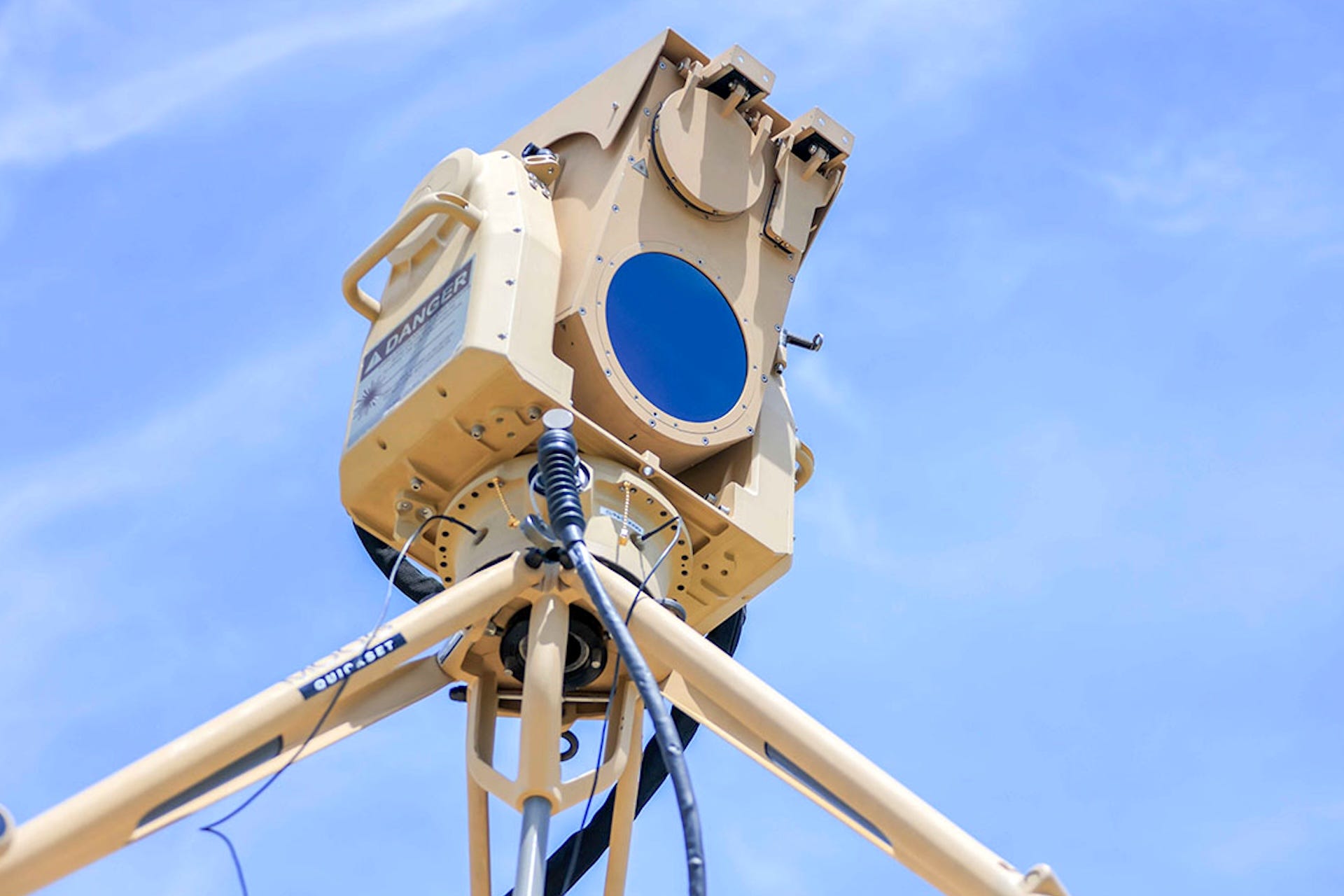
AV’s P-HEL is, at this point, the closest thing the US military has to a veteran laser weapon. Based on the company’s LOCUST Laser Weapon System, the 20 kilowatt system has been watching over American troops overseas since at least 2022. It shot down 17 drones from the flight deck of the aircraft carrier USS George HW Bush during a first-of-its-kind live-fire test in October 2025. Its vehicle-mounted sibling, the Army Multi-Purpose High Energy Laser (AMP-HEL), has had a busy year on the home front: after scoring the US military’s first acknowledged laser kill near the US-Mexico border in February (a friendly-fire shootdown of a US Customs and Border Protection drone, unfortunately), it was also the laser the Federal Aviation Administration (FAA) put through its paces at White Sands Missile Range in New Mexico in March to determine whether such weapons could safely operate in domestic airspace.
LOCUST appears to have become the US military’s laser weapons of choice. In August, US Northern Command announced that American soldiers had used AMP-HEL to down 11 cartel-linked drones in less than two weeks. Days later, the Army announced it had awarded AV a $464.8 million contract to produce 26 of its new 30 kw LOCUST X3 lasers under the Enduring High Energy Laser (E-HEL) program, the US military’s first-ever laser weapon production contract. If any laser weapon has earned a spot guarding American bases, it’s LOCUST — and now it will actually do so as P-HEL.
The Comeback Kid: Boeing’s CLaWS
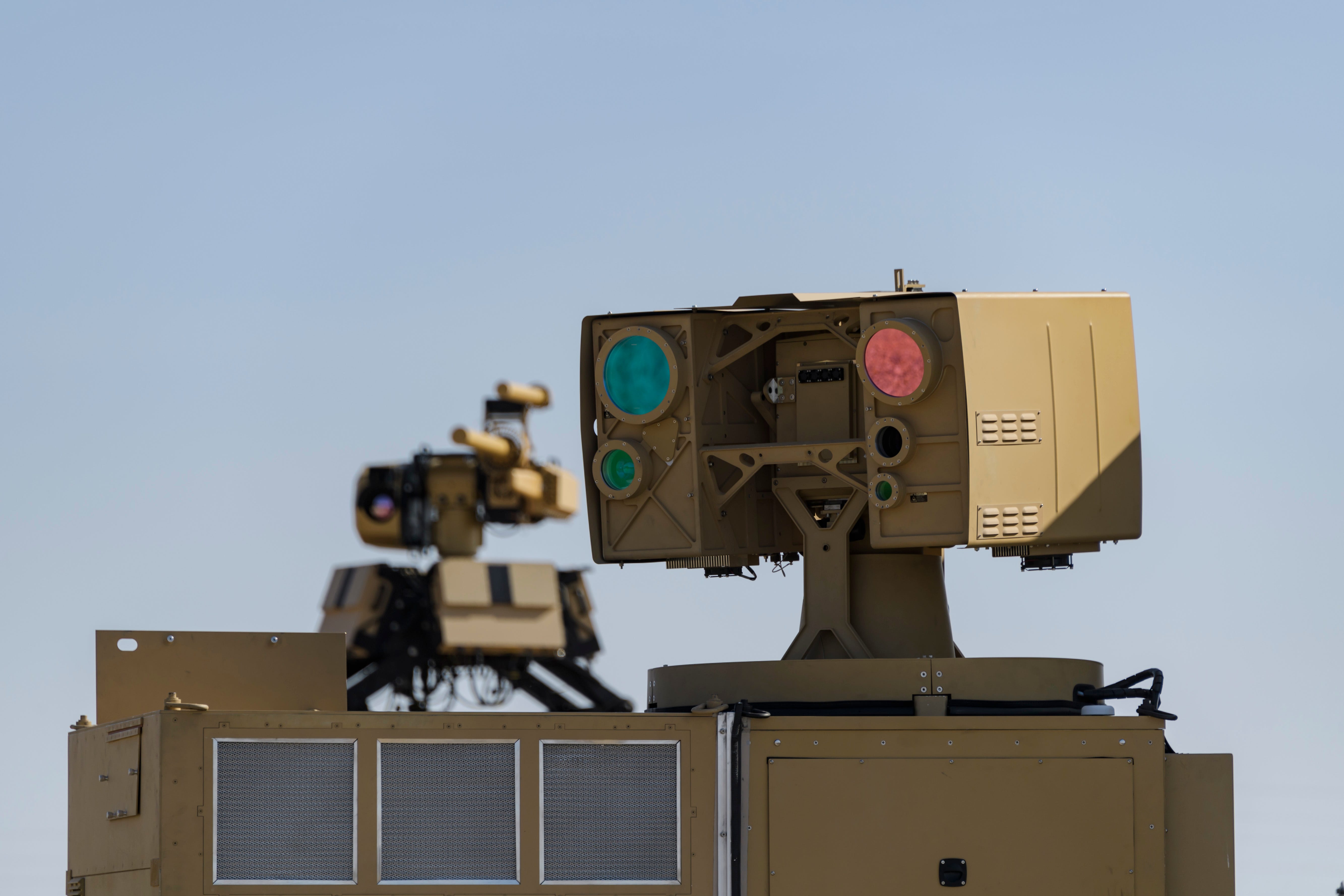
In contrast to AV’s P-HEL, Boeing’s 5 kw CLaWS is on its second life. First procured by the US Marine Corps in 2018 and billed as “the first ground-based laser approved by the Department of Defense for use by warfighters on the ground,” the service quietly returned its five CLaWS units to Boeing, as Laser Wars first in January 2025, with a spokesperson stating at the time that the Corps had decided to “invest in more deliberate programs of record.” Despite this, the US military has continued to experiment with CLaWS in recent years, with the system downing Group 3 drones for the first time during testing in the US Central Command area of operations in October 2024. In June, the US Naval Research Laboratory demonstrated a CLaWS array beaming power wirelessly before switching to counter-drone duty; the next month, the US Air Force disclosed it had sent several units to protect air bases across Europe.
The New Guy: KBR’s Firefly
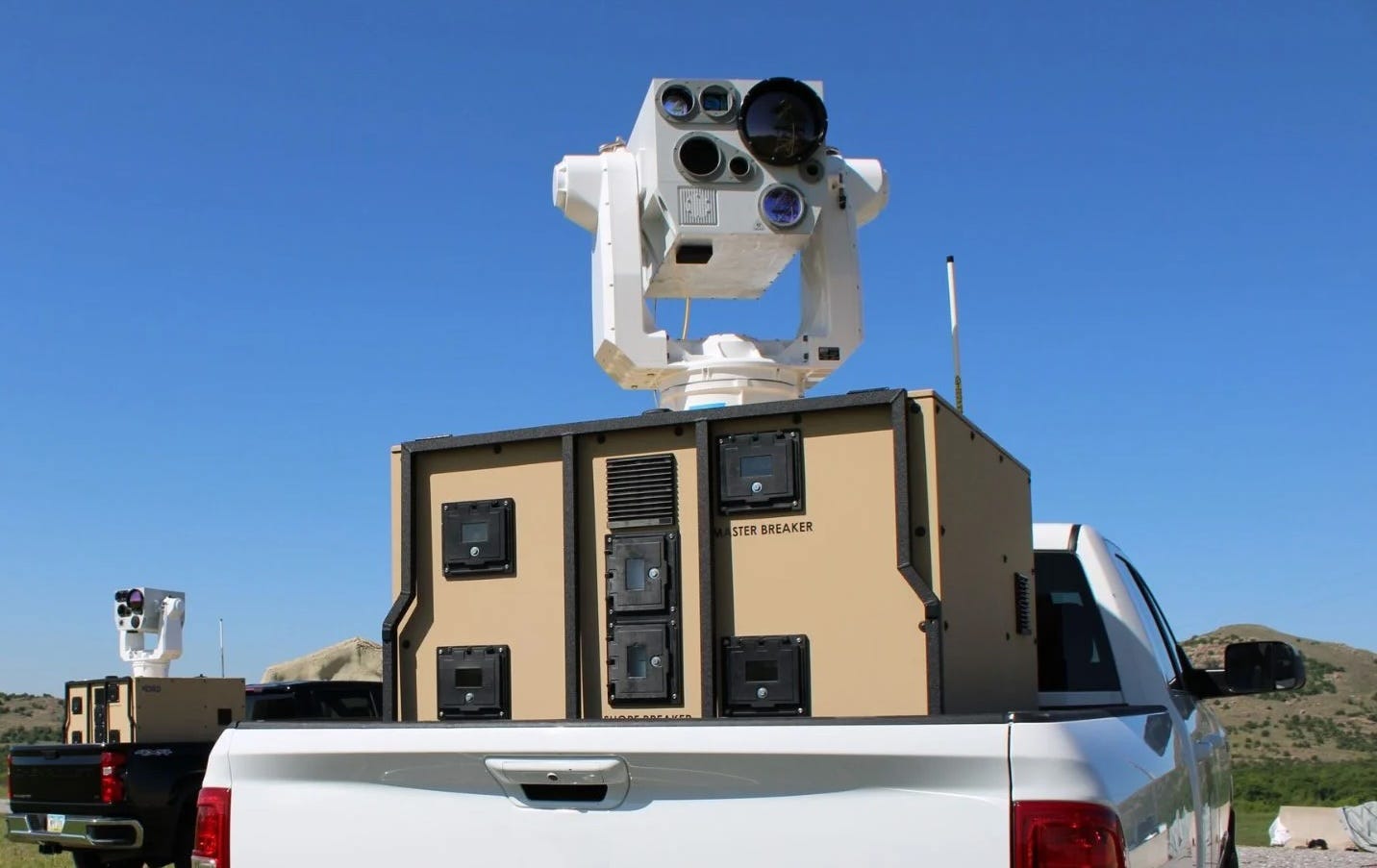
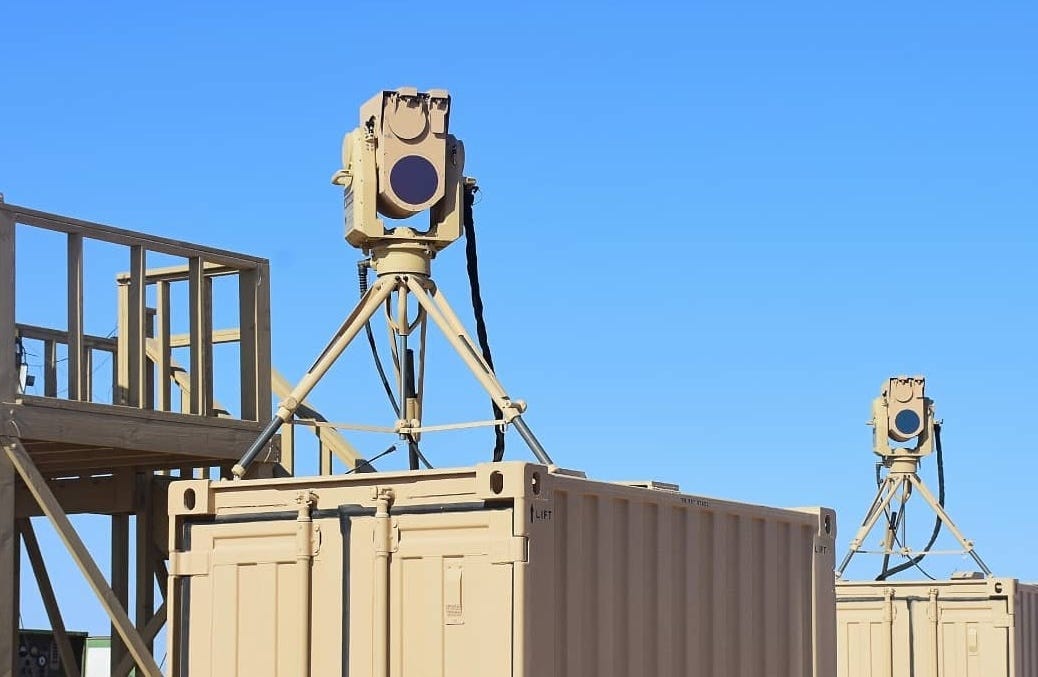
Kord’s Firefly is the least-known name on the list, but the company is no stranger to laser weapons. The company’s KBR subsidiary helped integrate Raytheon’s 50 kw laser onto the Stryker combat vehicle for the Army’s Directed Energy Maneuver-Short Range Air Defense (DE M-SHORAD) effort. As Laser Wars has reported, the service soured on that program after soldiers struggled with the challenges of operating a laser on a vehicle constantly on the move, as then-Army acquisition chief Doug Bush told lawmakers in 2024. Firefly appears built to sidestep those vehicle integration problems entirely: KBR markets it as a palletized system scalable from 5 to 40 kw, which is exactly the fixed-site configuration a base defense mission calls for.
The Other Guy: Epirus’ Leonidas
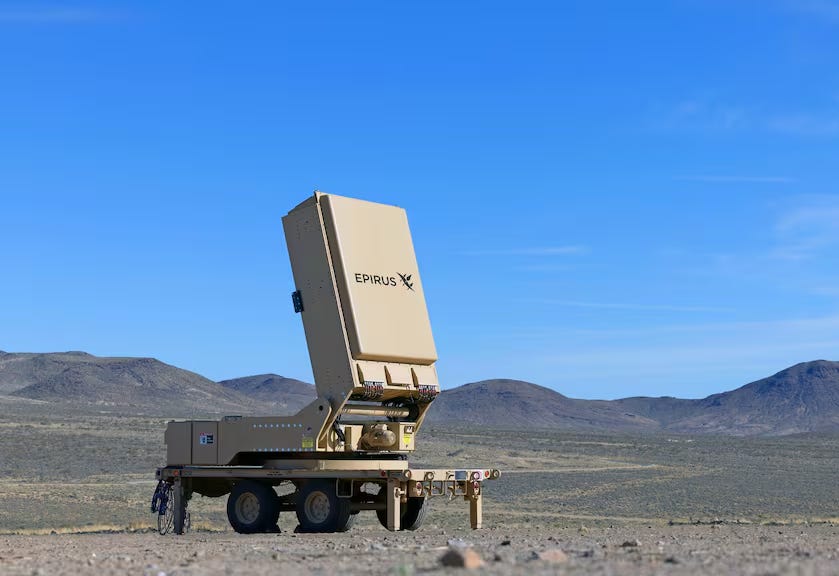
Epirus’ Leonidas is the only high-power microwave weapon in the mix. Designed to fry the electronics of multiple drones at once, the Army awarded Epirus a $66.1 million contract in 2023 for its IFPC-HPM prototypes, and a Leonidas system was among the directed energy weapons demonstrated for Defense Secretary Pete Hegseth during a historic exercise at White Sands in June. While Army officials previously told the Congressional Research Service in April that there were no plans for the additional procurement of Leonidas systems beyond the four prototypes already in the service’s hands, this calculus appears to have changed in recent months.
Beyond the selected systems, there are two other elements that stand out in the new JIATF 401 announcement. The first element is who isn’t mentioned in the initial tranche of directed energy weapons — namely nLight Defense and Lockheed Martin, both of whom were recently awarded contracts to develop laser weapons capable of shooting down cruise missiles under the Pentagon’ s Joint Laser Weapon System (JLWS) program. In May, nLight had unveiled its 70 kw HADES laser weapon system, drawing on lessons from its work on the DE M-SHORAD program, while Lockheed has touted the 3 kw Crossbow laser from IPG Photonics as a key element of its evolving counter-drone architecture. Their absence from the JIATF 401 pilot program suggests the two companies are more focused on the JLWS work — after all, if you can shoot down a missile, you can probably shoot down even the fastest jet-powered drones.
The second element is the timeline. The fiscal year 2026 National Defense Authorization Act, signed into law in December 2025, directed the Pentagon to select and procure laser and microwave counter-drone systems for at least four military installations within 180 days and to have them deployed within one year. The procurement milestone passed in mid-June, nearly four months before the Pentagon publicly named its picks, and the deployment deadline arrives in mid-December — the same month JIATF 401 plans to host a directed energy “shoot-off” at Dugway Proving Ground in Utah to identify “additional” laser and microwave systems to potential field at domestic military installations. It’s also worth noting that the JIATF 401 announcement came just days after Hegseth issued a memo designed to accelerate the deployment of counter-drone systems across the country.
America’s laser dome is gradually taking shape, but Congress has made clear that “gradually” has an expiration date. If the Pentagon makes this deadline, the pilot will put directed energy weapons into continuous, real-world service at domestic bases for the first time ever. But whether or not they work effectively against drones is only half the equation: according to Ross, the ultimate goal of the pilot is to finally pin down the “fully burdened cost” of these weapons, from maintenance and sustainment to system downtime. “If I procure that system and it costs me $6,000,000 and I take one shot a year, you can’t tell me that that shot only costs 8 cents,” as he told reporters in August. This is the real test for AV, Boeing, Kord, and Epirus: shooting down drones on a test range is one thing, but standing ready to do it every day, at a reasonable cost, for a whole year is another.
The Pentagon has picked its directed energy guardians. Now the clock is ticking.

The JIATF 401 pilot does not include Cape Canaveral Space Force Station in Florida, which will soon host “Air Force Research Laboratory-tested” directed energy weapons to protect space launches from drones threats.