


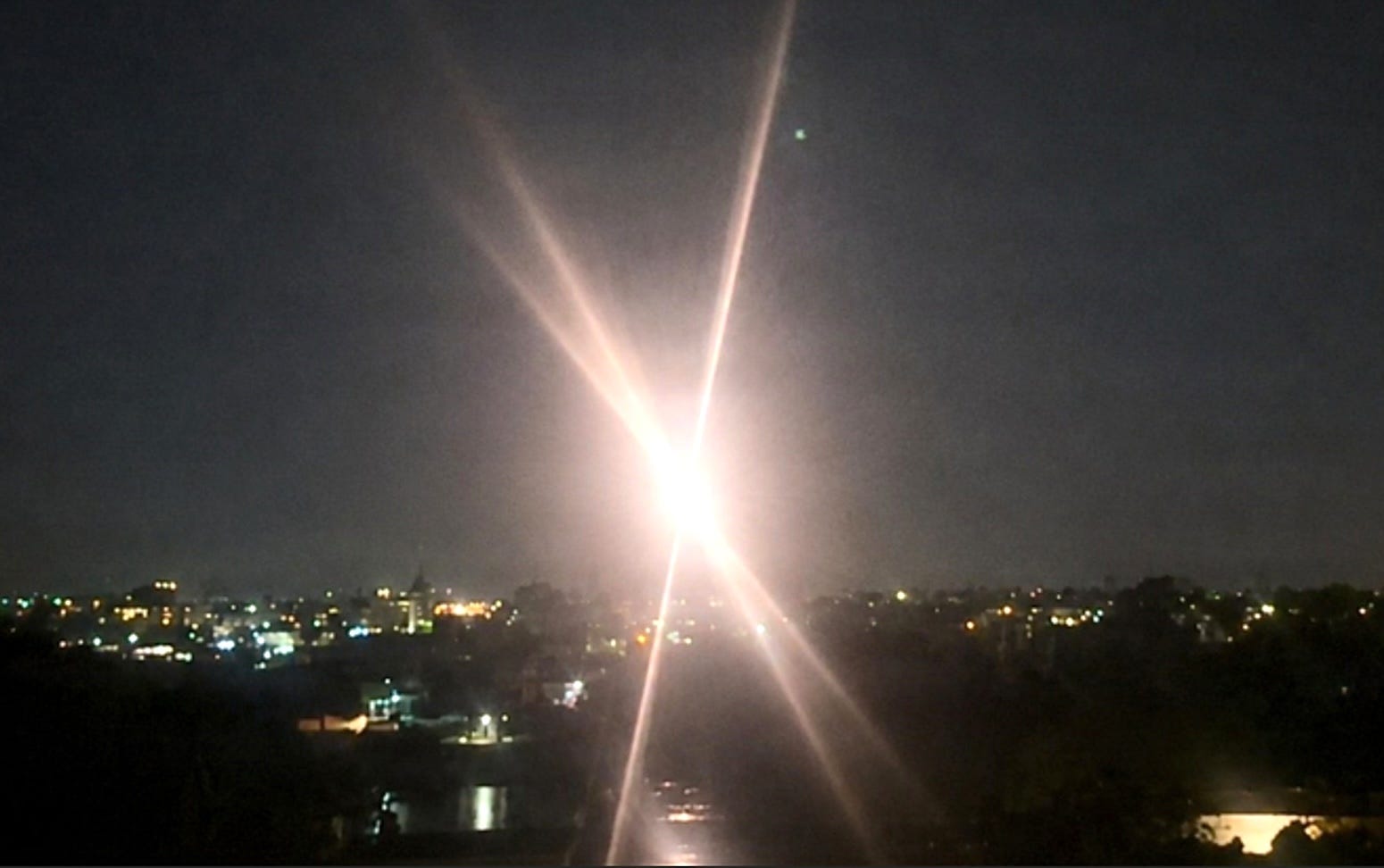
On July 7, 1960, American physicist Theodore Maiman introduced the “light amplification by stimulated emission of radiation,” or “laser,” to the American public for the first time at a press conference in New York City. Although the concept preceded Maiman‘s historic announcement by decades, he was the first to actually generate a coherent beam in a lab, using a cylindrical ruby crystal and xenon flash lamp to create what Albert Einstein once referred to as the “splendid light” of stimulated emission.
As Maiman outlined the new technology’s potential scientific applications, a reporter from the Chicago Tribune interrupted him: “We hear that this laser is going to be a weapon.” Maiman pushed back: any such thing was at least twenty years away. The reporter pressed harder: could Maiman say it would never be a weapon? In his 2000 memoir, The Laser Odyssey, Maiman recalled replying: “I can’t say that, but…”
The headline splashed across the front page of the Los Angeles Herald the next day was burned in Maiman’s mind for decades to come: “LA Man Discovers Science Fiction Death Ray.”
Maiman, who died in 2007, had thought weaponization was twenty years off. In reality, it would take more than six decades, billions of dollars in research and development funding, and dozens of aborted U.S. military programs to actually get there — and now, more than 65 years later, that moment has finally arrived.
In the evening hours between August 25 and 26, US Army soldiers deployed to Texas in support of US Customs and Border Protection (CBP) personnel at the US border with Mexico used an Army Multi-Purpose High-Energy Laser (AMP-HEL) system — based on the 20 kilowatt LOCUST Laser Weapon System from defense contractor AV and deployed to the region since at least July 2025 — to engage and defeat a trio of drones Rio Grande Valley, Joint Task Force - Southern Border (JTF-SB) announced on August 27. The drones were linked to Mexican drug cartels and posed a “physical threat” to military and law enforcement personnel operating in the region, according to JTF-SB.
The shootdowns mark the US military’s first known “kills” on actual adversary drones in a real-world operational environment — at least, the first officials have publicly announced. While I previously reported in 2024 that the US Army had deployed LOCUST-based Palletized High Energy Laser (P-HEL) systems to an undisclosed location overseas (likely the US Central Command area of operations), defense officials never definitively confirmed if those systems had achieved confirmed kills on adversary drones.
“Cartel networks are increasingly employing unmanned aircraft systems to facilitate illicit human-smuggling and actively spy on our personnel and law enforcement partners,” JTF-SB commander Maj. Gen. Curtis Taylor said in a statement. “By integrating layered countermeasures alongside advanced directed-energy capabilities like this laser system, we have made it clear that we will not tolerate hostile surveillance.”
The successful engagement puts the US in rarefied company. The only other country with a publicly verified combat laser kill is Israel, which in May 2025 released footage showing its Iron Beam system reportedly downing several Hezbollah-launched drones over Lebanon during the Israeli Defense Forces’ October 2024 invasion. There have been scattered other claims of laser kills from Russia, Ukraine, and elsewhere in recent years, but none of them have been independently confirmed.
The Rio Grande shootdowns came months after back-to-back high-profile laser incidents in Texas in February, where CBP personnel used an AMP-HEL system to target a cluster of party balloons near Fort Bliss and Army soldiers accidentally downed a CBP drone in a bizarre friendly-fire incident near Fort Hancock. The Federal Aviation Administration (FAA) responded to both engagements by closing the surrounding airspace out of concern for civilian air traffic due to the lack of coordination and communication between state and federal agencies.
No such airspace closure appears to have accompanied the Rio Grande shootdowns. Two months after the February incidents, the FAA and US Defense Department reached a “landmark safety agreement” paving the way for the domestic use of laser weapons to counter cartel drones on the US-Mexico border, stating that such systems “do not pose undue risk to passenger aircraft,” the agency announced in April. A month later, the Pentagon announced five US military bases to host directed energy weapons as part of a pilot program focused on bolstering domestic counter-drone capabilities.
This is the secondary significance of the US military’s milestone laser weapon kill: not only has the Pentagon successfully neutralized a hostile drone over American soil, but the lack of a major airspace closure suggests that the US government has, at least to some extent, overcome some of the jurisdictional challenges and operational ambiguity that yielded the interagency chaos that defined the February shootdowns. Using a laser weapon to fry a drone at the speed of light is one thing, but accelerating the decision-making that governs when you can actually pull the trigger is another thing entirely.
More than six decades after that Chicago Tribune reporter cornered Maiman about death rays, the US military’s AMP-HEL operations are an undeniable signal that laser weapons have finally matured into real-world capabilities. With AV’s LOCUST almost certainly set to become the Army’s laser weapon of choice under the service’s Enduring High Energy Laser (E-HEL) program, the Pentagon and other national security agencies are slowly but surely marching towards the ultimate goal of fielding directed energy weapons at scale to counter the rising drone threat. The Rio Grande shootdowns may be the first known laser kills in US military history, but as long as hostile drones continue to violate American airspace, they won’t be the last.
