
Here Comes the Lasercopter
The Israeli military wants to integrate a high-energy laser weapon with an attack helicopter.


If the AH-64 Apache attack helicopter is generally considered an absolute death machine bristling with machine guns and missiles, then only one thing could make it even more fearsome: a high-energy laser weapon.
Defense contractor Elbit Systems revealed on March 17 that the company had secured a contract from the Israel Ministry of Defense in 2025 for not only an airborne version of the combat-proven 100 kilowatt ‘Iron Beam’ laser weapon for fixed-wing aircraft, but a separate system designed for helicopters as well.
While Elbit didn’t identify which aircraft are under consideration to host these notional laser weapons, CEO Bezhalel Machlis told Israeli business outlet Calcalist that the systems would end up outfitting “fighter jets and combat helicopters,” indicating a likely focus on the Israeli Air Force’s growing Apache fleet rather than, say, its UH-60 Black Hawk or CH-53 Sea Stallion squadrons.
Israel isn’t the first country to actively explore the development of a laser-equipped helicopter. In June 2017, a US Army Apache outfitted with a specialized Raytheon laser weapon pod successfully engaged targets during testing at White Sands Missile Range in New Mexico, the first publicly known helicopter-based firing of a high-energy laser in history.
Initiated in 2015 under a Cooperative Research and Development Agreement (CRADA) between US Special Operations Command and Raytheon, the “Laser Apache” initiative was designed to “explore the effects of rotor wash on laser weapon systems,” a SOCOM spokesperson told Laser Wars in an email.
“There is absolutely a niche I believe for [the] use of directed energy weapons,” then-SOCOM rotary wing project manager Army Col. John Vannoy told reporters in May 2016. “The lens we are looking at this through right now is: ‘Is it feasible to do this?’ We’re not at the point where we’ve laid out a business case to advance it … We really want to understand the environment on the wing, the beam quality we can get off the wing, and the ability to beam steer and keep power on a target.”
The ultimate goal of the initiative was to determine if directed energy could provide an inexpensive alternative to conventional munitions against certain targets, according to Vannoy.
“The vision is not destroying tanks with lasers,” he said. “If you imagine the timeframe for expending light energy against softer targets, whatever that may be – I’m not discussing units here; I’m talking about vehicles, maybe generators, those kinds of structures – vice sending a missile, which can be very costly, maybe $150,000, you just start devising … a business case.”
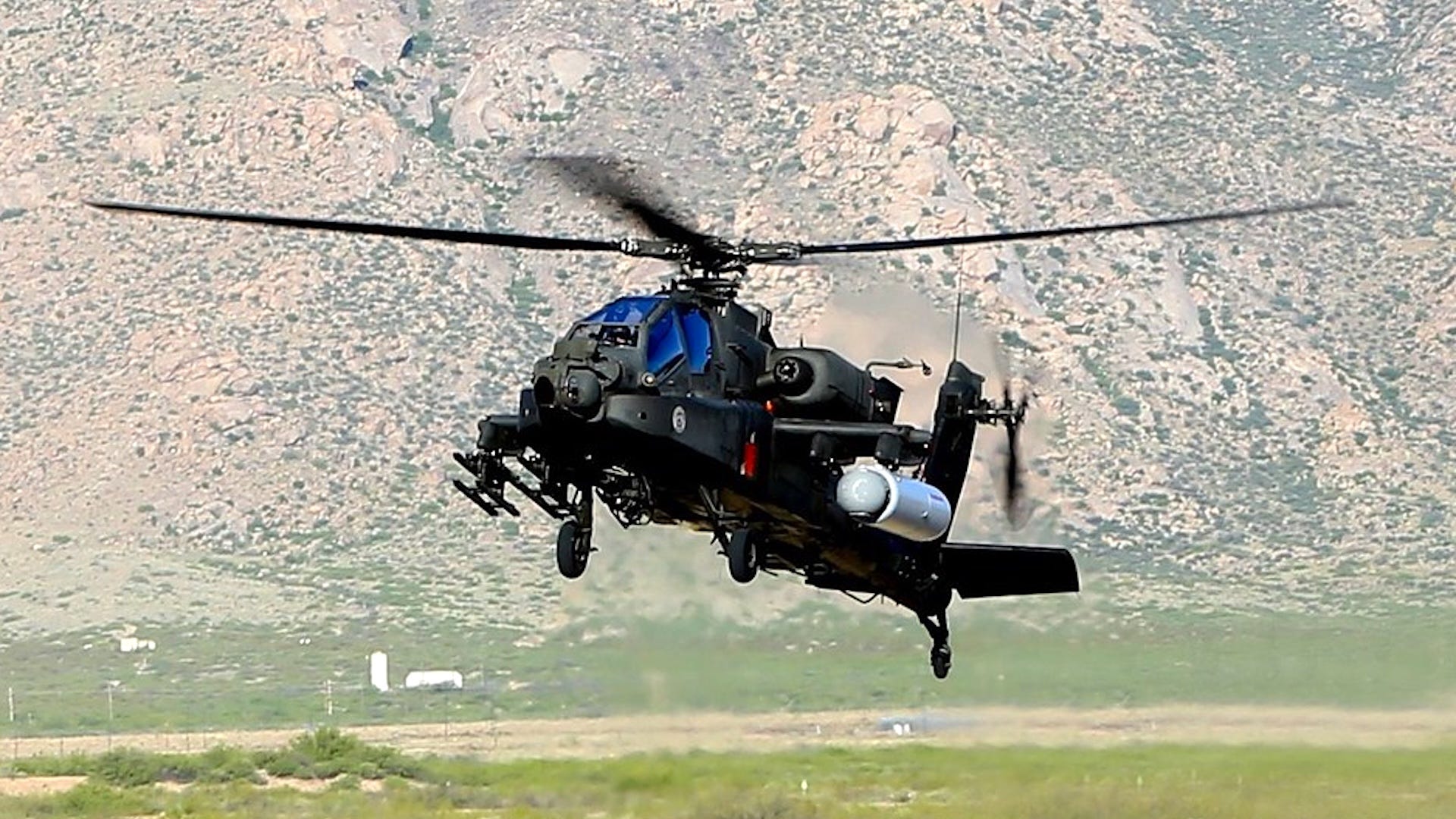
The 2017 test at White Sands “achieved all primary and secondary goals, providing solid experimental evidence for the feasibility of high resolution, multi-band targeting sensor performance and beam propagation supportive of High Energy Laser capability for the rotary-wing attack mission,” Raytheon said in a statement at the time. “The design of future HEL systems will be shaped by the data collected on the impact of vibration, dust and rotor downwash on HEL beam control and steering.”
But it appears the results weren’t promising enough for the US Defense Department to pursue further development of the Laser Apache: the CRADA concluded in 2017, the SOCOM spokesperson said, and neither the Pentagon or Raytheon have publicly mentioned the project since. (When reached by Laser Wars, a Raytheon spokesperson was unable to provide details regarding the fate of the laser weapon pod.)
All of this leads me to wonder: Is strapping a laser weapon to stub wing of an attack helicopter actually a good idea?
On paper, Laser Apache’s appeal is obvious: a laser-equipped attack helicopter could potentially engage both aerial and ground targets with a virtually unlimited magazine and minimal cost per shot. Against drones, light vehicles, or exposed equipment, this combination offers a compelling alternative to AGM-114 Hellfire missiles or 30mm cannon fire, especially in scenarios where resupply is constrained or collateral damage is a concern.
In practice, helicopters may prove one of the most challenging platforms imaginable for laser weapons. Unlike ground vehicles or warships, which can draw on relatively stable platforms and significant onboard power, rotary-wing aircraft are defined by constant vibration, limited power margins, and complex airflow generated by rotor wash, not to mention the atmospheric turbulence associated with high-speed aerial operations. These factors can drastically degrade beam quality, complicate targeting, and reduce effective range, all while competing with other critical systems for power and thermal management capacity. This is likely why SOCOM and Raytheon didn’t pursue the Laser Apache further: they quickly discovered the very conditions that make helicopters so effective in combat may also make them uniquely hostile to laser weapon performance.
This doesn’t mean the concept is doomed, but it does suggest that Elbit has some serious physics challenges ahead for making their notional system work under real-world conditions. If the company does manage to succeed, however, then the venerable Apache may eventually count laser weapons as part of its arsenal — and that’s objectively metal as hell.

⚡️Pulse
Updates from around the directed energy ecosystem
Inside a ‘first of its kind’ counter-drone laser test in the American desert: My former Military.com colleague Drew Lawrence, now reporting for DefenseScoop, has details from the US military’s March 11 test of the Army Multi-Purpose High Energy Laser (AMP-HEL) system at White Sands. The test was primarily undertaken to reassure the Federal Aviation Administration that the domestic use of AMP-HEL, which shut down airspace in Texas twice in February, poses no real threat to commercial air traffic. From the article:
[Joint Interagency Task Force 401 deputy director Army Col. Scott McLellan] said the evaluation involved “localized” firing of the AMP-HEL from various distances at the fuselage of a Boeing 767 airliner that testers lugged on to White Sands to assess the system’s damaging effects, “or lack thereof” on aircraft material. He said it aimed to “disprove some myths” about the capability, noting “that energy clearly dissipates over time and space and doesn’t have the effect everyone thinks it does as far as lasers are concerned.”
A JIATF 401 spokesperson said the laser was fired at its “maximum effective range for up to 8 seconds” at the grounded fuselage, “demonstrating that even at full intensity, the laser caused no structural damage to the aircraft.”
Read Drew’s entire story at Defense Scoop here and watch newly released footage of the AMP-HEL system downing multiple drones during the test below:
RIP DE M-SHORAD: The Pentagon’s annual assessment of weapons systems for fiscal year 2025 from the Director, Operational Test & Evaluation, published on March 16, confirms that the Army is “no longer pursuing” the 50 kilowatt Styker-mounted Directed Energy Maneuver-Short Range Air Defense (DE M-SHORAD) system as its chief laser weapon. The service will instead apply lessons learned to its nascent Enduring High Energy Laser (E-HEL) initiative, which is “expected” to eventually become the service’s first program of record.
Laser rifles on guard aboard the USS Nimitz: A new photo published to the Pentagons’ Defense Visual Information Distribution System (DVIDS) shows a US sailor standing watch with a LA-9/P laser dazzler on the catwalk of the US Navy aircraft carrier USS Nimitz in San Diego on March 10 — which, given the rise of drone warfare and the specter of a potential domestic strike looming over critical infrastructure and capital assets, makes total sense:

A sailor stands watch with a LA-9/P laser dazzler aboard the aircraft carrier USS Nimitz in San Diego, March 10, 2026. (US Navy photo)