Marines in Iraq Once Requested an Airborne Laser Weapon to Torch Insurgents and Terrify Onlookers
Pentagon whistleblower Franz Gayl reflects on his vivid 2006 request for an flying laser capable of “instantaneous burst-combustion of insurgent clothing [and] a rapid death through violent trauma."

At the height of the Iraq War, the US Marine Corps made an unusual request: American troops desperately needed an airborne high-energy laser weapon to set insurgents ablaze from miles away.
In a December 2006 Urgent Universal Need Statement (UUNS) on behalf of the I Marine Expeditionary Force deployed to Iraq as part of Multi-National Force West (MNF-W), then-senior civilian science advisor (and former Marine) Franz Gayl detailed an “urgent operational need” for an airborne laser weapon platform capable of “destructively engaging” both unmanned aerial vehicles and ground targets during urban operations.
Dubbed the Precision Airborne Standoff Directed Energy Weapon (PASDEW), the notional system would destroy its targets quietly, invisibly, and, importantly, with minimal collateral damage even when operated in “in immediate proximity to innocents.”
The problem PASDEW was meant to solve was not raw firepower, but optics: how to kill insurgents embedded in cities, crowds, and protected structures without triggering civilian casualties or strategic blowback.
“While the [rules of engagement] allow such [coalition forces] kinetic self-defense, collateral injury and damage can often impede local and theater Information Operations (IO) and Public Affairs (PA) campaigns, political-military objectives, and social-economic recovery/restoration goals,” Gayl wrote in his request at the time. “In fact, collateral damage from defensive return fire is in many cases the primary objective of terrorists and insurgents when they decide to engage CF in the [area of operations].”
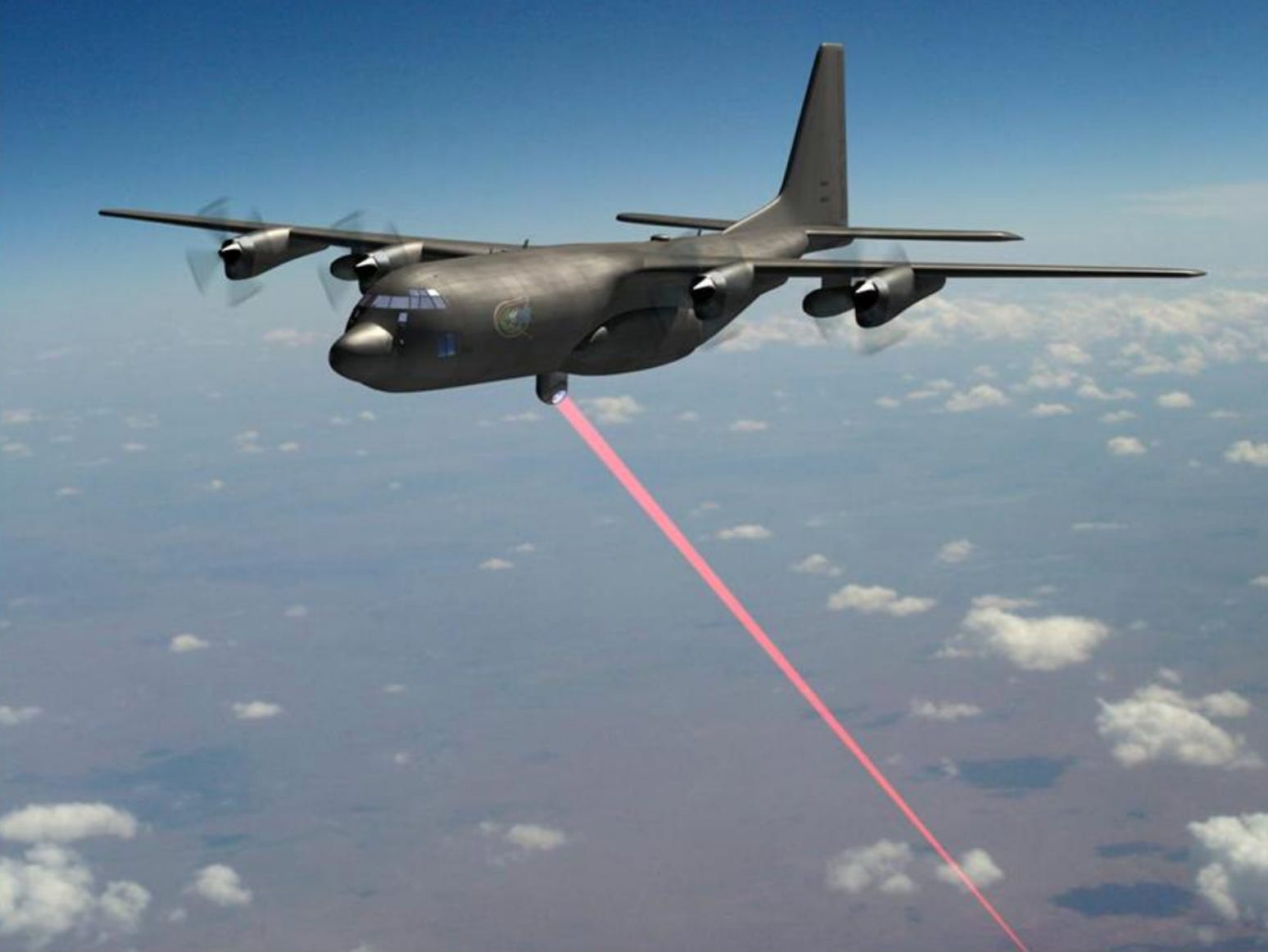
The logic of PASDEW was simple. As Gayl wrote, the US military’s fleet of AC-130s, AH-1W Super Cobra helicopters, and A-10 Thunderbolt II attack aircraft had proven essential air support assets since the 2003 US-led invasion — why not swap out their destructive guns and missions for the “scalable, controlled, precision lethality” of a high-energy laser beam that can melt steel and ignite clothing from miles away?
“It was something you could actually discriminate between innocents and insurgents, no matter how close in proximity they were to each other,” Gayl told Laser Wars in an interview. “You could engage people in all sorts of crazy places.”

The PASDEW solution Gayl envisioned in his request consisted of an AC-130 gunship equipped with a 100 kilowatt laser weapon derived from the Advanced Tactical Laser (ATL), the experimental chemical-based airborne laser weapon system that US Special Operations Command and the US Air Force’s 46th Test Wing, in partnership with defense prime Boeing, were developing at the time through an Advanced Concept Technology Demonstration (ACTD).
“We wanted to accelerate the process of getting a directed energy weapon that had utility onto an aircraft,” Gayl said. “That’s what the ATL’s ACTD was approved for.”

If successful, Gayl wrote, PASDEW could eventually proliferate to smaller aircraft like future combat drones and the new MV-22B Osprey as part of the service’s Gunship Advanced Combined Arms Weapon Suite (GACAWS) initiative, which, launched in response to previous UUNS he had authored in May 2002, sought to integrate both conventional and directed energy weapons into a unified strike package adaptable across the service’s fleet of airborne platforms.
“Our position was that you had to have a complementary kinetic weapon that, at least for part of the range, complemented the laser,” he said of the GACAWS concept. “You can’t depend on one or the other … we emphasized a combined arms approach.”

But Gayl wasn’t just asking for precision lethality — he was also explicitly arguing for sheer terror. From the UUNS:
In an anti-personnel mode, [directed energy weapons] can be compared to long range blow torches or precision flame throwers, with corresponding psychological advantages for CF. A precision engagement of a [positively identified] insurgent by a DEW will be a highly surgical and impressively violent event. Target effects will include instantaneous burst-combustion of insurgent clothing, a rapid death through violent trauma, and more probably a morbid combination of both. It is estimated that the aftermath of a sub-second engagement by PASDEW will also be an observable event leaving an impression of terrifyingly precise CF attribution in the minds of all witnesses.”
The PASDEW capability will give CF an asymmetric psychological edge over the insurgency. It is a lethal capability they cannot readily counter and will not fully comprehend, particularly as the DEW is invisible to the unaided eye and the aircraft can engage from significant stand off. For all witnesses, it will be perceived that overt insurgency participation in the MNF-W AOR is less attractive due to the terrifying potential consequences.
When asked about the colorful language of his request, Gayl told Laser Wars that he “liked to write documents and make them as visual and precise” as he could so Marine Corps leaders could effectively envision the practical applications of a novel system.
“Insurgents were psychologically adaptive to gunfights the same way our soldiers and Marines are,” he said. “But to suddenly be engaged by an invisible beam that nobody sees … if you could get that pinpoint accuracy, that’s a terrifying weapon. And the psychological effects of a weapon that’s silent, whose source is not known … holy cow.”
Gayl’s request called for the development of four PASDEW systems. The request was ultimately approved by the I MEF’s Deputy Commanding General (Operations) Brig. Gen. Robert Neller, who would go on to serve as the 37th Commandant of the Marine Corps from 2015 to 2019.
But PASDEW never saw the light of day. The Air Force would end up abandoning the ATL project that was supposed to serve as PASDEW’s technological basis after the service deemed the system “not viable” for military operations. Subsequent attempts at mounting laser weapons on AC-130 gunships yielded similarly disappointing results. Indeed, Gayl’s vivid UUNS for the capability likely would have remained buried inside the US Defense Department had Wired not published a leaked copy of the document in December 2007 highlighting the “violent trauma” language.
The Wired story, though alarming to some defense observers, garnered zero blowback from within the Pentagon, Gayl recalled. In fact, the department’s primary response was for the Naval Criminal Investigation Service (NCIS) to open an investigation in 2012 into the unauthorized release of the document, which was marked “For Official Use Only” (FOUO) at the time, and how Wired obtained it.
The real obstacle to PASDEW was that the concept “didn’t have enough champions” in the Pentagon to push its development forward, Gayl said.
“We didn’t have a funded program yet, and we had a lot of laser programs at [the Air Force Research Lab in] Albuquerque, which meant that starting a new program would require reprogramming funds,” he said. “The system had a great advocate in Boeing, of course, but it didn’t have champions.”
Gayl’s life had changed dramatically by the time the NCIS began investigating how the UUNS ended up in Wired’s hands. Within a year of authoring the PASDEW request, he became one of the most consequential internal critics of the US military’s approach to the Iraq War, documenting how the Pentagon’s delays in fielding Mine Resistant Ambush Protected (MRAP) vehicles and non-lethal laser dazzlers were leading to the unnecessary deaths of both American troops and Iraqi civilians and relentlessly pushing Marine Corps leaders to rapidly deploy these new capabilities. When his internal warnings failed, Gayl went outside the chain of command, briefing lawmakers and speaking to reporters in 2007 on the MRAP fielding delays. The result was a surge of MRAPs into Iraq and the effective end of his career, albeit temporarily. A 2008 US Defense Department Inspector General report would later substantiate Gayl’s claims that the Corps had delayed MRAP deliveries and he was eventually reinstated in his job in 2014.
Gayl is now fully retired from government service, but not entirely by choice. In 2021, he authored a pair of op-eds in the Global Times, a Chinese state-run publication, arguing against the US government’s current policy towards Taiwan – namely that that US was poised to “sleepwalk” into an unnecessary conflict with China over what amounted to an internal matter between Beijing and Taiwan’s democratically-elected leadership, who he dubbed “renegade secessionists” in one article. While subsequent IG and NCIS investigations determined that he hadn’t shared any classified information with Global Times, the Pentagon was “very upset’ that he didn’t get pre-approval for publication.
“Taiwan got me to finally retire early,” Gayl said. “They were right [about pre-approval], but it was an issue that was urgent enough that I knew it would not have been approved. Nobody else would publish me. So they sent me home and took my clearance, and I knew I wasn’t going to get it back, just like the MRAP situation.”
Gayl’s PASDEW request remains a fascinating artifact of the Iraq War, a rare moment of institutional candor when the US military openly articulated the limits of kinetic force in urban war and seriously entertained high-tech horror as a deliberate battlefield effect. Today’s military laser weapons are framed primarily as defensive systems rather than instruments of anti-personnel warfare — drone killers, missile shields, and, when it comes to ground attack, tools to disable enemy vehicles or mission-critical infrastructure. But PASDEW is a reminder that one of the first serious visions for battlefield laser weapons were not about protection, but visceral destruction and terror.
“We saw that these were inevitable developments,” Gayl said of Pentagon laser weapon research at the time. “We knew that as soon as these were mature, they’re going to be packaged as weapons and used, and the utility is undeniable.”
“These are not pleasant weapons in combat, especially when they’re used as anti-personnel weapons,” he added. “But we all felt it was inevitable, and so it is.”
Read Gayl’s full UUNS below:


Fascinatin dive into precision lethality vs kinetic overkill. The bit about creating repeatable terror through invisible engagement is wild but kind of reveals how optics-aware counter-insurgency really got. I've seen siimilar logic in directed energy white papers since, but nothing quite spelled out the psychological endgame like Gayl did here.
The insurgents cleared a hangfire mortar round once by dropping another round in the tube
Having the effect desired in the request
Crispy critters lol and we did