


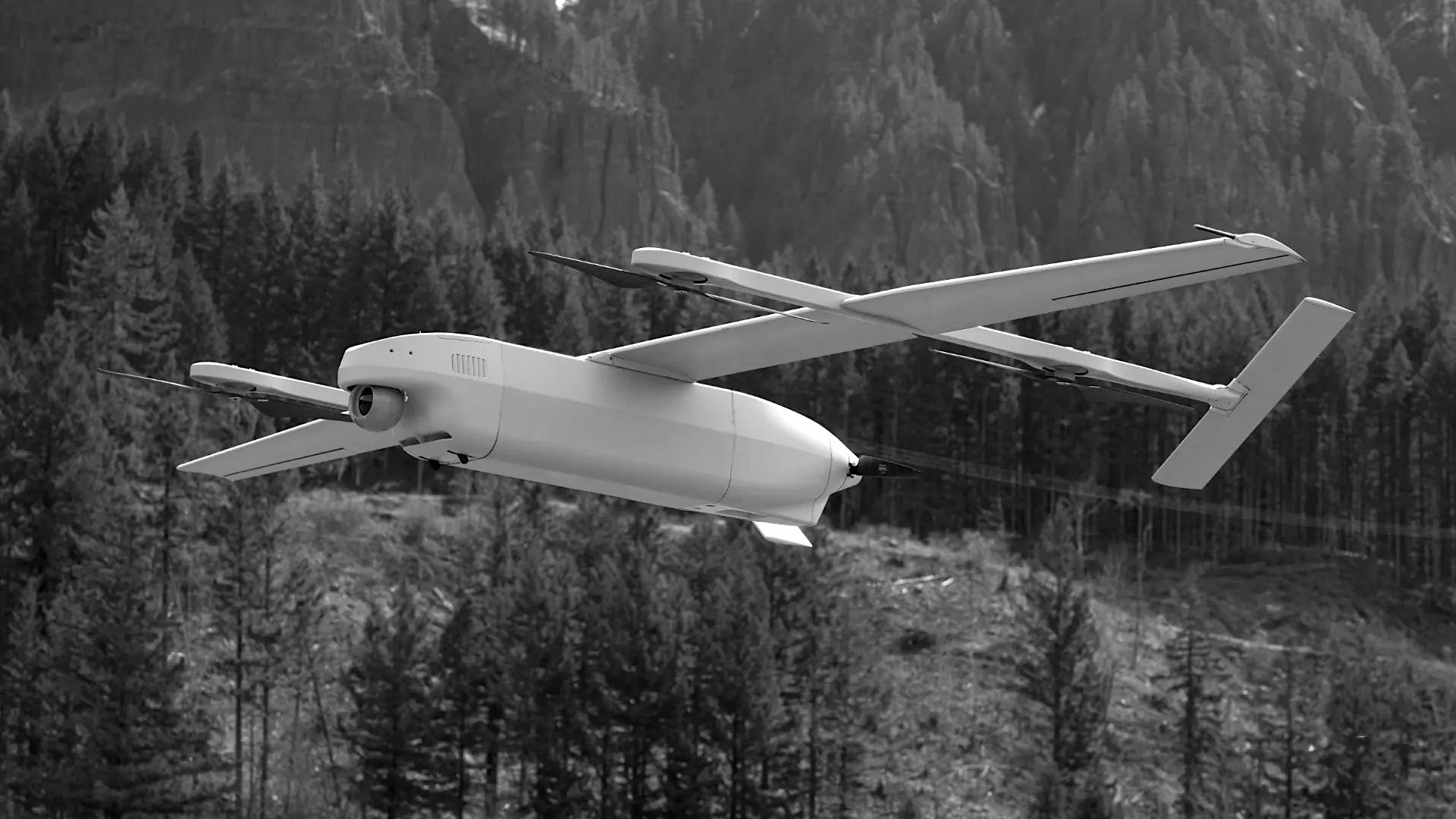
On a modern battlefield defined by the ever-expanding “affordable mass” of cheap, disposable drones, Ben Levinson wants to build something that lasts.
Levinson is the founder and CEO of Heven AeroTech, the Virginia-based maker of hydrogen-powered drones for long-endurance operations. In a recent interview with Laser Wars, he described the company’s approach to drones as “a pickup truck mindset,” focused on reusable “mothership” platforms capable of stealthily hauling mission-specific payloads at extended ranges with minimal noise and thermal signature thanks to unique hydrogen fuel cells. And that, he claims, may prove an ideal platform for the airborne high-energy laser weapons that the US Defense Department has pursued for decades.
“We’re not in the laser space,” Levinson said. “But we actually are a platform for lasers.”
Levinson traces Heven’s roots to his service as an infantry combat commander in the Israel Defense Forces in 2018 during a period of airborne arson attacks involving hundreds of incendiary balloons and kites launched from Gaza into Israel. Levinson volunteered to build a drone outfitted with a thermal camera to track down nascent fires and alert Israeli firefighters with GPS coordinates; his second model was designed to extinguish blazes with a chemical solution. Recognizing that standard small camera drones offered limited utility, Levinson founded Heven in August 2019 to focus on heavy-lift capabilities.
“The skies are open,” Levinson said. “Compared to any ground, compared to our streets, our forests, our parks, and our battlefields, it’s just open. I had this deep conviction that drones would power the world. What I also realized is that as long as drones are small flying cameras, it would be very limiting — you can’t do much with that information. So drones have to be more like flying robots.”
While Heven initially pursued short-range heavy-lift drones, Levinson quickly discovered that long-endurance missions suffered from an “energy gap”: existing power solutions simply don’t offer the energy density for prolonged operations, Levinson says, and traditional solutions like noisy combustion or jet power systems are a non-starter for both defense and commercial applications. Levinson pointed to the depletion of the US military’s MQ-9 Reaper drone fleet in the war with Iran and regional proxies as a prime example of the need for low-signature capabilities.
The solution, Levinson found, lies in hydrogen fuel cells. “It’s basically an electric drone, but we’re creating electricity in the sky by having a small amount of hydrogen, less than one pound, in a highly pressurized tank that goes to a fuel cell,” he said. “There’s no combustion. There’s no noise. There’s no thermal signature. We’re getting 10, 13, 15 hours of flight time and 100, 300, 500 kilometers of distance.”
Heven’s flagship Z1 is the first (and currently only) Blue UAS Select-certified hydrogen-powered system of its kind in the Pentagon’s arsenal, and the company announced a $100 million Series B raise at a $1 billion valuation in December 2025 to invest in capabilities to meet “escalating demand from US Special Operations Command, combatant commands, and allied forces.”
“We want to make the best drones as platforms in the world in terms of capacity to fly stealth with significant payloads, net distance, etc.,” Levinson said.

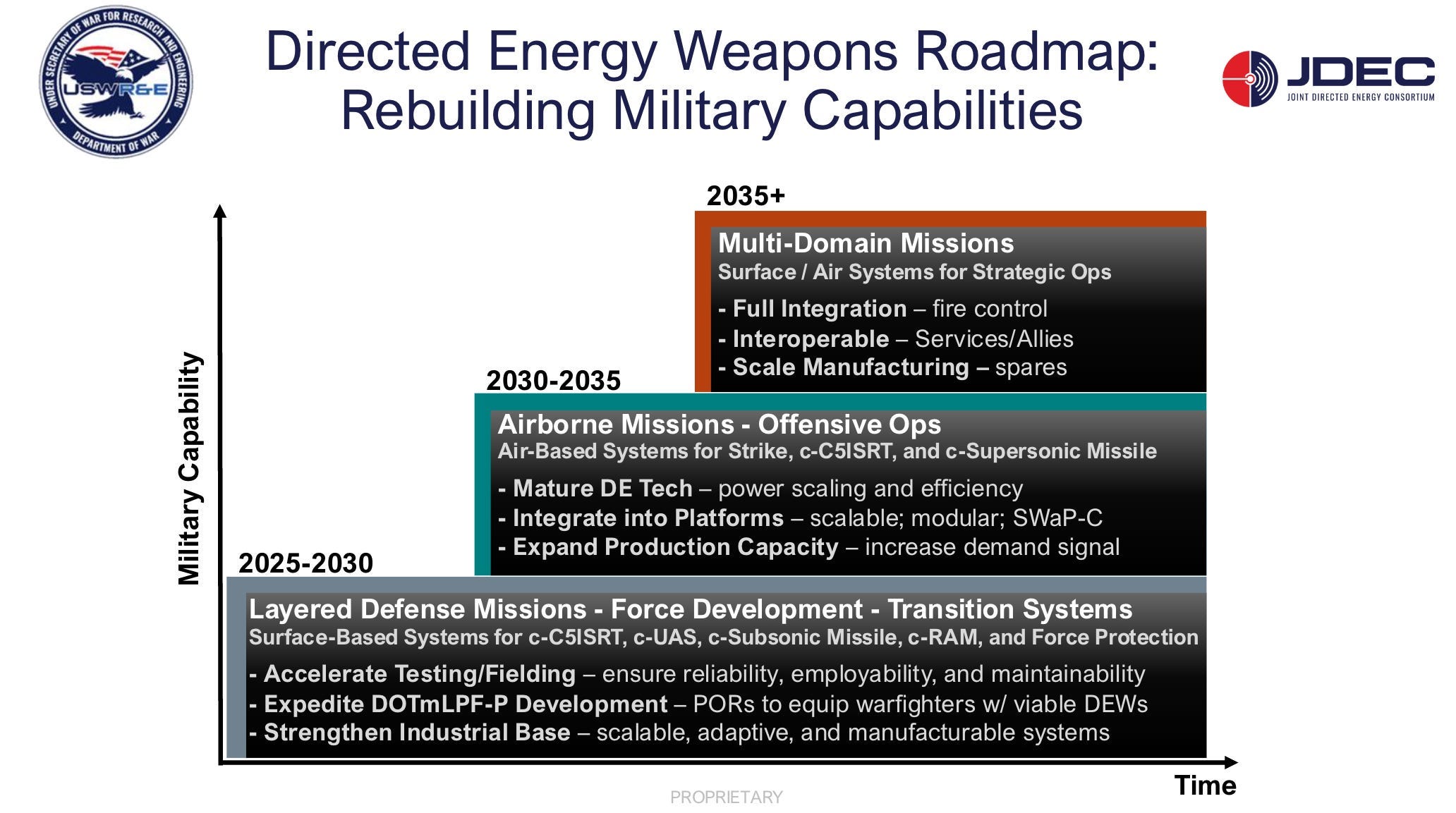
Heven’s mothership approach may have arrived at the perfect time for the Pentagon’s next airborne last weapons push. As Laser Wars previously reported, the US Air Force plans on developing a new “laser system technology demonstrator” for airborne testing starting in fiscal year 2027 following the disappointing conclusion of the service’s Self-Protect High-Energy Laser Demonstrator (SHiELD) project, which sought to mount a laser weapon pod on a fighter jet to counter incoming missiles, and the Airborne High Energy Laser (AHEL), which Air Force Special Operations Command sought to install aboard an AC-130J Ghostrider gunship. In April, US Missile Defense Agency director Air Force Lt. Gen. Heath Collins stated that the organization was “all in” on “bringing potentially game-changing directed energy capabilities to bear in an unmanned platform” for domestic air defense against hostile drones and missiles. And the most recent Pentagon directed energy roadmap shared by the department’s Scaled Directed Energy (SCADE) team during a Joint Directed Energy Consortium webinar in September envisions a major push for airborne laser platforms starting in 2030.
While most past airborne laser weapon efforts have focused on larger manned platforms, Pentagon has pursued drone-mounted systems in particular for more than two decades with minimal success. The High Energy Liquid Laser Area Defense System (HELLADS) effort, initiated in 2003 by the Defense Advanced Research Projects Agency, sought to develop a 150 kilowatt system to integrate into both manned and unmanned aircraft before grinding to a halt in 2015. The MDA pursued outfitting drones with laser weapons for ballistic missile defense for more than a decade through its Low Power Laser Demonstrator (LPLD) initiative before then-Undersecretary of Defense for Research and Engineering Michael Griffin threw cold water on the project in 2020, citing the unique technical and environmental challenges inherent to mounting lasers on aircraft.
“I think it can be done as an experiment, but as a weapon system to equip an airplane with the kinds of lasers we think necessary — in terms of their power level, and all their support requirements, getting the airplane to altitudes where atmospheric turbulence can be mitigated appropriately — that combination of things doesn’t go on one platform,” Griffin told reporters in May 2020, per Breaking Defense. “So, I’m just extremely skeptical of that.”

Levinson’s interest in laser weapons is, like many military planners and defense contractors, primarily focused on magazine depth. He described a scenario in which an adversary launches a mass drone attack (say, 10,000 drones against a US aircraft carrier) and argued that no existing kinetic air defense system can keep pace: shoot down 2,000 drones, and the remaining 8,000 “could be as stupid as possible, but they’ll just go through, because you have no more munitions.” A laser weapon, by contrast, only needs power to keep firing. “I think lasers are a big part of the solution,” he said.
When asked about the power requirements for airborne lasers weapons and associated challenges that Griffin described in 2020, Levinson responded that the company’s Z1’s 1.2 kw hydrogen fuel cell “provides for a lot of onboard power for payloads and devices not associated with simply keeping the aircraft flying.”
“That’s one of the other nice things about fuel cells: they can sustain higher power output for much longer than batteries,” he added. “For larger operational requirements, [Heven’s] Raider is expected to have 9 kw of onboard power output from its fuel cells. We’re continually developing fuel cell technologies to provide higher power output, more efficiency, and better power management across our platforms.”
But beyond power, weight is a major consideration: a 2016 Air Force Research Laboratory report on the service’s directed energy efforts stated that the target weight for a podded solution on a fighter jet was around 1,500 pounds, well below the 5,000 pounds the service considered “feasible” for a defensive airborne laser weapon at the time. The Air Force appears to be slowly addressing this challenge, issuing an Small Business Innovative Research solicitation in May 2025 for its Lightweight Optical Turret for Extended Capability HEL (LOTECH) effort to develop a “fully functional lightweight 10 centimeter class high energy laser beam director for tactical airborne applications.”
“Smaller. Lighter. More efficient. Size, weight, and power decide what flies,” as Assistant Secretary of Defense for Critical Technologies Michael Dodd put it in a series of social media posts on the Pentagon’s directed energy efforts in August. “We want tech on aircraft and high-altitude platforms for counter-drone, expeditionary and special operations missions, and disrupting adversary C2.”
Heven’s Atlas drone, currently the company’s most capable heavy-lift platform, maxes out at 70 pounds in payload capacity. According to Levinson, future developments will offer a heavy-lift capability in the 100-pound range.
“The problem with lasers is [that] they’re heavy,” he said. “But with our 50-to-100 pound payloads now in some of our systems, you can start taking some of these relatively lightweight portable lasers and actually do really cool stuff with it.”
Levinson was candid about how immature the laser technology remains for airborne applications, stating that Heven is in early discussions with “a couple” of laser manufacturers. (”Everyone has good presentations,” he said. “We’re waiting to see data.”) He also stated that Heven has not yet approached the end users most likely to buy an airborne laser platform, like the Air Force or MDA, because the company wants a validated system in hand first. “You want to have the solution first,” he said.
For now, Heven’s laser ambitions remain a notional future capability. But the case Levinson is making — long-endurance, stealthy, hydrogen-powered airframes designed as reusable motherships — is a bet that whoever solves lightweight directed energy first will need a power-rich platform to mount it on for airborne missions. Time will tell if any drone in Heven’s line will be able to actually clear the weight bar Griffin described five years ago, but with the Pentagon increasingly focused on airborne laser weapons, we may find out sooner rather than later.

I've been writing about this for at least 2 years. In fact, I have an article about drone motherships on here.