
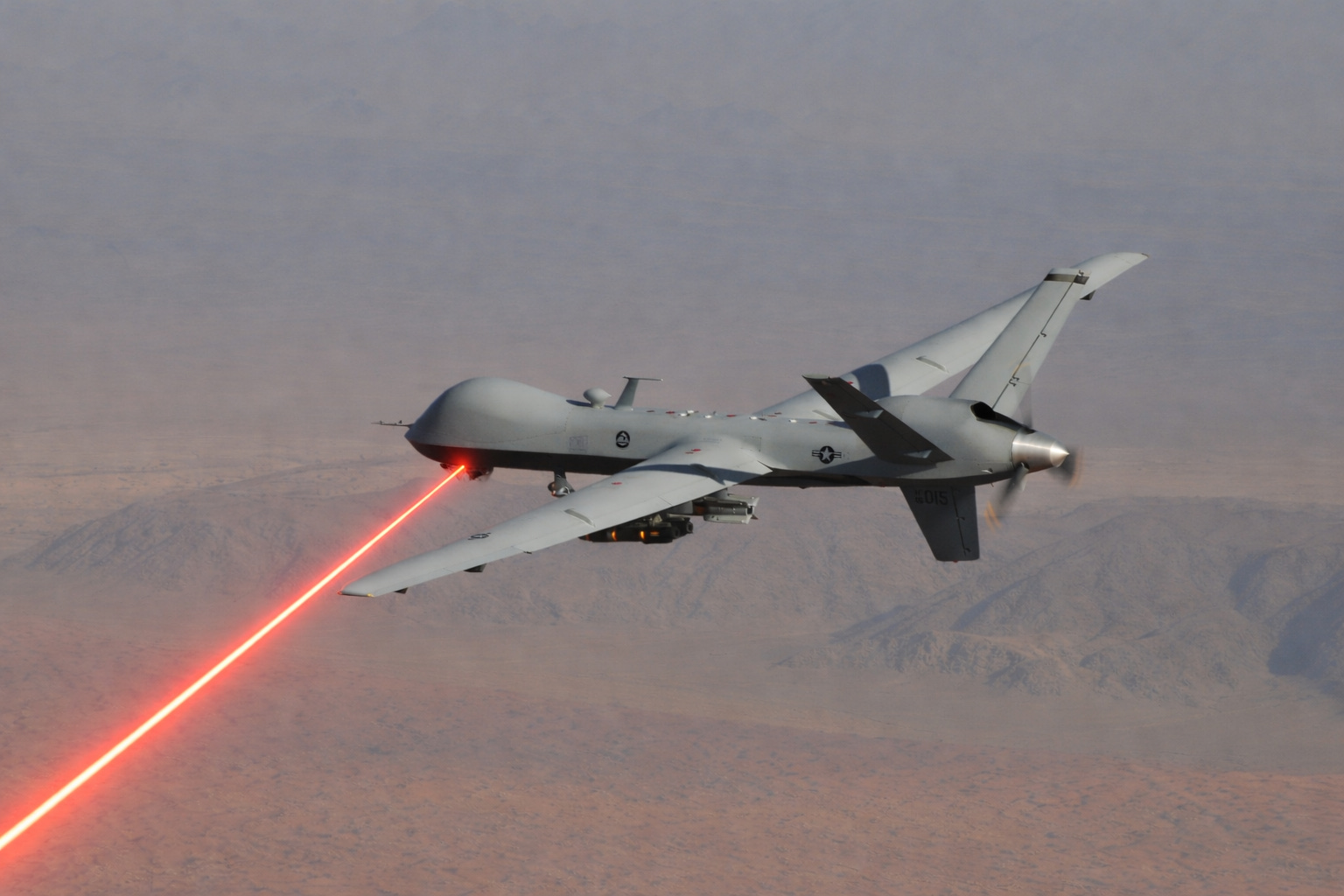
The US Military Wants Laser-Armed Drones for Domestic Air Defense
The US Missile Defense Agency is “all in” on “bringing directed energy to the fight,” according to the agency’s director.

The US military is once again pursuing flying directed energy weapons to counter threats to American airspace, according to the US Defense Department’s missile defense boss.
Speaking to members of Congress during a House Armed Services Subcommittee on Strategic Forces hearing on April 15 on the Pentagon’s planned missile defense activities for fiscal year 2027, US Missile Defense Agency director Air Force Lt. Gen. Heath Collins stated that his organization was “all in” on “bringing directed energy to the fight,” including integrating such weapons into unmanned platforms for domestic air defense against hostile missiles and drones.
“We are certainly putting more attention into bringing potentially game-changing directed energy capabilities to bear in an unmanned platform … [an] air platform is what we’re focused on so we can bring that capability to the edge of the fight and thin the herd on [unmanned aerial vehicles], potentially air threats, and the like,” Collins stated in response to a question from Rep. Gabe Vasquez (D-New Mexico) regarding the MDA’s adoption of directed energy weapons.
While Collins did not identify specific directed energy capabilities of interest to the MDA, his written statement to the subcommittee notes that the agency is “accelerating the operational use of high-energy lasers on various platforms” to add a “critical, non-kinetic layer” to the existing US missile defense architecture.1
It’s unclear how much the MDA plans on spending on these efforts. While the “skinny” version at the Pentagon’s historic $1.5 trillion fiscal year 2027 budget request published in early April includes a significant boost to directed energy research and development for homeland missile defense under the Trump administration’s ‘Golden Dome for America’ initiative, the documents do not contain any R&D or procurement efforts explicitly tied to the agency.2
Watch the exchange between Rep. Vasquez and Lt. Gen. Collins below:
As Laser Wars readers likely already know, the Pentagon has been examining airborne laser weapons for missile defense since the 1970s, when the US Air Force established its Airborne Laser Laboratory (ALL) program to explore the development of a laser-armed “aerial battleship” to protect strategic bombers from incoming interceptors. In 2010, the service’s Boeing 747-based YAL-1 Airborne Laser Test Bed successfully destroyed several ballistic missiles in flight during testing but was subsequently canceled the following year due to “significant affordability and technology problems,” as then-Defense Secretary Robert Gates put it at the time.
As military laser weapons have evolved from bulky chemical-based systems to more compact and efficient solid-state designs in recent decades, US military planners have increasingly explored integrating them into unmanned airborne platforms. The High Energy Liquid Laser Area Defense System (HELLADS) effort, initiated in 2003 by the Defense Advanced Research Projects Agency, sought to develop a 150 kilowatt system to integrate into both manned and unmanned aircraft before grinding to a halt in 2015. The MDA itself pursued outfitting drones with laser weapons for ballistic missile defense for more than a decade through its Low Power Laser Demonstrator (LPLD) initiative before then-Undersecretary of Defense for Research and Engineering Michael Griffin threw cold water on the effort in 2020, citing the unique technical and environmental challenges inherent to mounting lasers on aircraft.
“I think it can be done as an experiment, but as a weapon system to equip an airplane with the kinds of lasers we think necessary — in terms of their power level, and all their support requirements, getting the airplane to altitudes where atmospheric turbulence can be mitigated appropriately — that combination of things doesn’t go on one platform,” Griffin told reporters in May 2020, per Breaking Defense. “So, I’m just extremely skeptical of that.”
Griffin isn’t wrong. Despite advances in laser technology, engineering a directed energy weapon that’s both powerful enough to destroy an incoming target and compact enough to integrate onto a relatively small airframe like a multirole combat aircraft or drone is a significant challenge. And even if an integration were technically simple, operational feasibility is an major question: atmospheric conditions are limiting factors for laser weapons in any domain, but turbulence is a particularly thorny one for fast-moving airborne platforms tasked with maintaining a coherent beam long enough to successfully neutralize targets moving at equally high speeds.
Despite this skepticism, the dream of laser-armed drones appears alive and well. As recently as 2024, the MDA was gearing up for another run at airborne lasers, albeit with an initial focus on low-powered systems for tracking before ramping up to high-energy weapons. In January 2025, the US Navy released a slick vision of future naval operations that included notional drone wingmen outfitted with directed energy weapons running interference for manned aircraft. And in the last year, defense contractor General Atomics has released multiple renderings of its MQ-9B SkyGuardian and MQ-20 Avenger drones outfitted with laser weapons, although a company spokesman cautioned reporters that the systems were not designed for “any specific government program or contract.”
Directed energy weapons offer an alluring alternative to traditional missile-based air defenses, with low cost-per-shot, deep magazines, and the ability to engage targets at the speed of light. But the Pentagon has been here before: airborne laser concepts have repeatedly surged on waves of optimism, only to collapse under the weight of technical complexities and ballooning costs. Indeed, the Air Force’s Airborne High Energy Laser (AHEL) and Self-Protect High-Energy Laser Demonstrator (SHiELD) efforts, which respectively sought to mount laser weapons on an AC-130J Ghostrider gunship and F-15 Eagle fighter jet, proved too challenging to even advance to airborne tests. (Undeterred, the service is poised to restart airborne laser efforts in fiscal year 2027 amid a surge in broad institutional support for directed energy. Time is a flat circle.)
Whether the MDA is barreling towards a genuine directed energy inflection point or just another familiar R&D cycle remains an open question. For now, the message from Collins is clear: when it comes to determining whether airborne laser weapons are a viable missile defense capability, the US military is once again willing to find out the hard way.
It’s possible but unlikely that Collins is referring to a drone-mounted high-powered microwave weapon like the Leonidas Pod concept from defense contractor Epirus.


