

‘A Laser on Every Ship': Navy Leaders Are Dreaming of a Laser Fleet
Including megawatt-level laser weapons for the service’s future Trump-class battleships.

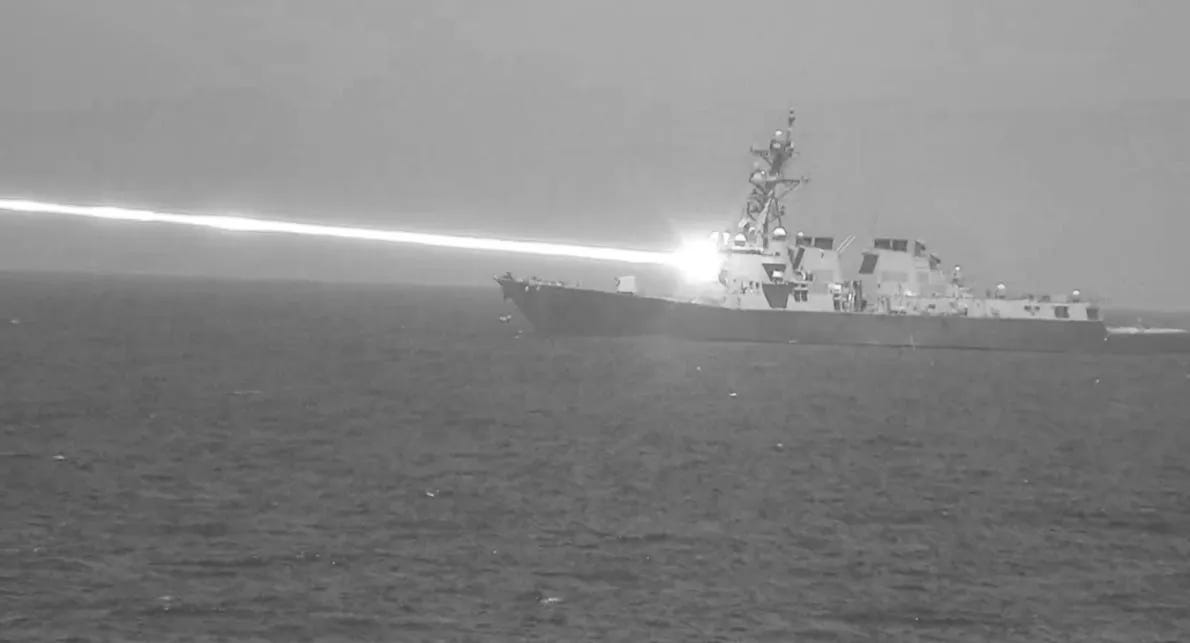
After years of hesitation and incremental progress, senior US Navy leaders are now publicly committing to fielding shipboard high-energy laser weapons across the surface fleet – a marked shift from the caution that previously defined the service’s approach to directed energy.
Speaking at the Surface Navy Association (SNA) annual symposium in Arlington, Virginia this week, Secretary of the Navy John Phelan, Chief of Naval Operations Adm. Daryl Caudle, and Naval Surface Forces commander Vice Adm. Brendan McLane all affirmed that the Navy would accelerate its pursuit of shipboard laser weapons. Their comments represent a major departure from the service’s position less than a year ago, when acting CNO Adm. James Kilby publicly warned that senior leaders were “not ready to go all in yet” on the systems.
The Navy currently fields several laser weapons across its Arleigh Burke-class guided-missile destroyer fleet: eight low-power Optical Dazzling Interdictor, Navy (ODIN) systems primarily designed to dazzle and blind the sensors on hostile drones, and one 60 kilowatt High Energy Laser with Integrated Optical Dazzler and Surveillance (HELIOS) system installed on the USS Preble. In late December, President Donald Trump unveiled plans for a new “Trump-class” of “battleship” adorned with 300 or 600 kw laser weapons that are still in the research and development stage.
In their remarks on January 13, Phelan and McLane situated their support for the Navy’s directed energy R&D efforts as part of the US Defense Department’s embrace defense tech innovation in the service of “lethality,” whatever that actually means.1 Here’s Phelan in his keynote (emphasis mine):
To operate at a wartime footing, we must unleash our innovators – uniformed and civilian, public and private. We are now operating in an era of software-defined warfare, and the Navy is rapidly adopting AI and digital capabilities to increase the lethality and survivability of the Fleet. Operation Absolute Resolve made that undeniable. It worked. And we intend to scale it across the Fleet. Unmanned systems, AI, C5ISR, directed energy, hypersonic, and long-range conventional strike are not futurism. They are operational realities.
McLane, who has repeatedly criticized the pace of the Navy’s directed energy efforts in years past, framed laser weapons as a foundational capability rather than a niche experiment. Here’s McLane in his ‘State of the Force’ update:
As an enterprise, we must continue to think big as we develop the future platforms within the world. We must lay the foundations for the systems on those ships now so that they deliver on their promise to the American people. Developing and scaling software-centricity in our systems is one way we are doing that work. Continued iteration with USS Preble’s HELIOS laser weapons system is another example of this. Last Fall successful at-sea testing paved the way for future laser weapons systems. We need to continue on this path. I am committed to advancing laser technology to the fleet. The dream of a laser on every ship can become a real one.
Taken together, Phelan and McLane’s comments signal that, despite recent technical hiccups with HELIOS, the Navy’s senior leaders are serious about fielding laser weapons across the fleet as quickly as possible. But it was Caudle, an outspoken advocate for shipboard lasers who once declared that the Navy should be “embarrassed” by its lack of operational systems, who most clearly articulated leaders’ current view of (and vision for) directed energy weapons in a roundtable with reporters the next day — a vision that includes megawatt-class laser weapons for the Trump-class battleship.
Here’s a lightly-edited transcript of Caudle’s relevant remarks during the SNA roundtable in response to a question from Axios reporter Colin Demarest:
Laser power is available. I may have told you this, but my thesis research at the Naval Postgraduate School is on directed energy and nuclear weapons. We have continuous free electron lasers today that can scale to a megawatt-plus, a gigawatt pulse. Laser power is not the issue – it’s the form factor, it’s the engineering of the power to get the density of that in a shipboard design, that’s the challenge. And then the targeting is always a challenge when you’re in a high moisture environment, because the optics are critical to lasers. So there’s engineering challenges to all this.
We were heavy into this with the Strategic Defense Initiative. We were really into high-powered lasers that we just basically .. there was no business case for people to be out there working on this. So I don’t think we devoted the actual industrial might and the brainpower across academia and think tanks and other places that generate this type of outcome toward directed energy in an effective way … I said something similar last year, and I stick to that.
So now’s the time. We’re going to put a clear signal out there that we want anything that’s line of sight. This is my goal: If it’s in line of sight of a ship, the first solution that we’re using is directed energy. What that does for me is it improves my loadout optimization, so that my loadout, my payload volume, is optimized for offensive weapons and not [for] defending myself. So as you increase power, the actual ability to actually engage and keep power on target, and the effectiveness of a laser, just goes up … it’s an exponential improvement on that. So, you know, [USS] Preble, and some of the work we’ve done with that has given us some idea of the engineering aspects of this, but we’ve got to have different class lasers going forward on the battleship to make them effective.…
I don’t think a one-megawatt laser is beyond what should be on that battleship. That’s how I would say it: I’ll take what I can get and then, like anything else, we can evolve that. But yes, point defense needs to shift to directed energy as an infinite magazine.
These remarks from top Navy leaders make clear that the service’s laser ambitions are no longer constrained by skepticism about whether high-energy lasers can work, but whether the fleet can actually generate, manage, and distribute enough power to make them operationally useful. That tension has been building for years: In 2019, the service’s then-director of surface warfare Rear Adm. Ron Boxall bluntly warned that the new Flight III Arleigh Burke-class destroyers were already “out of Schlitz” when it came to their electrical margin due to the power requirements of the new AN/SPY-6 Air and Missile Defense Radar system, leaving little space for other power-hungry systems like laser weapons.2 At roughly 60 kw, HELIOS may sit at the upper edge of what the Burke design can comfortably support without trade-offs elsewhere in the ship’s combat system.
This explains why Navy leaders like Caudle are framing lasers as core design drivers for future surface combatants rather than bolt-on systems for existing warships. Indeed, Rear Adm. Derek Trinque stated plainly at the SNA symposium that plans for the now-scrapped next-generation DDG(X) destroyer that heavily informed the new battleship plan “came from a recognition that we were approaching the limit of what we could add to the Arleigh Burke-class destroyer,” as he put it on January 13. “We needed something newer and bigger that could have more power and accept more weapons and project more power than the Arleigh Burke-class destroyer.”
The Trump-class battleship “will have power for directed energy and future railguns,” he added. “It will give us capacity that we don’t have in any surface ship right now.”
The Navy’s path to “a laser on every ship” does not run through today’s destroyer fleet, but new hulls designed from the keel up to generate megawatts of electrical power, manage heat at scale, and integrate laser weapons as part of the ship’s baseline architecture. This logic underpins everything from the service’s long-running Integrated Power System research to speculative concepts like the proposed Trump-era battleship, where directed energy weapons are presented as a natural outgrowth of vastly expanded power generation (as long as it’s not nuclear power, according to Caudle).
It’s unclear how the Navy’s laser promise will take shape in the coming years. While leaders are signaling urgency and intent, the service’s fiscal year 2026 budget request effectively threw the brakes on ODIN and HELIOS efforts by reducing their funding to near zero, according to budget documents. And even if the service was full steam ahead on producing new laser weapons and proliferating them across the surface fleet, the warship that could fully realize Caudle’s directed energy vision does not exist yet and likely never will.
One thing is clear: the Navy’s laser champions finally have the opportunity to make their dream of a laser fleet a reality ahead of the next big war. Unfortunately, actually building it will rely less on rhetoric and more on a revolution in American shipbuilding – and in that case, the laser fleet will never see the light of day.

I wrote about the rise of “lethality” as the US military’s preferred euphemism in The New Republic in September 2019.
Regular readers of Laser Wars have likely noticed that I frequently invoke Boxall’s 2019 “out of Schlitz” comments. I’ll stop doing it when they stop being relevant.
It’s sad to see that the Navy is still talking about FELs which are really not much closer to being feasible than when Teller promised them in three years in the 80’s. Even a Ford class CVN, using all of its electrical margin, would have trouble powering more than 2-300 kw of FEL laser output. The Navy has always insisted that megawatt class lasers are needed for anything much bigger and faster than a drone. The money we waste chasing the same old $hit.
Power generation does seem to be the big limiting factor.
Perhaps a containerized micro reactor, set up just to power the ship's laser systems?
I admit, I haven'y looked much at the idea yet... but there seems to be potential there. I don't recall the project name off the top of my head, but there was one to build containerized reactors to fit in a 20 or 40 foot container, sized to make between 1-5 mw of power.
Could be a solution...