Laser Dome: the UK Is Eyeing Laser Weapons for Homeland Drone Defense
The UK Ministry of Defence is reportedly exploring laser weapons to protect military installations and critical infrastructure at home.

Israel has its “Iron Dome.” The United States is pursuing a “Golden Dome.” Now, the United Kingdom is reportedly dreaming of its own novel air defense screen: a “Laser Dome.”1
The UK Ministry of Defense is drawing up plans to potentially employ laser weapons domestically to protect military installations and other critical infrastructure from the unidentified drones that have increasingly menaced military bases, airports, and power plants across various Europe nations in recent months, the Times of London reports – a major expansion of the military’s directed energy ambitions beyond protecting British troops deployed overseas.
While the MoD has spent recent years focused on its 50 kilowatt “DragonFire” shipboard high-energy laser weapon as its near-term answer to drone threats like the attacks on commercial vessels in the Red Sea by Iran-back Houthi rebels in Yemen, the Times reports that officials are now also exploring “lower-power” systems for persistent homeland drone defense, where safety and rules of engagement matter more than destructive power. This suggests a narrow focus on soft-kill laser “dazzlers,” similar to the US Navy’s shipboard Optical Dazzling Interdictor Navy (ODIN) laser weapon, to blind and disable the sensors on incoming drones rather than burn them out of the sky outright.2
“Laser weapon technology offers significant potential across a wide range of defence and civil applications,” the MoD told the Times in a statement. “We are actively exploring opportunities, particularly in counter-drone systems.”
According to The Times, the MoD’s examination of laser weapons for homeland defense is part of £20 million ($27 million) in new funding for research into “additional” laser systems to “complement” DragonFire — announced in December as part of a broader £140 million ($189 million) boost for drone and counter-drone technology — through the newly formed UK Defence Innovation (UKDI) organization, which the military stood up in July to “scale up innovative prototypes rapidly” for widespread fielding. In a December 15 statement, UK Secretary of State for Defence John Healey explicitly cited “increasing Russian-linked drone incursions across Europe” as a motivating factor behind the UKDI cash infusion .
“The Strategic Defence Review was clear that we must learn the lessons of the war in Ukraine, which is why we’re surging investment into drone and counter drone systems,” Healey said. “Russia’s continued bombardment of Ukrainian civilians and their grey-zone drone incursions across Europe show why this drone drive is so urgent.”
Other government officials echoed this sentiment. When asked about the new UKDI funding by Member of Parliament James Cartlidge the day after it was announced, Parliamentary Under-Secretary of State for the Armed Forces Al Carns affirmed that the MoD was “exploring [directed energy weapon] applications across many use cases, both within the MoD and with partners across government.”
“This [funding] will contribute to advanced future capabilities across laser and radio-frequency (RF) systems across all domains, that will come into service on a longer timescale, building on the learnings we take from accelerated capabilities like DragonFire,” Carns said.

The prospect of a Laser Dome is noteworthy not because of the novelty of its technology, but the timing of its inception. In the last few years, cheap drones have turned domestic airspace into a contested domain, exposing gaps in how governments protect critical national assets. With advanced militaries currently stuck shooting down relatively cheap drones with expensive missiles — or even just scrambling fighter jets like the UK Royal Air Force’s Typhoon as a standard response to airspace incursions3 — comparatively low-cost directed energy weapons like lasers are increasingly considered among the only economically viable solutions to this growing problem.
The UK’s laser technology appears to have finally matured to a point where it can serve as that solution. While the MoD has been working on laser weapons for decades (and with intensifying effort since 2017), the department’s new focus on homeland defense applications comes on the heels of a particularly transformative two-year stretch for British directed energy weapons research and development:
In January 2024, DragonFire successfully engaged aerial targets for the first time during trials at the Hebrides Range in Scotland.
In April 2024, the Royal Navy announced its intent to install DragonFire on a Type 45 guided-missile destroyer by 2027, five years earlier than previously planned, citing the service’s involvement in the US-led multinational military response to Houthi attacks in the Red Sea.
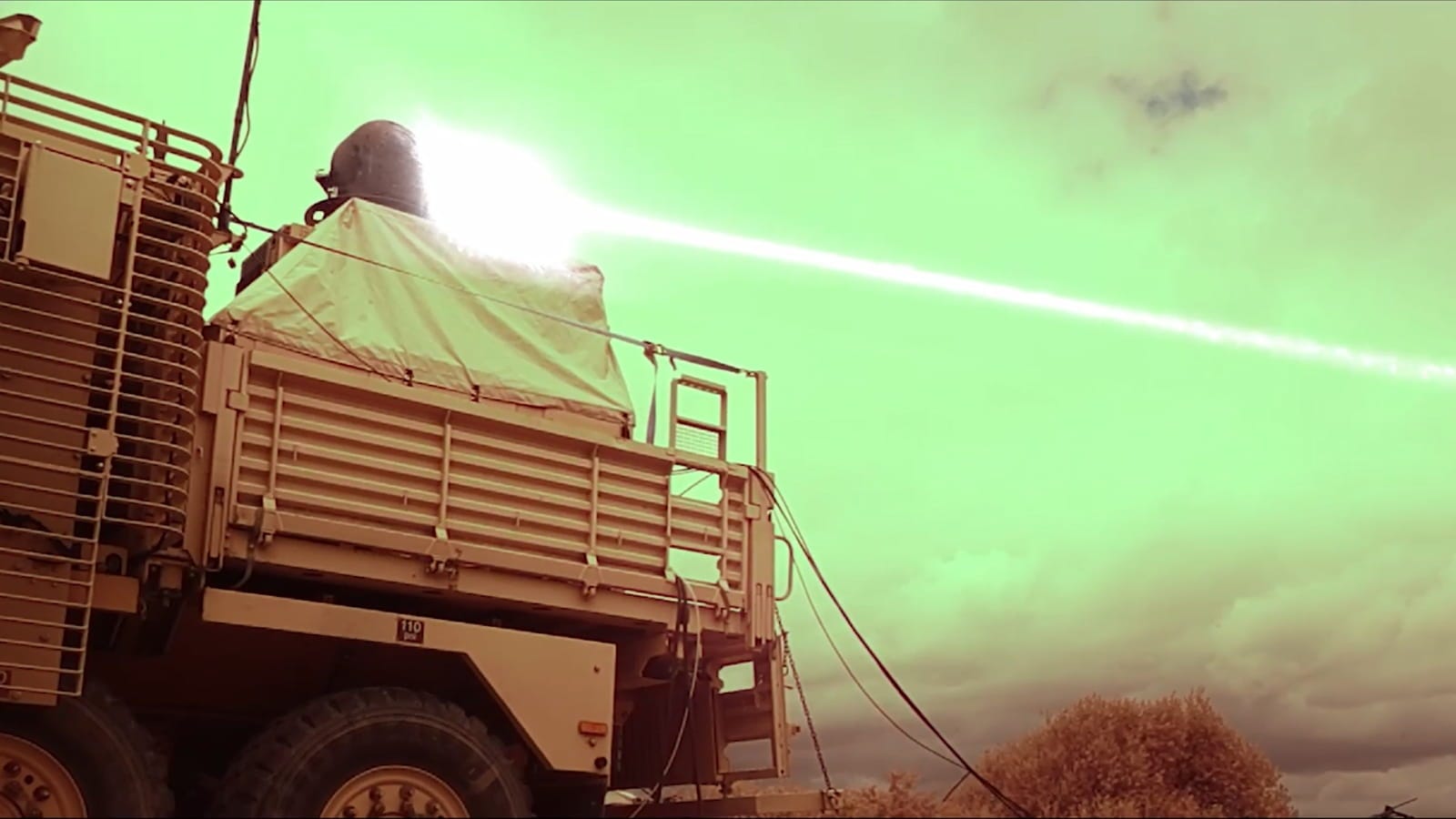
In early December 2024, the British Army announced it had successfully destroyed drones with its Land Laser Directed Energy Weapon (LLDEW) demonstrator — defense contractor Raytheon’s 15 kw High-Energy Laser Weapon System (HELWS) integrated onto a Wolfhound combat vehicle — at the Radnor Range in Wales following initial test-firings the previous July.4
In late December 2024, the British Army revealed that soldiers had successfully neutralized several drone swarms during trials at Air Defence Range Manorbier in Wales with a MAN Support Vehicle-mounted Radio Frequency Directed Energy Weapon (RFDEW) based on defense contractor Thales’ “RapidDestroyer” system, which employs high-intensity radio waves to disable the electronics on multiple drones at once. The dmeon5
In March 2025, the Royal Navy expanded its DragonFire integration plan from one Type 45 destroyer to four amid a broader £2.2 billion ($2.9 billion) boost in defense spending.
In April 2025, the Defence and Security Accelerator (now part of UKDI) launched a new Innovation Focus Area — a capability gap of interest and demand signal to the defense industry — soliciting proposals on “novel ideas to enhance the performance and/or reduce the size, mass and volume” of directed energy weapons, with the end goal of making them a “realistic choice” for British forces.
In June 2025, the MoD outlined an ambitious proposal to eventually transform its Type 45 destroyers into “minimally crewed or autonomous air dominance systems” armed with laser weapons as part of the new Strategic Defence Review released alongside a fresh £1 billion ($1.3 billion) investment into directed energy R&D.6
In July 2025, Minister of State for Defence Procurement and Industry Maria Eagle stated that the MoD was actively working on a new land-based directed energy weapon to deliver to the British Army “by the end of the decade.”
And in November 2025, the MoD announced a formal £316 million ($413 million) contract with defense giant MBDA for DragonFire following several successful trials conducted between March and June of that year, calling the system “the first high-power laser capability entering service from a European nation.”7

Against this backdrop of the MoD’s accelerating directed energy weapon R&D efforts, the idea of a domestic Laser Dome starts to feel more like a logical outgrowth of existing programs an less like a sci-fi pipe dream. DragonFire is proof that the MoD can turn laser weapons into (close to) operational capabilities, while the LLDEW and RFDEW demonstrators indicate the military has internalized how drones have permanently altered the economics of warfare and is actively pursuing every possible capability to build an effective layered air defense.
This is also why that £20 million in UKDI funding for domestic laser weapons is about more than just money. While DragonFire may be MoD’s flagship directed energy program, UKDI is an attempt to create a pathway to scale next-generation capabilities at the pace of a drone threat that’s evolving faster than traditional defense acquisition cycles. In this context, the fresh laser weapon funding looks less like yet another modest investment in experimental systems and more like an attempt to institutionalize speed as hostile drones transition find their way to the home front.
But even if UKDI does provides a path to laser weapons that can be fielded at scale, actually using them domestically is a regulatory and civil-military minefield. Take the US experience developing domestic drone countermeasures: as recently as October 2024, American military planners were explicitly avoiding even considering not just directed energy weapons, but standard guns and other kinetic interceptors for homeland defense given their potential for inflicting collateral effects on the surrounding area. Existing US legal and safety frameworks restrict when and how these systems can be used, incentivizing military planners toward “soft kill” options that can fit within these narrow authorities. This applies to a British Laser Dome concept as well: even fielding lower-powered dazzlers across UK territory will require regulatory clarity on engagement authorities and interagency coordination to avoid imperiling unsuspecting civilians in nearby neighborhoods.
It’s also worth noting that, despite my cheeky shorthand, a real-world Laser Dome would likely bear little resemblance to Israel’s Iron Dome beyond defensive intent. Rather than a centrally integrated, radar-driven interceptor network designed to shoot down fusillades of incoming rockets, the UK approach would almost certainly take the form of a distributed, site-specific architecture shaped by those restrictive rules of engagement governing domestic UK airspace — a network of defense screens rather than a seamless national shield. This likely explains why the MoD is reportedly exploring dazzlers rather than destructive high-energy lasers like DragonFire for persistent air defense around fixed sites: they can be used continuously without imposing unacceptable risk on civilian aircraft or nearby infrastructure.
Whether the MoD’s vision of a Laser Dome actually has a chance at becoming a reality is, of course, an open question. But if the future of warfare will be shaped by drones, then the UK apparently plans on meeting that threat with directed energy in every battlespace – foreign and domestic.
Rafael, the Israeli defense giant behind the Iron Beam, says the system is officially called the “Laser Dome” in English, but whatever.
The War Zone’s Tyler Rogoway and Joseph Trevithick laid out a strong argument for laser dazzlers as an overlooked drone countermeasure in July 2024.
The Times of London report states that the MoD’s domestic laser systems “could be integrated into Britain’s existing air defences, which primarily consist of scrambling fighter jets,” which feels unlikely given the technical complexities and brutal physics assocaited with airborne laser weapons.
Raytheon is developing a palletized version of its HELWS and is in discussions with “non-land customers” in the UK about “additional applications,” Breaking Defense reported in July.
The LLDEW and RFDEW demonstrators were developed through a £72.5 million ($97.2 million) contract under the MoD’s Novel Weapons Programme awarded in September 2021.
According to recent remarks from Minister of State for Defence Lord Vernon Coaker, the UK has no current plans to outfit its Queen Elizabeth-class aircraft carriers with such systems.
The there’s the matter of the MoD’s airborne laser weapons. The UK has been working with Italy, Japan, and a consortium of defense contractors (including DragonFire lead MBDA since at least 2018 to develop a sixth-generation fighter jet known as ‘Tempest’ designed to support future directed energy capabilities for intercepting missiles — capabilities that consortium officials have repeatedly emphasized would be heavily informed by DragonFire R&D.