


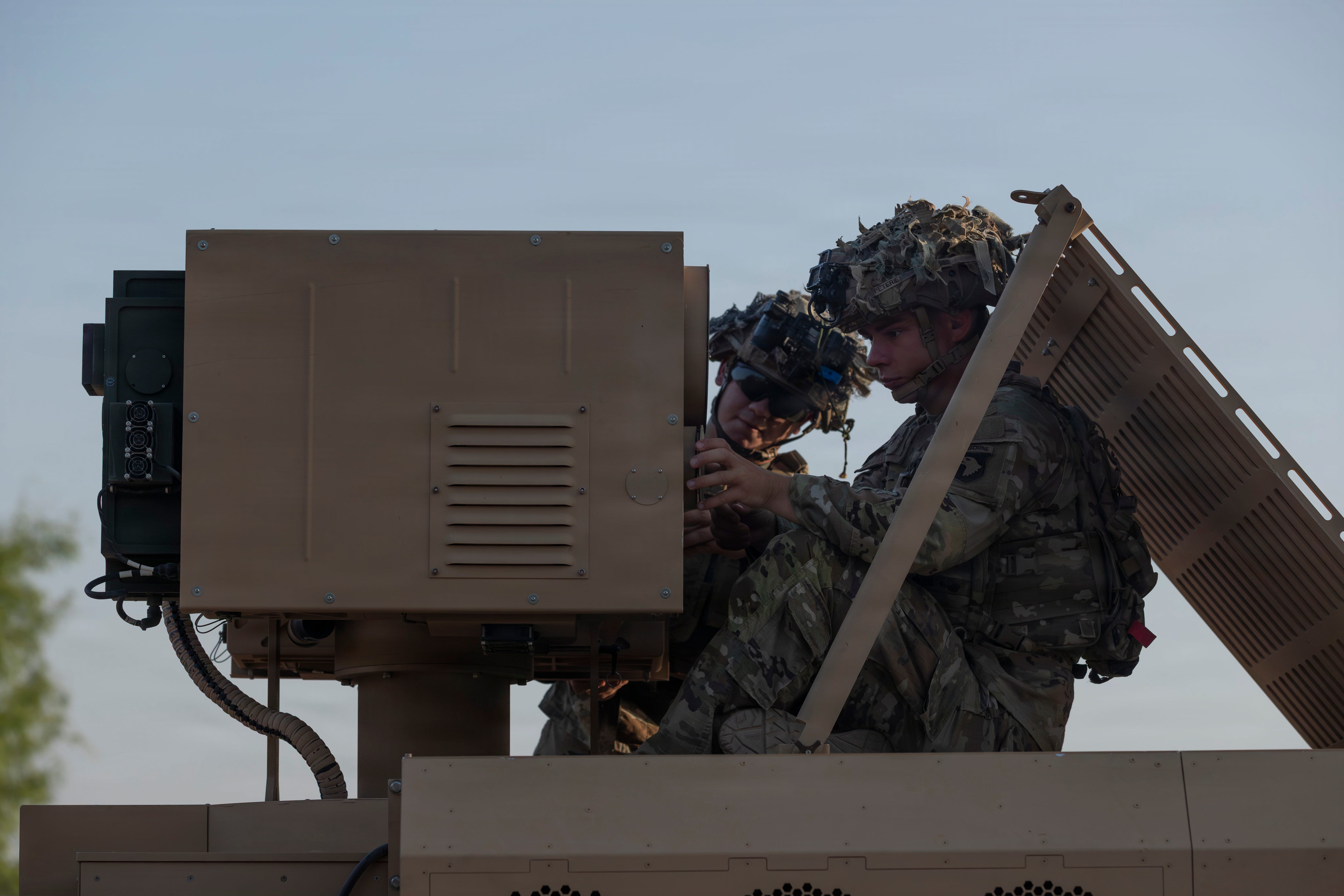
Take a look at the photo above.
The image shows two US Army soldiers, Spc. Caleb Mullens and Spc. Peterie Gage of the 2nd Battalion, 327th Infantry Regiment, perched atop a Joint Light Tactical Vehicle (JLTV) near Rio Grande City, Texas, on August 31. According to the official US Defense Department caption, the pair are inspecting an Army Multi-Purpose High Energy Laser (AMP-HEL) system, a 20 kilowatt laser weapon currently operating at the southern border with Mexico under US Northern Command’s Joint Task Force-Southern Border (JTF-SB).
To the best of my knowledge, Mullens and Gage are not laser physicists or optical engineers. They are likely regular US service members, deployed to the border with standard-issue small arms, night vision goggles, concertina wire, and grit. And that’s exactly why this photo captures a major challenge ahead for the Pentagon’s plans to field laser weapon at scale: after spending half a century proving lasers can shoot down targets, military leaders must now ensure that junior enlisted troops can maintain and sustain them, day after day, without a clean room, a PhD, or the defense contractor that originally built them.
Military leaders know how critical maintenance and sustainment are for laser weapons. A US Government Accountability Office review of US military directed energy programs published in April 2023 listed maintainability as a central long-term challenge (alongside battle management, tactics, and user safety) to fielding laser weapons due to their technical complexity. The root cause is a matter of physics: because a laser weapon sends light through lenses and off mirrors, an errant speck of debris on an optic can absorb heat from the weapon and cause damage to the lens,1 which typically requires a specialized clean room for repairs. Unfortunately, combat zones and clean rooms don’t mix; indeed, one unidentified prototype directed energy weapon fielded in an operational environment in recent years ran into battery charge and cooling problems and “had to be returned to the manufacturer in the United States for repairs,” according to the GAO report, a process which “reduced system availability, which is key to a successful weapon.”
“This is not a Humvee that’s sitting in the motor pool,” as then-US Army Space and Missile Defense Command boss Lt. Gen. Daniel Karbler said of laser weapons at the Space and Missile Defense Symposium in Huntsville, Alabama in August 2023. “Many of the some of the main [laser] components… you’re not going to have a supply room or maintenance office full of repair parts. Those are going to be ones that are going to have to be built out.” To wit, Maj. Gen. Sean Gainey, then the director of the Pentagon’s Joint Counter-Unmanned Aerial Systems Office, stated at the same event that the Army “had three or four systems in the [US Africa Command area of responsibility] and essentially it takes three to make one.”
“We’ve got to work on maintainability because … we can’t get by with the thought of having clean rooms out in combat,” Lt. Gen. Robert Rasch, at the time the head of the Army’s Rapid Capabilities and Critical Technologies Office, said at a subsequent SMD symposium in August 2025.
For the now-diminished Director, Operational Test and Evaluation (DOT&E), “operational suitability” (which includes reliability, availability, maintainability, logistics supportability, manpower supportability, and training requirements, among other criteria) can determine whether a new system is adopted and fielded under a program of record. Consider the Army’s experience with its 50 kw Stryker-mounted Directed Energy Maneuver-Short Range Air Defense (DE M-SHORAD) system. After four prototypes deployed to the US Central Command area of responsibility in February 2024, then-Army acquisition chief Doug Bush told lawmakers that the systems’ power level was proving a challenge for a vehicle constantly on the move, citing “the heat dissipation, the amount of electronics, kind of the wear and tear of a vehicle in a tactical environment versus a fixed site.” The service ended up abandoning DE M-SHORAD in favor of the Enduring High Energy Laser (E-HEL) program, under which the service awarded defense contractor AV a $464.8 million production contract in September.
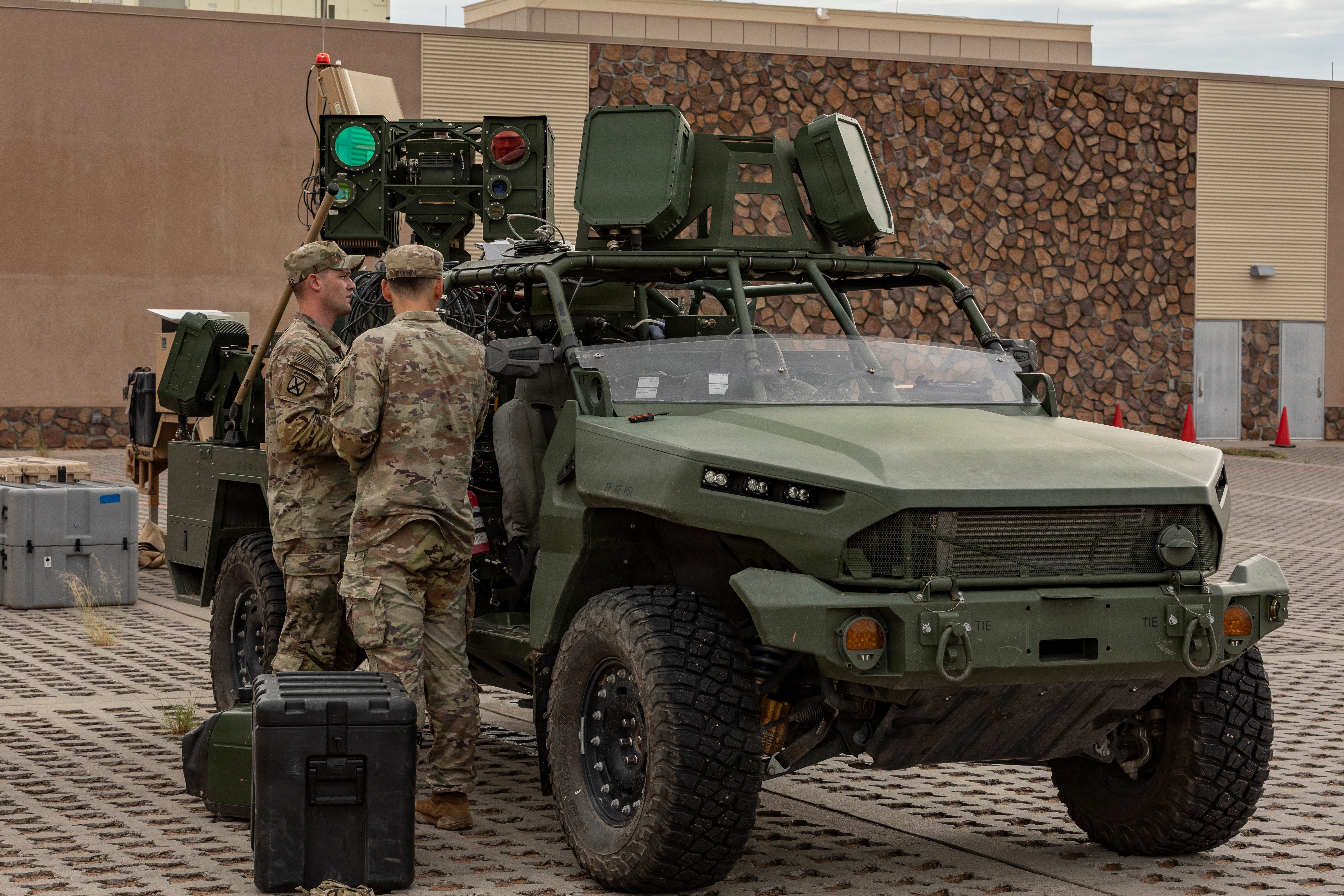
The Army is currently working to address maintainability and sustainability challenges through the E-HEL program by embracing a modular system architecture. The service’s 2024 solicitation for the effort explicitly asked defense contractors to “present opportunities for soldier-led maintenance activities and replacement of a major [high-energy laser] sub-system component,” as well as multiple line-replaceable units (LRUs) supporting field and sustainment maintenance in accordance with Army Regulation 750-1. Components like defense contractor Attalon’s new kWIC fiber disconnect, which Laser Wars covered in July, are the kind of hardware that could actually make a laser weapon truly field-ready.
But the Army’s progress on this front remains uncertain. While E-HEL is supposed to “leverage” sustainment lessons from past efforts like DE M-SHORAD, Pentagon weapons testers never had a chance to fully evaluate the latter for operational suitability, namely because the CENTCOM deployment “prevented RCCTO from starting the scientific and technical testing planned for [fiscal year 2024],” according to DOT&E’s annual report on testing activities that year. In addition, DOT&E said that the Army’s in-theater assessment was “not being conducted in accordance with a test plan, nor being observed by ATEC or DOT&E,” leaving testers with “insufficient data to assess DE M-SHORAD’s operational effectiveness, lethality, suitability, and survivability.” (To be fair, the US military has certainly gathered some operational suitability data in the past. When the US Air Force bought an additional Raytheon High Energy Laser Weapon System (HELWS) in December 2019 for an overseas field assessment, the contract included six months of in-theater maintenance training and the collection of availability, reliability, maintainability, and supportability data.)
In the near term, it appears that defense contractors will continue doing the heavy lifting for the US military’s directed energy maintenance and sustainment apparatus. The 2023 GAO report found that US Navy operators of fielded directed energy weapon prototypes like the low-power Optical Dazzling Interdictor, Navy (ODIN) and High-Energy Laser with Integrated Optical-dazzler and Surveillance (HELIOS) “received a great deal of support from the DE weapon developers,” more than typical with new technology. Similarly, the Army’s Palletized High Energy Laser (P-HEL) system from BlueHalo (now part of AV) that deployed to CENTCOM starting in 2022 received a four-year logistics support contract in April 2024 “to provide preventative and corrective maintenance along with operator and maintenance team training.”
The AMP-HEL deployment to the southern border with Mexico is the closest thing the US military has to a live maintenance and sustainment experiment for laser weapons, one that’s hopefully yielding data and lessons that prior efforts like DE M-SHORAD effort never produced. And while firing off a laser beam into the night sky is no longer an insurmountable engineering obstacle for the US military’s directed energy ambitions, the photo from the border underscores a significant challenge ahead for their proliferation across combat formations: making that, when the damn things eventually break under real-world conditions, the average soldier can repair one with ease so it’s ready when they need it most.
