


Welcome to In Focus, an occasional interview series with subject matter experts in the directed energy space.
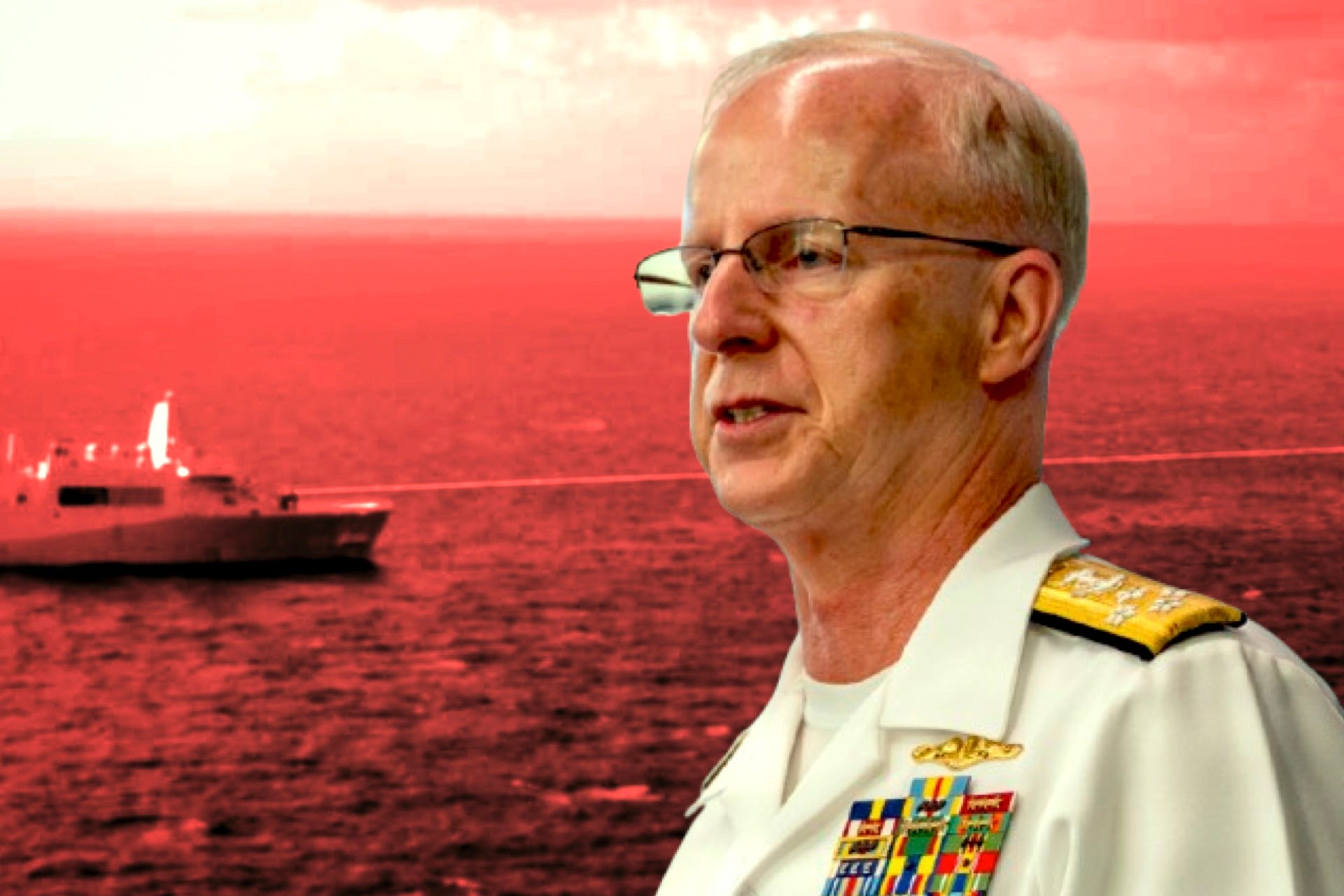
US Navy Adm. Daryl Caudle is the 34th Chief of Naval Operations and a longtime student of directed energy who’s currently on something of a media blitz in support of the service’s vision of a “laser on every ship.”
Laser Wars originally submitted a list of 18 detailed questions, including many proposed by readers, to the Office of the Chief of Naval Operations for Caudle to answer. Public affairs officials subsequently requested a pared-down list to ensure timely responses, which are printed in full below.1
LASER WARS: What does the US Navy’s five-year roadmap for the development and fielding of high-energy laser weapons look like?
NAVY ADM. DARYL CAUDLE: Our approach is to move on two tracks simultaneously. First, we need to get useful directed-energy capability into the hands of sailors now. Containerized systems give us a way to accelerate that effort on existing ships, shorten integration timelines, experiment operationally, and build the tactics, training, maintenance practices, and human expertise we will need as these weapons mature.
At the same time, we have to design future ships with directed energy in mind from the beginning — with the electrical generation, energy storage, cooling, combat-system integration, and optical architecture required to support much higher-power systems. I have been clear that the Navy needs to be moving from the hundreds-of-kilowatts range toward megawatt-class capability as the technology and engineering support it. The objective is not another demonstration. It is reliable, maintainable weapons in the fleet that sailors know how to fight.
Some of the defining Navy capabilities of the 20th century took big bets and long-term commitment from senior leaders (Rickover with nuclear propulsion, Meyer with Aegis and MK 41 VLS). How does the service think about making another bet on transformational capability like laser weapon systems for every combatant platform? How can today’s acquisition leaders own and lead that commitment like leaders of the past?
I don’t view directed energy as a replacement for kinetic weapons. I view it as an essential part of a layered defense that can fundamentally change our magazine-depth problem. Today, every VLS cell allocated to a defensive interceptor is a cell that cannot carry an offensive weapon. Directed energy gives us the opportunity to shift an increasing portion of the defensive fight from a finite magazine to the ship’s ability to generate and manage electrical power. That changes both the economics and endurance of naval combat and allows us to preserve our most capable kinetic weapons for the threats that demand them.
That’s why I continue to push this so hard. We need the Foundry solving the engineering and industrial challenges, the Fleet developing the operators, tactics and CONOPS, and ultimately a capability that gives our sailors greater endurance and lethality in the Fight.2
You’ve been advocating for megawatt-class laser weapons since your 1992 Naval Postgraduate School master’s thesis. Given the trajectory of current laser technology, what’s the best way to achieve the power levels necessary for shipboard missile defense: coherent beam combining or spectral beam combining?
I don’t want the Navy prematurely choosing an engineering architecture when industry and our technical community are still advancing multiple approaches. Both coherent and spectral beam combining offer potential pathways to higher power, and both present engineering challenges as we scale. What matters to me is the operational result: sufficient power on target, excellent beam quality, efficiency, reliability, maintainability, and the ability to operate in a demanding maritime environment. Encouraging industry to pursue diverse technological avenues fosters open and fair competition. Ultimately, this approach delivers superior operational performance to our sailors standing watch—ensuring they can focus entirely on fighting their ship rather than worrying about the underlying technology.
I want us setting demanding operational requirements and creating a strong business case for industry to solve those problems. I am much less interested in prescribing the technical solution than I am in getting a scalable, reliable weapon into the hands of sailors.
In 2019, then-surface warfare boss Rear Adm. Ron Boxall declared the Navy’s fleet “out of Schlitz with regard to power” because the new Flight III Arleigh Burke destroyers were strapped for juice powering the new AN/SPY-6 Air and Missile Defense Radar: “We used a lot of power for that and we don’t have as much extra for additional functions.” How do you plan to address the power issue with regards to proliferating laser weapons across the existing fleet?
We have to distinguish between the fleet we have and the fleet we are designing. For existing ships, containerization and modularity can allow us to introduce directed-energy capability without waiting for major ship alterations. Where practical, that can include modular power, energy storage, and thermal-management solutions that reduce demands on legacy ship systems.
For future combatants, we need to stop treating electrical power as simply a ship-service requirement. Power is increasingly a warfighting resource. Future ships need sufficient generation, distribution, storage, and cooling margins to dynamically support sensors, electronic warfare, directed energy, propulsion, and other high-demand mission systems. If we want megawatt-class weapons tomorrow, we have to design the electrical and thermal architecture for them today.
For laser weapons to effectively counter small drones, warships must be able to detect, classify, and track them with very high reliability – something that AN/SPY family of radars does exceptionally well with larger targets, but will likely struggle with against smaller and slower ones. How does the Navy plan to address this problem with the current Aegis sensor stack?
The laser is only one element of the kill chain. Detecting, classifying, tracking, assigning and maintaining a precise track on increasingly small and maneuverable targets is every bit as important as generating the beam.
Our objective is not to bolt a laser onto a ship as an independent weapon, but to fully integrate it into the ship’s combat system. Directed energy, integrated with Aegis and our broader sensor and fire-control architecture, gives the tactical watchstander another critical option.
That is particularly important against unmanned systems, where the economics favor the attacker if we are forced to use an expensive kinetic interceptor against every inexpensive threat. By shifting a portion of the defensive fight from a finite missile magazine to the ship’s electrical power, we break that unfavorable cost curve and preserve our most capable kinetic weapons for more demanding threats. A commanding officer should never be in a position where they are worried about choosing the most cost effective interceptor. Directed energy allows for future kinetic preservation at a fraction of the cost.
The Directed Energy Systems Integration Laboratory reportedly brought the Navy’s “one-of-a-kind” 150 kilowatt Solid State Laser Technology Maturation (SSL-TM) demonstrator back to life starting in early March 2025, with the system eventually shooting down four drone targets during the Crimson Dragon exercise in September. Can you share any details regarding the restoration of that system and its role in the service’s directed energy efforts?
The SSL-TM demonstrator has been an important part of the Navy’s directed-energy learning. As has been publicly reported, the Navy restored critical functions of the system to support additional experimentation and learning. What matters to me is that we capture everything these demonstrators can teach us — about the weapon itself, maritime propagation, power and thermal management, combat-system integration, maintenance, and ultimately how sailors employ directed energy operationally.
We aren’t trying to preserve a particular demonstrator indefinitely. We are using what we learn from systems like SSL-TM, HELIOS, and our other efforts to accelerate the next generation of operational capability.
In September 2025, the CEO of Lockheed Martin stated during an earnings call that the company was testing a previously undisclosed shipboard laser weapon capability in the Red Sea with the Navy. Can you provide any additional detail or context regarding that system or test?
I can’t provide additional details at this classification level. What I can say is that operationally relevant testing and experimentation are essential to moving directed energy from a promising technology to a dependable fleet weapon. We will continue to test these systems under realistic maritime conditions, learn rapidly from the results, and feed those lessons directly back into our engineering, training, and tactics to deliver real capability to our sailors in the fleet. Consequently, a top priority is to continue conducting rigorous afloat testing and operational demonstrations. This means moving beyond scripted, proof-of-concept events to deploy systems in realistic, real-world threat environments. Ultimately, we must prove that laser weapon systems are a viable, combat-ready option for our warships in harm’s way.
One last question: What’s your favorite fictional laser weapon and why?
It’s a toss-up between the phaser on the Starship Enterprise and the Death Star’s superlaser. The phaser gets points for precision, versatility, and a little more restraint — but I have to give the nod to the Death Star. It’s completely over the top, wildly impractical, and about as subtle as a sledgehammer. But when you absolutely, positively need to make a statement to the entire galaxy, nothing else comes close.

For what it’s worth, a Pangram analysis of the responses Caudle’s office sent to Laser Wars yielded a 87% AI rating.
The capitalization and emphasis here are Caudle’s.