The Air Force Is Eyeing Its Bomb-Busting Laser Weapon to Detonate Downed Drones
By the beard of Zeus!

The US Air Force is assessing a high-energy laser weapon originally intended to blow up bombs as a potential countermeasure against a new kind of explosive hazard on the battlefield: downed drones.
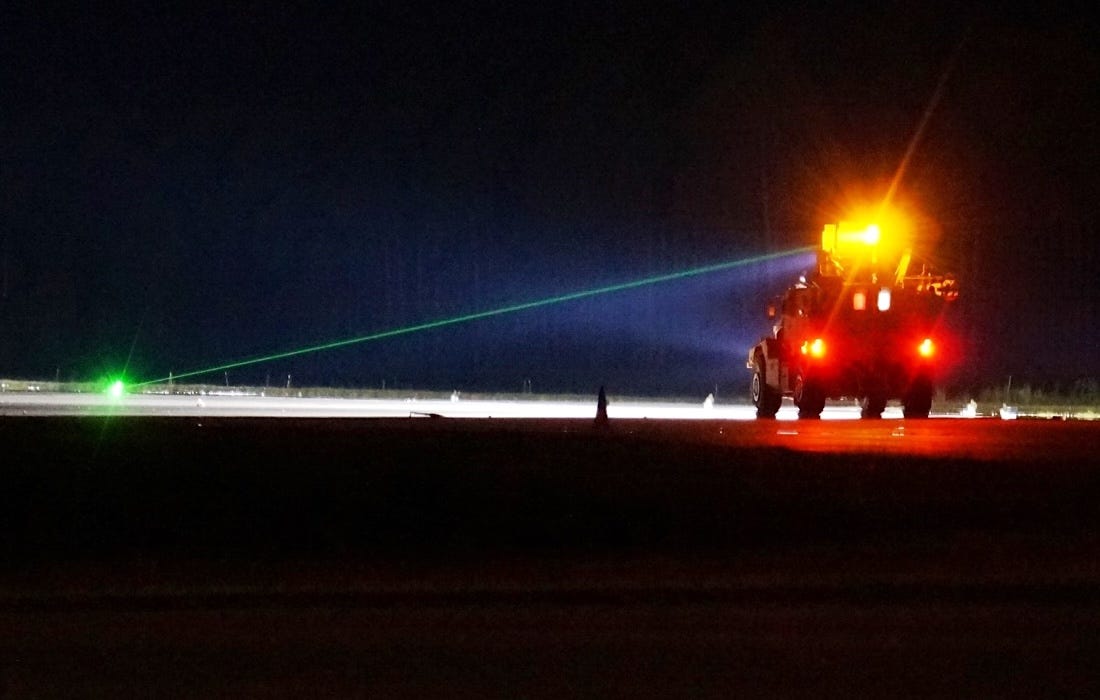
US Defense Department photos published to the Defense Visual Information Distribution Service (DVIDS) in March show airmen assigned to the 8th Civil Engineer Squadron at Kunsan Air Base in South Korea engaging a drone target with the 3 kilowatt Zeus III laser weapon of a Recovery of Airbase Denied by Ordnance (RADBO) system “to determine its ability to destroy downed small unmanned aerial systems,” according to the photo captions.

Developed by defense contractor Parsons and mounted on an Cougar 4x4 Mine-Resistant Ambush Protected (MRAP) vehicle, the RADBO system was designed to clear unexploded bombs, mines, and improvised explosive devices (IEDs) from far-flung airfields, primarily in the US Central Command area of operations. By engaging munitions with precision from up to 300 meters away, operators can neutralize threats faster and safer than traditional explosive ordnance disposal methods1 — threats that increasingly include low-cost weaponized drones grounded by guns, electronic warfare, and other countermeasures.
“We have an air superiority mission. If we are in a high threat environment, and there are unexploded ordnance on the airfield, maintainers can’t take care of the aircraft and the aircraft can’t get off of the runway,” Tony Miranda, the Air Force’s RADBO program manager, said of the system in 2022. “These RADBO vehicles will be utilized by Explosive Ordnance Disposal (EOD) technicians to detonate the unexploded ordnance from a standoff range, so we can get back to the business of flying planes.”

Initiated in 2012 and first delivered to the Air Force in 2023, the RADBO system is described by both the Air Force and Parsons as the first US military directed energy system to move beyond research and development and into sustained production. The service had been experimenting with a range of other ground-based laser weapons for airbase defense since at least 2019, including Raytheon’s High-Energy Laser Weapon System (HELWS), but none have advanced further than operational testing.
Parsons was awarded a $50.6 million contract to produce 13 RADBO systems in October 2020 and received a $62.9 million contract modification in April 2024 to bring that total number to 29. The Air Force’s fiscal year 2027 budget request does not include funding for any additional units beyond $6 million for ongoing maintenance and sustainment.
The Zeus III at the heart of the RADBO system isn’t totally new. The fiber laser weapon is the successor2 to the 0.5 kw Zeus-High Mobility Multi-Purpose Wheeled Vehicle (Zeus-HLONS) system the US Army sent to Afghanistan and Iraq during the early years of the Global War on Terrorism to counter the unexpected (and defining) threat of IEDs — the cause of more than half of American combat casualties at the time. It was the first known deployment of a US military laser weapon to a combat zone in history.
Zeus-HLONS apparently proved highly effective in Afghanistan, neutralizing more than 200 munitions during a six-month period in 2003 and an additional 1,400 during a second deployment in 2025, with an overall success rate of 98 percent. Between deployments, the system underwent significant upgrades, with the laser power quadrupling from to 2 kw and the platform shedding thousands of pounds in a transition to a lighter fiber. Despite this, development stalled after a subsequent deployment to Iraq in 2006 revealed that the system “often could not burn through materials hiding” IEDs, according to the Army.
The Army would continue to pursue directed energy weapons for ordnance disposal in the intervening years, most notably through a Boeing-funded demonstrator consisting of a 1 kw laser weapon mounted on an AN/TWQ-1 Avenger Air Defense System. The system, known as the “Laser Avenger,” saw successful testing for both IED clearance and air defense against drones between 2007 and 2009 but never received funding from the Pentagon for additional development efforts.3

The current iteration of the RADBO system integrates an upgraded Zeus laser into an armored platform with a robotic arm and sensor suite, allowing operators to identify, approach, and neutralize threats without leaving the vehicle using an Xbox-style controller known as a Freedom of Movement Control Unit (FMCU). The system underwent operational testing for the first time during Exercise Cope North 24 in Guam in January 2024.
The next-generation version of the RADBO system, unveiled in March 2025, comes mounted on a Joint Light Tactical Vehicle (JLTV) and offers improved mobility, reduced size and weight, and AI-enabled rapid targeting capabilities, according to Parsons.

The March experiment in South Korea occurred as the US military continues to grapple with the proliferation of low-cost weaponized drones, which have rapidly displaced IEDs as the most significant threat to US troops in the Middle East. In this context, downed drones present an emerging variant of the same airfield denial challenge RADBO was built to solve: an armed drone that crashes on a runway is, functionally, an unexploded ordnance problem. The Air Force appears to be testing whether a system already in production might be capable of handling it.
The Air Force is simultaneously pursuing ground-based laser options for air defense through its new Point Defense Battle Lab at Grand Forks Air Force Base, which issued a request for information in March seeking 2–20 kilowatt systems specifically for counter-drone base defense — a power requirement the Zeus III's output would just barely meet at the low end. Whether RADBO has a role in the service’s broader directed energy architecture or the South Korea testing is simply an expedient experiment with a system already available remains to be seen.
For now, the most successful laser weapon the US military has ever fielded may find a second life — not as the air defense breakthrough the Pentagon has spent decades chasing, but as a more efficient answer to a familiar problem with a new face.
The US military isn’t the only fighting force pursuing directed energy for ordnance disposal. Israel’s 2 kw THOR laser weapon has been in the works since 2006. India’s Defense Research and Development Orgnization (DRDO) has been working on its 30 kw Laser Ordnance Disposal System (LORDs-N) since at least 2024. And in October 2025, the Russian military unveiled its own mine-clearing laser weapon, mounted to a Kurier unmanned robotic ground vehicle and dubbed ‘Ignis.’
The Air Force was actually responsible for Zeus’s initial development under the Mobile Ordnance Disrupter System initiative, which saw the service field test a 0.3 kw laser weapon outfitted onto an M113A2 armored personnel carrier for ordnance disposal in 1994, according to the Army.
That I know of!