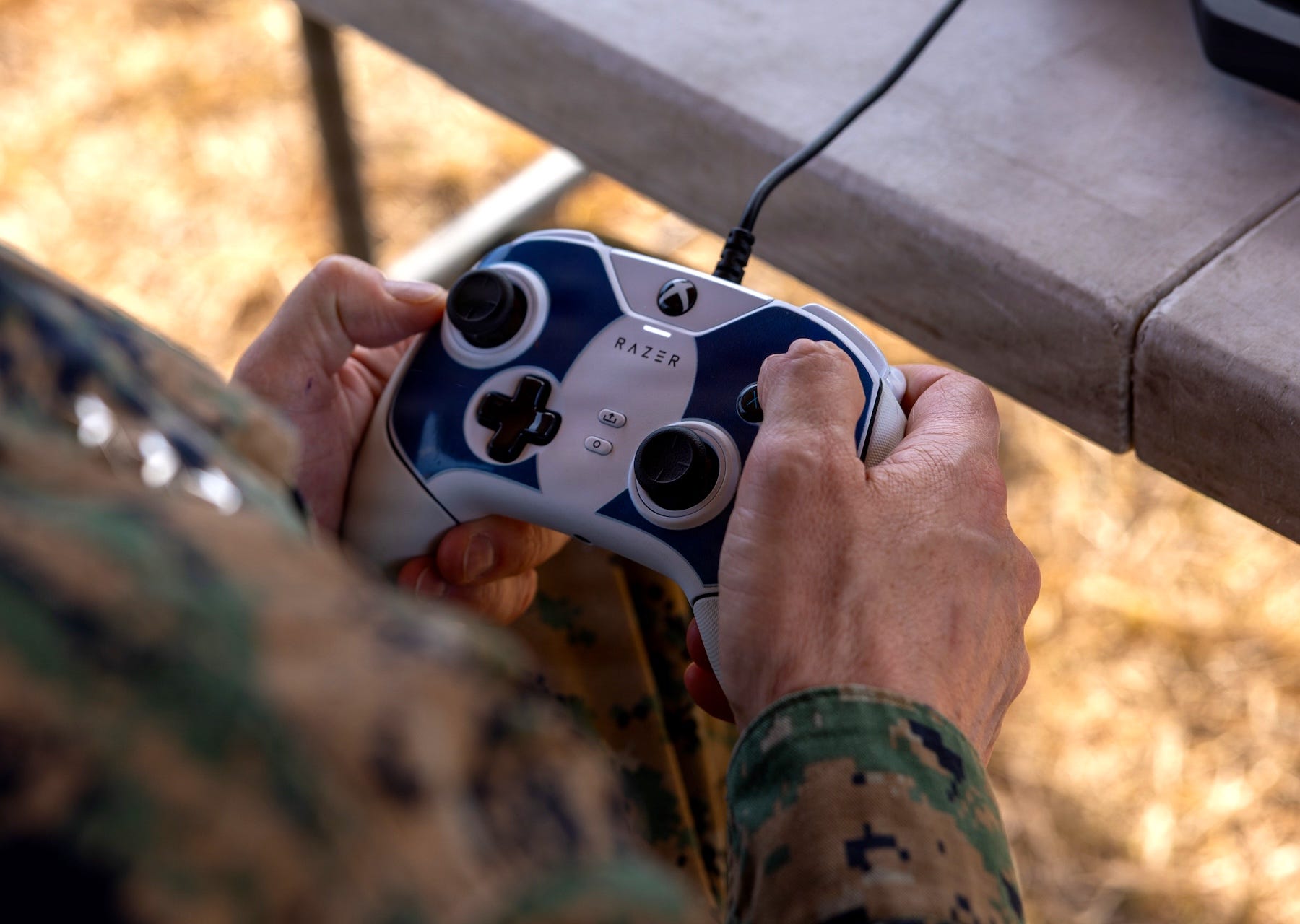
The Xboxification of Laser Weapons
High-energy laser weapons and video game-style controllers are a match made in heaven – for now.

One of the most distinctive features of the US military’s high-energy laser weapon of choice isn’t the system itself — it’s how operators control it.
In a 60 Minutes segment on military laser weapons that aired on March 15, CBS News correspondent Lesley Stahl traveled to Albuquerque, New Mexico for an up-close look at defense contractor AV’s 20 kilowatt LOCUST Laser Weapons System, which has been watching over US service members abroad (and triggering occasional airspace shutdowns near the US-Mexico border at home) in recent years. With Iranian Shaheds now pummeling the Middle East and the US Defense Department racing to field inexpensive countermeasures to address the ever-expanding threat of low-cost weaponized drones, Stahl explores the advantages (and limits) of laser weapons and how they fit into the evolution of modern warfare.
But my favorite part of the 60 Minutes segment is when Stahl takes a LOCUST for a spin and discovers that the futuristic laser weapon is operated with a tried-and-true Xbox controller, an interface AV bills as “a natural fit to today’s warfighter.”

For years, US service members have relied on Xbox controllers to operate everything from small unmanned systems like airborne drones, explosive ordnance disposal robots, and experimental ground vehicles to larger assets like the US Army’s M1075 Palletized Loading System logistics vehicle, remote controlled weapon stations, and even the photonics mast that has replaced the traditional periscope on the US Navy’s new Virginia-class submarines. The logic of embracing the handset simple: if the vast majority of Americans grow up playing video games and even continue playing into adulthood, why not adopt a control system that capitalizes on US troops’ pre-service experience and reduce the training timelines for advanced weapons systems?
“The gaming companies spent millions of dollars developing an optimal, intuitive, easy-to-learn user interface, and then they went and spent years training up the user base for the US military on how to use that interface,” as military technologist Peter Singer previously old me of the Pentagon’s Xbox fixation. “These designs aren’t happenstance, and the same pool they’re pulling from for their customer base, the military is pulling from … and the training is basically already done.”
Xbox controllers and high-energy laser weapons in particular appear to be a match made in heaven, and not just with LOCUST. More than a decade ago, the beam director on the US Army’s truck-mounted 10 kw High Energy Laser Mobile Demonstrator (HEL MD) was operated using an Xbox handset. Today, so is the 10 kw High-Energy Laser Weapon System (HELWS) from Raytheon that both the US and UK militaries have tested in recent years, according to a 2018 video published to the US military’s Defense Visual Information Distribution Service (DVIDS). So too is Boeing’s 5 kw Compact Laser Weapon System (CLaWS) that the US Marine Corps began evaluating in 2019. And at the 2026 Singapore Airshow defense exposition in early February, American laser company IPG Photonics showed off its new Crossbow Mini — a 3 to 8 kilowatt laser weapon billed as a compact air defense option for US and allied forces — alongside a similarly styled Xbox controller.1
Even laser weapons that don’t use Xbox’s proprietary controllers themselves still rely on their familiar ergonomics. As I previously reported,2 the US military has its own ruggedized handset, the Freedom of Movement Control Unit (FMCU), that’s based on the tried-and-true dual-grip video game controller and used to operate several advanced weapon systems, including the Navy’s 30 kw AN/SEQ-3 Laser Weapon System (also known as the XN-1 LaWS) that was previously installed aboard the Austin-class amphibious transport dock USS Ponce, the US Air Force’s laser-equipped Recovery of Air Bases Denied by Ordnance (RADBO) truck, and the US Marine Corps’ Humvee-mounted High Energy Laser-Expeditionary (HELEX) demonstrator.
While Xbox-style controllers may make laser weapons easier and more intuitive to operate, they don’t solve a larger problem facing the US military: with the rapid proliferation of autonomous weapons systems across the modern battlefield, combat now occurs at machine speed, with tactical decisions unfolding in mere seconds — and sometimes milliseconds. By the time a human operator can visually confirm a target, slew a controller’s joystick, fine-tune their aim, and fire off a laser beam, the engagement window may already have closed. The “human weapon system” can be just as much a bottleneck to swift and decisive action as the design of a human-machine interface.
Video game controllers have lowered the training barrier, but it’s artificial intelligence that may prove decisive in squeezing every last iota of “lethality” out of laser weapons. With the right computer vision and machine learning software, an AI-powered weapon system can ostensibly identify and track targets faster and, with the appropriate control surfaces, more precisely than even the most skilled US service member3 can muster manipulating a physical joystick — precision that’s essential for laser weapons that must maintain a stable beam on a single weak spot for several seconds to inflict catastrophic damage. Indeed, AV’s LOCUST system relies on its AI-enabled “Wisard” acquisition, tracking, and pointing software to lock on to fast-moving threats with uncanny precision to purportedly deliver maximum damage in minimal time.4 The result, company executives previously told me, is a 20 kw laser weapon that can deliver effects equivalent to a 100 kw system without piling on additional power.
AI is slowly creeping into other military laser weapons. As of February 2025, the Navy was actively working to integrate AI into the Marine Corps HELEX demonstrator ahead of live-fire testing. The Pentagon has been testing the autonomous Archimedes Laser Sentinel developed by startup Aurelius Systems for the last year. And this logic extends beyond the US military: Israeli defense firm Rafael plans on adding AI to its operational ‘Iron Beam’ laser air defense system so operators can shoot down drones with enough precision to at least somewhat control the disabled target’s descent, according to company CEO and President Yoav Tourgeman
“For example, if it’s an airplane and you cut the right wing, [it will] flip over and come to the right. If you cut the left wing, you will fall to the left. You have a kind of a control where, how to intercept it, where you will be landing,” Tourgeman told Breaking Defense at the Association of the US Army annual expo in October 2025. “You understand that there is room [for] the system to learn and improve itself. And now we have the capability of every target, to work on several interception methods that will give different results.”
The argument for marrying AI and laser weapons is persuasive: when engaging small, fast-moving drones, especially in swarms, maintaining a lasers’s dwell time is a punishing task, and algorithms ostensibly don’t get tired or distracted and let their aim slip in scenarios where even a instant off target can break an engagement. In that sense, the Xbox controller may ultimately become less a tool of direct control and more a supervisory interface, an intuitive way for a human operator to authorize or abort decisions already generated by software.
The Xbox controller makes laser weapons easy to operate for generations of US service members who grew up on video games. But as AI enables these systems to move at the speed of the threat, the big question is how long humans will remain in the loop at all.