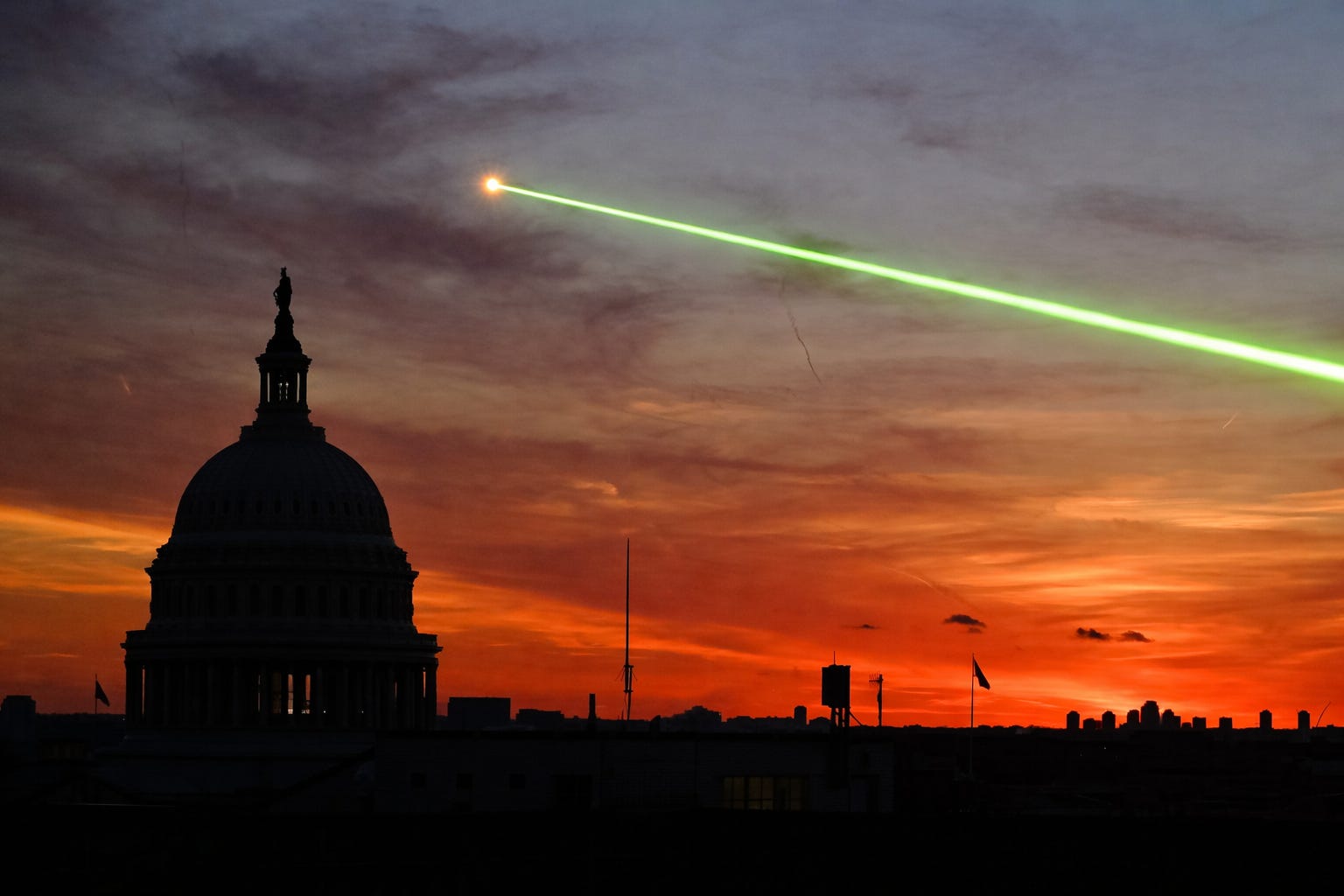
The Case for Building a Laser Dome Over Washington DC
Hear me out.

Washington DC may be the worst place in the United States to deploy a high-energy laser weapon. That may also make it the best.
The US Defense Department is considering deploying laser weapons to the nation’s capital amid concerns over unidentified drones probing the airspace above Secretary of Defense Pete Hegseth and Secretary of State Marco Rubio’s residences at Fort McNair, the New York Times reported on March 31.1 A US Army spokesman confirmed the Times that it had increased its counter-drone activities in the area in response to the reported drone sightings “to keep our service members and civilians who work and live on Fort McNair safe,” although they did not confirm whether laser systems were part of that effort.
In isolation, this is a logical response. But coming just weeks after two separate laser-related aviation incidents along the US-Mexico border, it raises a more uncomfortable possibility: the American government may be introducing a far more complex risk into the most sensitive airspace in the country.
Deploying laser weapons over Washington may seem like a terrible idea. But it may also be a necessary step in forcing US government decision-makers to rethink how the America defends its own airspace.
On paper, the National Capital Region (NCR) – the geographic area that encompasses the District of Columbia and several counties in Maryland and Virginia established in 1952 to strengthen regional cooperation and coordination – isn’t the worst idea for a directed energy sandbox. The region’s integrated air defenses are in desperate need of an upgrade beyond its current “small number of professionals equipped with systems largely designed and bought in the 1970s and ’80s, with no defined path to modernization,” as former US Northern Command and NORAD boss Air Force Gen. Glen VanHerck described it in 2024. One National Guard officer argued in June 2025 that the region’s fixed infrastructure and stable electrical grid also mean a laser emplacement wouldn’t struggle with the power generation issues plaguing forward deployed systems like the Army’s 50 kilowatt Directed Energy Maneuver-Short Range Air Defense (DE M-SHORAD), which officials previously acknowledged experienced “challenges” at various power levels during testing in the Middle East in 2024.
Unfortunately, the airspace over Washington is also an operational nightmare. The NCR represents some of the most densely trafficked, tightly managed, and politically sensitive airspace in the country.2 Every day, commercial aircraft descend into Ronald Reagan National Airport and Dulles International Airport, military helicopters shuttle officials across the region, and law enforcement and medevac aircraft must weave through a patchwork of restricted zones. The airspace only works (most of the time) because of a complex system of procedures, coordination, and constant communication between civilian and military authorities. The January 2025 collision between an American Airlines jet and an Army UH-60 Black Hawk helicopter that killed 67 people underscored how fragile that system really is. Civil and military aviation operate in close proximity, relying heavily on human coordination to stay deconflicted — but when that coordination breaks down, the consequences are immediate and catastrophic.
Now imagine introducing a new variable into that environment that operates at the speed of light, is invisible to the naked eye, and has no widely established rules for domestic use. That’s what a laser weapon deployment represents.
Alternatives to lasers exist, of course. Missiles and gun are tried-and-true countermeasures (albeit expensive and imprecise ones, respectively), and electronic warfare systems can render hostile drones inoperable. But those approaches also have limits in dense urban environments. Kinetic interceptors carry too much risk of collateral damage, and jamming threatens to interfere with civilian communications and navigation systems; meanwhile many small drones operate autonomously or on frequencies that are difficult to reliably disrupt. Even outside of laser weapons, there is no purely “safe” option, only different tradeoffs and the same questions surrounding airspace governance.
Existing airspace coordination systems were never designed to handle weapons like these at the scale required to effectively repel hostile drones. The Federal Aviation Administration (FAA) has already raised concerns about deploying laser weapons in particular along the US-Mexico border, citing risks to aircraft safety — concerns the Pentagon has actively taken steps to alleviate. But those fears are even more pronounced in the context of the NCR, where the risk of a misdirected beam, an unexpected reflection, or even interference with aircraft sensors in such highly trafficked airspace isn’t just an operational and regulatory challenge, but a political one as well.
These high-stakes circumstances actually make the idea of a “laser dome” over Washington more significant than a local security measure — it becomes a national test case, a forcing function for how the US approaches air defense at home. And that’s a good thing: if the federal government wants to deploy any kind of persistent countermeasures, let alone exotic directed energy systems, to defend against drones domestically, it will first have to figure out how to integrate them into the most complex airspace it controls. That means developing new rules, new coordination mechanisms, and new lines of authority that can reconcile military necessity with civilian safety. There is no shortcut around that process — and there is no better (or, for that matter, unforgiving) place to do it than Washington.
The Pentagon’s interest in placing laser weapons at Fort McNair is an early test of whether the US can adapt its airspace governance to accommodate a new class of countermeasures for a new era of warfare. Solve airspace deconfliction in the NCR, and a model for domestic air defense begins to take shape, one that could potentially extend to critical infrastructure, logistics hubs, and major public events across the country. Fail in the NCR, however, and the case for deploying these systems nationwide becomes far harder to justify.
Washington isn’t just the hardest place in the US to deploy a laser: it’s the place where the consequences of getting it wrong would be impossible to ignore. And for a nation suddenly waking up to the drone threat’s arrival on American soil, there may be no better crucible for rethinking the national air defense enterprise than the airspace directly above the decision-makers responsible for it.
Florida NBC News affiliate WPTV-TV claims an “anti-drone laser defense system” was deployed to Palm Beach International Airport near President Donald Trump’s Mar-a-Lago club, but the system in question actually appears to be a version of the US Air Force’s Rapidly Deployable Small Uncrewed Aircraft Defense System (RD-SUADS).
While Hartsfield-Jackson Atlanta International in Georgia is consistently ranked the busiest airport in the United States, the airspace above New York City is generally considered the country’s most congested and complex.