Last Ride of the HELIOS
Lawmakers want a containerized version of the US Navy's beleaguered chief high-energy laser weapon.

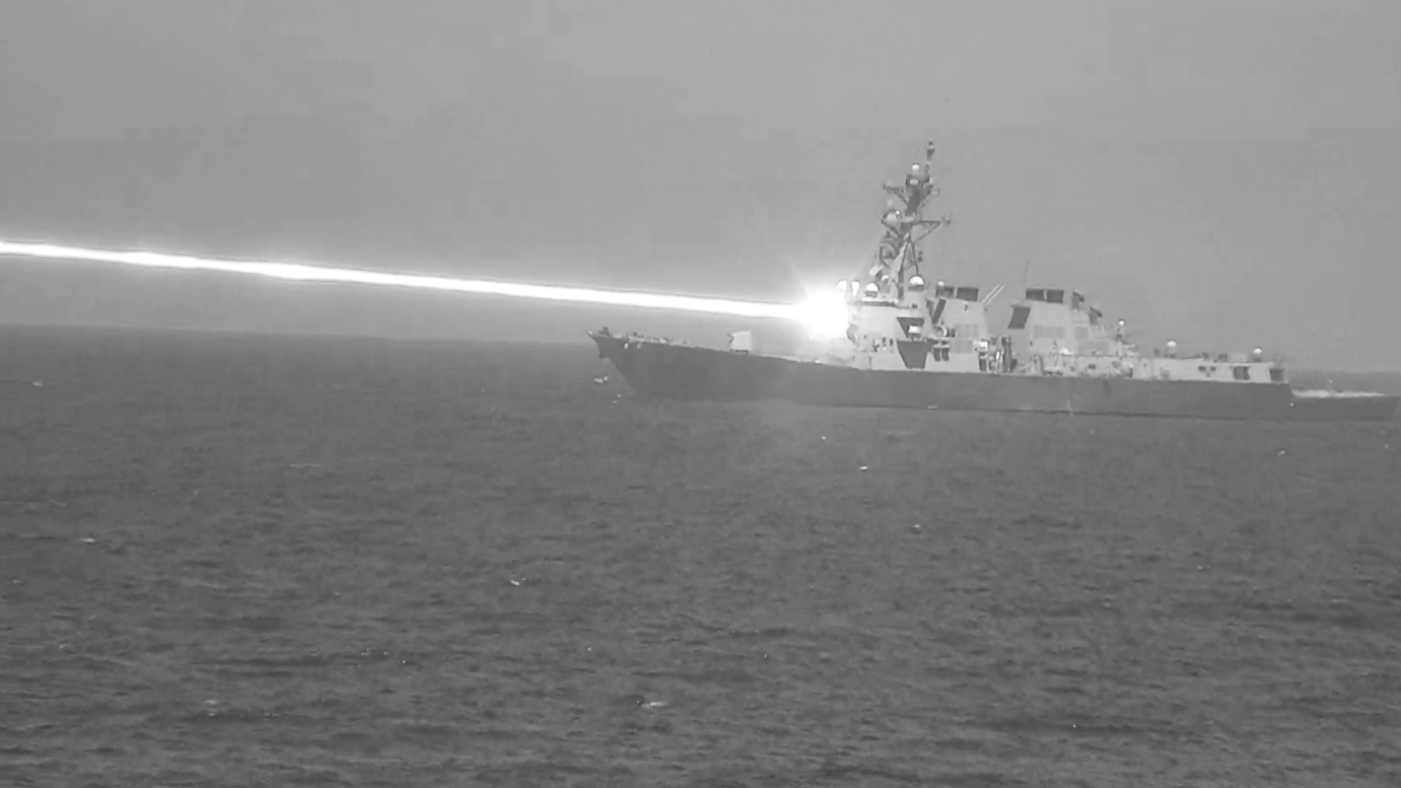
It cost nearly $350 million over more than a decade to develop. Its power levels have fluctuated due to unspecified “problems” during operational testing. It has managed to shoot down drones during at-sea demonstrations, but has not yet been fired in anger (that we know of). And it gave the world perhaps the coolest known photo of a high-energy laser weapon in action.
Now, the Navy’s beleaguered chief laser weapon is getting one final opportunity to shine before it’s cast aside in favor of a newer model.
Lawmakers are considering allocating an additional $5 million in funding to the US Navy under the service’s ‘Directed Energy and Electric Weapon Systems’ program element for a containerized version of its lone 60 kilowatt High Energy Laser with Integrated Optical Dazzler and Surveillance (HELIOS) system currently installed aboard the Arleigh Burke-class destroyer USS Preble, according to the ‘chairman’s mark’ version of the fiscal year 2027 National Defense Authorization Act released by House Armed Services Committee chairman Rep. Mike D. Rogers (R-Ala.) on May 26.
The Navy had previously requested $94.825 million under that program element primarily to kickstart development of the Joint Laser Weapon System (JLWS), the containerized 150 kw cruise missile killer that the US Defense Department envisions as a directed energy cornerstone of its ‘Golden Dome for America’ homeland missile shield. The budget documents did not contain any procurement dollars for HELIOS and only included $4.247 million in R&D cash solely for the system’s sustainment.
It’s worth noting that the chairman’s mark also contains an additional $2.5 million in proposed funding under the same program element for a so-called ‘Containerized Maritime High Energy Laser Weapon System.’ This funding is likely in support of the service’s push to marinize the US Army’s modular 30 kw Enduring High Energy Laser (E-HEL) system envisioned as the ground branch’s first official directed energy program of record. The Navy’s fiscal year 2027 budget documents contained $4.82 million in a congressional addition for that effort.
HELIOS was developed based on capabilities advanced through two earlier Navy shipboard laser programs: the 30 kw AN/SEQ-3 Laser Weapon System (better known as the XN-1 LaWS LaWS), which famously adorned the bow of the amphibious transport dock USS Ponce in 2014 before that vessel was decommissioned three years later, and the decommissioned (and since-resurrected) 150 kw Laser Weapon System Demonstrator Mk 2 Mod 0, which conducted at-sea firing tests aboard the USS Portland as recently as December 2021. Currently integrated directly into the Preble’s Aegis Combat System, HELIOS was supposed to finally translate a decade of hard-won at-sea lessons into an operationally useful laser weapon, and the Navy awarded prime contractor Lockheed Martin a contract with a $1.1 billion ceiling in 2018 to deliver at least two test units, with options for up to 14 production units through 2027 — options that were, needless to say, never exercised.
Indeed, the modest $5 million in proposed containerization funding represents a bright spot for a system that spent most of 2025 under a cloud. In May of that year, then-acting Chief of Naval Operations Adm. James Kilby disclosed to the House Appropriations Committee that HELIOS had only reached one-third of its intended power output during testing. The service’s fiscal year 2026 budget request released in June subsequently zeroed out R&D funding for HELIOS entirely, despite Lockheed executives’ insistence the following August that the system had been operating at full power for some time. Things appeared to be looking up for HELIOS in January 2026, when Lockheed CEO James Taiclet disclosed during an earnings call that the system had “successfully neutralized four drone threats” during a US Navy at-sea counter-drone demonstration, but the release of the Pentagon’s fiscal year 2027 budget request the following April all but confirmed that the system was going nowhere.

The congressional push for a containerized HELIOS fits squarely within the broader direction that Chief of Naval Operations Adm. Daryl Caudle has been steering the service toward for months. Speaking at the McAleese Defense Programs conference in Arlington, Virginia in March, Caudle laid out his vision in unambiguous terms: “From towed array sensors to drone swarms to electronic attack systems to high-powered lasers, I want to containerize everything.” He has since formalized that vision in a posture statement delivered to the House Armed Services Committee in May, framing his Containerized Capability Campaign (C³) as a mechanism to “decouple payloads from platforms” and deliver combat power “at the speed of relevance — not the speed of platform-centric acquisition.”
The explicit logic is that containerization allows the Navy to work around the power and integration constraints that have bedeviled efforts to bolt laser weapons onto existing warships. And there is proof-of-concept evidence behind the approach: In October 2025, the Navy conducted a live-fire test of the Army’s palletized LOCUST Laser Weapon System from the flight deck of the Nimitz-class aircraft carrier USS George H.W. Bush. With the modular (and operationally proven) LOCUST the leading contender of the Army’s E-HEL program and the JLWS envisioned as a containerized system from the start, containerization has become the Navy’s primary near-term strategy for rapidly fielding laser weapons as sea in meaningful numbers.

The congressional push for a containerized HELIOS makes sense: the system could follow the LOCUST model and swap across the surface fleet as operational needs dictate without requiring a lengthy and expensive integration process each time. There is also a knowledge-preservation argument: whatever its struggles, HELIOS represents the Navy’s most mature shipboard laser effort to date, the culmination of a decade of hard-won lessons about power, thermal management, and beam control under at-sea conditions. The JLWS is designed to build on those lessons, but a containerized HELIOS could serve as a more immediate testbed for the modular shipboard integration approaches the Navy will need to master before JLWS ever arrives.
While the US has wrestled over HELIOS’s power output, the global naval laser race has only accelerated. The UK Ministry of Defence has committed to fielding its 50 kw DragonFire laser weapon aboard a Royal Navy Type 45 destroyer by 2027. China publicly showcased its new LY-1 shipborne laser weapon at a military parade in Beijing in September 2025. Germany wants to field at least one operational laser weapon available to its surface fleet by 2029. Japan’s Kawasaki Heavy Industries recently tested a 100 kw shipboard directed energy system on a testbed ship. None of these programs appear to have fully solved the fundamental integration and environmental challenges that have dogged naval laser weapons everywhere, but the pace of development underscores a growing international consensus that directed energy at sea is a strategic necessity.
It’s unclear whether HELIOS containerization lifeline survives the full defense budget process, let alone proves tactically valuable under real-world conditions. But at the moment, this appears to be the system’s last shot at prime time before it follows the path of too many US military laser weapons before it: doomed to oblivion in the valley of death.