Why Aircraft Carriers Are the Best (and Worst) Place for Laser Weapons
High-energy laser weapons are a natural fit for large, power-rich aircraft carriers — with limits.

When US Navy leaders declared that “the dream of a laser on every ship can become a real one” earlier this year, they apparently had one particular ship in mind.
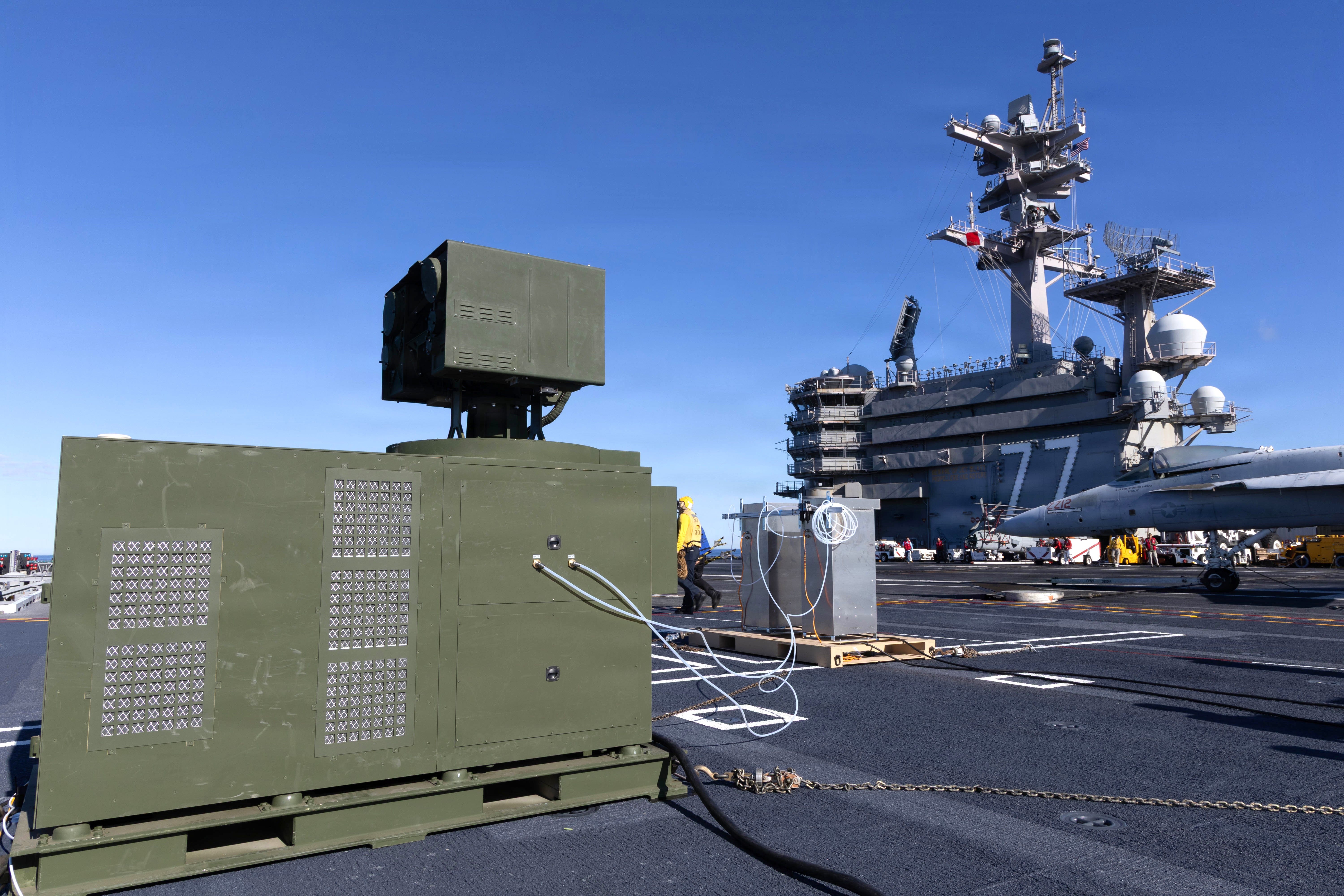
The Nimitz-class aircraft carrier USS George HW Bush shot down multiple drones with a high-energy laser weapon stationed on its flight deck during a first-of-its-kind live-fire test in October 2025, the Navy recently revealed. Photos published to the Defense Visual Information Distribution Service (DVIDS) on April 20 show a 20 kilowatt Palletized High Energy Laser (P-HEL) system — based on the LOCUST Laser Weapon System from defense contractor AV and on loan from the US Army’s Rapid Capabilities and Critical Technologies Office (RCCTO) — ahead of testing in the Atlantic Ocean.
The laser weapon “tracked, engaged, and neutralized multiple target drones, including drone swarms” from the deck of the Bush, AV officials said in a press release, “marking a major milestone toward fielding operational directed energy capabilities across all domains and platforms.” AV vice president for directed energy systems John Garrity told Laser Wars that the live-fire test involved 17 drones.
Beyond the containerized P-HEL, which has been protecting US service members from low-cost weaponized drones overseas or years, the Army currently possesses at least four LOCUST systems integrated onto M1301 Infantry Squad Vehicles and Joint Light Tactical Vehicles through the service’s Army Multi-Purpose High Energy Laser (AMP-HEL) initiative. The US Marine Corps also awarded a contract to AV in November 2023 to deliver a LOCUST laser weapon for integration into a JLTV, although it’s unclear if the service has taken receipt of that system yet.
As I previously reported, AV predecessor company BlueHalo1 had been in discussions with the Navy since at least 2024 to test the LOCUST not just on aircraft carriers, but potentially on submarines as well.
The live-fire aboard the Bush represents a departure from the Navy’s previous shipboard laser weapon efforts. As Laser Wars has previously noted, the service’s Arleigh Burke-class guided missile destroyers that host the 60 kw High-Energy Laser with Integrated Optical-dazzler and Surveillance (HELIOS) and lower-power Optical Dazzling Interdictor, Navy (ODIN) systems are inherently strapped for juice due to existing power demands from capabilities like the Flight III variants’ new AN/SPY-6 Air and Missile Defense Radar systems. As Garrity told Laser Wars, the Bush live-fire showed that LOCUST can not only recharge from an aircraft carrier’s nuclear reactors with ease, but that power requisition aboard Flight III destroyers should prove no significant obstacle to keeping the system in a fight.
Then there’s the space element. While the Navy had previously integrated the HELIOS and ODIN systems directly into Aegis Combat Systems across the service’s Arleigh Burke fleet, the employment of a palletized LOCUST is firmly in line with Chief of Naval Operations Adm. Daryl Caudle’s vision of a future surface fleet augmented by modular, containerized capabilities that can be rapidly configured for specific missions and deployed aboard warships without a costly and time-consuming integration process. (Indeed, HELIOS maker Lockheed Martin is also developing a containerized version of the laser weapon, a company executive revealed in September 2025.)
“Missiles and [unmanned surface vehicles] are not the only thing that can fit inside of these, from towed-array-systems, to drone swarms, to electronic attack systems, to high-powered lasers,” Caudle stated at the McAleese Defense Programs conference in Arlington, Virginia on March 17. “I want to containerize everything.”

At first glance, the aircraft carrier seems like the ideal naval platform for laser weapons, containerized or otherwise, simply because it does not suffer the same power or space constraints as smaller surface combatants. This isn’t a totally new concept: Navy Capt. William McCarthy, at the time the commander of the Nimitz-class aircraft carrier USS George Washington, argued in a study for the US Air Force Center for Strategy and Technology in 20002 that “given the sheer size and the margin of power available, the [Carrier Vessel Nuclear] is the best-suited warship to integrate the directed energy technologies” like laser weapons.
Just as importantly, aircraft carriers sit at the center of the Navy’s most valuable and threatened formations, prime targets for drone and cruise missiles attacks and other asymmetric threats like explosive-laden drone boats. The service has increasingly fielded novel counter-drone capabilities like Coyote and Roadrunner interceptors to carrier strike groups deployed to the Middle East for this exact reason following attacks by Iran-backed Houthi rebels in Yemen on military and merchant vessels in the Red Sea. With their low cost-per-shot and relatively deep magazines, laser weapons and other directed energy systems could potentially offer carriers a “robust self defense capability” so they can save their limited kinetic interceptor stockpiles for higher-end threats, as McCarthy put it, a capability that may also come with restored maritime mobility.
“Freed from the need for a layered defensive screen of ships, the nuclear powered carrier, operating in tandem with a nuclear powered submarine, could exploit its inherent speed and self-sufficiency to deny its adversaries an opportunity for conducting asymmetric attacks,” McCarthy argued. “By dispersing the battle group, each platform could choose the optimum location for its primary mission of launching cruise missiles, defending against theater missiles, protecting commerce, or maritime interdiction. This flexibility will become increasingly important as the Navy moves to a smaller and more capable force that operates in the littoral region close to the shore.”
Of course, the challenges that come with employing laser weapons in a maritime environment do not simply evaporate on the flight deck of an aircraft carrier. As Laser Wars previously noted, atmospheric instability wrought by water vapor, dust, salt aerosols, and temperature fluctuations can all contribute to bending, diffusing, or bleeding off energy from a laser beam, reducing even the most powerful system’s effectiveness. Meanwhile, access to a potent power source like a carrier’s nuclear reactors can’t overcome the fact that laser weapons require dwell time to neutralize incoming targets, meaning they can be easily overwhelmed by saturation attacks like those that have defined the rise of drone warfare. Sure, a single successful strike that squeaks through is nowhere near powerful enough to sink an aircraft carrier, but adversaries could plausibly exploit these dwell time constraints by using drones to run interference against laser emplacements or deplete interceptor arsenals to pave the way for devastating anti-ship cruise missiles.
But the more significant problem for carrier-based laser weapons may be actually using them during a high-intensity combat engagement. The flight decks on carriers are arguably among the most congested and dynamic airspace in military operations, with multiple aircraft launching and recovering during combat. Introducing a weapon that requires a stable, uninterrupted beam (that’s also invisible to the naked eye) adds a punishing layer of complexity to an already crowded battlespace, requiring meticulous deconfliction with friendly aircraft and sensors to avoid a catastrophic mishap. Now imagine that deconfliction playing out against, say, a swarm of incoming Iranian Shahed-136 drones. An carrier obviously does not suffer from the same jurisdictional or governance ambiguity that yielded the airspace-closing laser shootdown in El Paso, Texas in February, but the same risk of friendly fire remains a valid concern even with automated safety layers like those integrated into the LOCUST system.3
The Bush live-fire proves that laser weapons are a natural fit for large, power-rich aircraft carriers, but the more pressing question is whether they can function effectively within the compressed and chaotic battlespace that such capital assets designed to survive. Once thing is certain: when the Navy’s laser carrier is ultimately put to test, it will almost certainly be a trial by fire — or, in this case, light.
AV completed its acquisition of BlueHalo in May 2025. I interviewed the latter’s CEO, Johnathan Moneymaker, the previous year for an article for Fast Company.
Yes, this study is fairly old and therefore, but it’s also extremely comprehensive with regards to the relationship between Nimitz-class aircraft carriers like the Bush and directed energy weapons.
Is this analysis completely off base? Shoot me a note with critiques or suggestions: