The Global Laser Weapon Wave
The UAE offers vivid proof that high-energy laser weapons are proliferating faster than anyone predicted -- and the Iran war revealed a looming challenge on the horizon
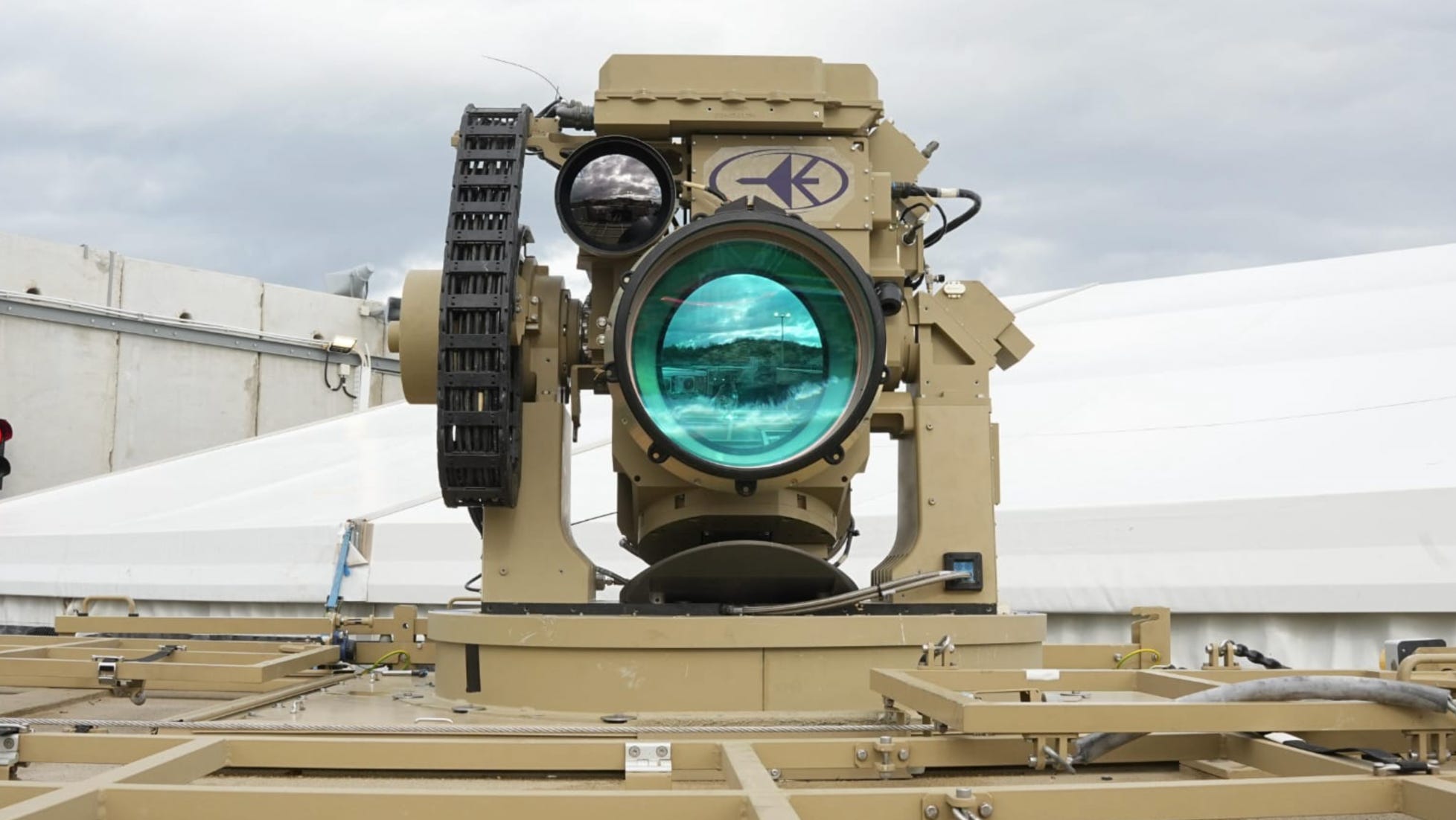
On April 30, the Financial Times reported Israel had sent a version of its 100 kilowatt Iron Beam high-energy laser weapon to the United Arab Emirates to help Abu Dhabi fend off hundreds of missiles and drones fired by Iran since the beginning of the US military’s Operation Epic Fury. The FT notes the deployment is one of the first examples of major defense cooperation between the two countries since the 2020 Abraham Accords — a display of “the value of being Israel’s friend,” according to a regional official.
There is little information publicly available on Iron Beam’s performance in the UAE. But on May 7, Defence Blog reported a Chinese-made vehicle-mounted laser weapon had been spotted at Dubai International Airport. Tentatively identified as consistent with the Guangjian-21A system first displayed at the Zhuhai Airshow in 2022, there was no announcement of the systems’ export from Beijing or an acknowledgement of its arrival in the country from Abu Dhabi.1
The sudden appearance of laser weapons in the UAE isn’t a total surprise: the government has previously expressed interest in procuring foreign directed energy systems through both direct sales and strategic partnerships and even pushed to develop its own indigenous research and development ecosystem. But neither story mentioned that the Abu Dhabi was already in the process of acquiring an American laser weapon system as well. A notification to Congress published on April 15 revealed that the UAE had asked to buy 10 counter-drone Fixed Site-Low, Slow, Small Unmanned Aircraft Integrated Defeat Systems (FS-LIDS) from the US Defense Department for $2.1 billion — and, notably, the system’s command and control (C2) architecture was being specifically scoped to integrate an unnamed laser weapon “being purchased” by Abu Dhabi through direct commercial sales.2
Three laser weapons. Two geopolitical blocs. One customer. This is the state of the global laser weapons race: a competitive, proliferating market where systems from rival powers increasingly coexist in the same inventory and even the same operational theaters.
In September 2025, Laser Wars wrote that the world was approaching a laser weapon inflection point. This analysis followed a week in which China unveiled its LY-1 shipborne laser weapon at a Beijing military parade, the United States delivered its first laser-armed Infantry Squad Vehicles to the US Army, France ordered a new counter-drone laser demonstrator, and India tested its Integrated Air Defence Weapon System with a directed energy component. I concluded with a hedge: the winner of the global laser weapon arms race “won’t be a question of technological superiority, but who has the political will to make their directed energy dreams a reality.”
If that week in September marked an inflection point, then the UAE’s expanding laser weapon arsenal is part of a larger global wave — one that doesn’t just answer the political will question, but raises another one that will define how directed energy weapons reshape the battlefield for years to come.
In roughly four weeks across April and May, the pace of global laser weapon development reached a tempo that I haven’t seen since (and has arguably exceeded) since that inflection point analysis.
On April 10, Germany’s Bundeswehr published a account of laser weapon testing at its WTD 91 range in Meppen detailung four distinct systems at staggered readiness levels, including a JUPITER German-Dutch joint system integrated into a Boxer fighting vehicle and the naval demonstrator tested aboard the frigate Sachsen that’s headed for an operational deployment by 2029.
On April 21, the Australian government announced plans to double its investment in counter-drone capabilities to $7 billion over the next decade, with an initial $21.3 million contract to AIM Defence to further develop its Fractl portable high-energy laser system. A week later, Defence Industry Minister Pat Conroy stated that Australian Army plans on mounting laser weapons on its next tranche of 300 Bushmaster vehicles.
On April 22, Army Recognition reported that China’s Novasky Technology was pitching its 3 kw truck-mounted NI-L3K laser weapon at the Defence Services Asia 2026 weapons expo in Malaysia. Designed as a last line of defense against drones, the company stated that the weapon was explicitly designed for export, the second such systems to surface in as many weeks amid Beijing’s increasing involvement in the global directed energy arms trade.
On April 24, the Seoul Economic Daily reported, citing sources, that South Korea planned on deploying a second 20 kilowatt Cheongwang laser weapon near Seoul to shoot down North Korea drones, with an accelerating timeline toward broader coverage of critical infrastructure like nuclear power plants, airports, and seaports by 2027.
On May 1, state-run TASS reported that Russia’s government had issued a formal decree listing counterdrone laser weapons among the systems on active duty protecting the country’s airspace borders. While Russia’s laser weapons have long existed in the murky overlap between confirmed capability and propaganda, the decree is a solid indication that Moscow’s systems may have tipped into the former category.
On May 5, Turkey showed off multiple new laser weapons — namely ASELSAN’s 10 kw Gokberk 10 and TÜBİTAK’s 20 kw YGLS (purportedly scalable to 80 kilowatts) — at the SAHA 2026 in Istanbul. Both systems feed into the country’s “Steel Dome” concept, which envisions a unified command-and-control architecture integrating missiles, radar, electronic warfare, and directed energy into a single national air defense network.
On May 6, the United States announced that the Pentagon’s Joint Interagency Task Force 401 had selected five military installations to participate in a directed-energy counter-drone pilot program, a major step towards the formulation of a domestic ‘laser dome’ to defend strategic assets and critical infrastructure. Operations are expected to begin later this year, following a 180-day period to finalize deployment plans with installation commanders.
On May 7, Ukraine’s Celebra Tech announced that its Tryzub laser complex — first mentioned publicly by the head of Ukraine’s Unmanned Systems Forces in December 2024 and demonstrated in April 2025 — had been integrated into a trailer-mounted mobile platform and was preparing for a public presentation following final tests. The system now claims an effective range of 1,500 meters against reconnaissance drones, 800 to 900 meters against FPV drones, and, according to the company, practical capability against Shahed-type UAVs at distances up to 5 kilometers, with AI-assisted targeting and radar integration added during the most recent development sprint.
The question September’s analysis left open has been answered: multiple militaries, in different ways and at different speeds, have demonstrated that the political and institutional will exists to translate laser weapon technology into operational reality. The UAE is slowly becoming the world’s busiest laser weapon market. Germany is testing parallel programs toward market readiness. Australia is rewriting its defense budget. China is showcasing more and more export-ready systems at defense expos. South Korea is expanding deployments. Russia is enshrining lasers in national air defense doctrine. Turkey is building an indigenous industrial ecosystem. Ukraine is compressing a decade of development into 16 months of wartime necessity. Even the US, characteristically deliberate in its development and deployment of next-generation defense technologies, appears to be playing for keeps when it comes to directed energy.
Political will, it turns out, is the easy part — and the Iran war revealed the harder problem hiding inside the very deployment that seemed to prove laser weapons had finally arrived.
In March, the IDF acknowledged it was not using Iron Beam regularly during the US-led war with Iran despite the Israel Defense Ministry’s December 2025 disclosure that the system had been formally rolled out in the field. The gap between that announcement and that admission was three months, during which Iron Beam was simultaneously celebrated as a historic milestone and quietly sidelined from the conflict it was built to fight.
In May, the Israel Air Force explained why: Iron Beam requires 14 batteries to have significant enough impact — batteries Israel simply didn’t have.
This doesn’t just complicate the subsequent UAE deployment, but Israel’s ostensible laser supremacy as well. Israel developed the Iron Beam, funded it for a decade, used it in active combat operations, formally declared it operational, and deployed it to a foreign ally’s soil, but 14 batteries were still more than it had when it needed them most. Effective ranges, kilowatt counts, engagement times — none of it matters if you don’t have enough critical systems in the field.
Those 14 batteries are the most important data point in the laser weapon story of 2026, underscoring the core challenge looming over the extraordinary global wave of laser weapon activity that has unfolded over the last month: laser weapon technology appears proven, combat-tested, operationally deployed, but its critical components are not yet produced at the scale that modern drone warfare demands.
As a result, the next phase of the global laser weapon arms race will be purely industrial. Who has the supply chain depth, production capacity, and procurement urgency to field not one laser weapon or four or ten, but enough of them to matter against the coordinated, multi-vector saturation attacks that the Iran war proved are now the baseline threat environment?
The solution to the scale problem is far from evenly distributed:
China appears to be in the strongest industrial position. With a defense industrial base that has demonstrated the ability to scale hardware from concept to export catalog at speeds Western procurement systems cannot match, Beijing’s two-track export strategy — budget systems like the NI-L3K for price-sensitive customers, higher-capability systems like the Guangjian-21A for more sophisticated ones — appears designed to dominate the global laser weapon market the same way Chinese drones dominate the commercial market: by being cheaper, faster to market, and available to customers that Western export controls exclude.
So far, Israel has the deepest operational knowledge, with dozens of Hezbollah drone kills beginning in 2024. Part of this is a product of the country’s unique organizational culture of defense tech innovation, where the IDF deploys systems that are “good enough,” learns in combat, and iterates. Still, 14 batteries is a supply chain problem, not a culture problem, and solving it requires industrial capacity that Israel does not have in unlimited supply even when operating at wartime levels.
Turkey is building the most integrated indigenous approach among mid-tier military powers with the Steel Dome architecture that combines laser weapons like the Gokberk, YGLS, and ALKA-Kaplan “laser tank” into a unified national system designed for both strategic autonomy and export competitiveness. If this architecture succeeds, Turkey becomes the template for a dozen other countries looking to build sovereign laser weapon capability without dependence on US or Israeli suppliers or exposure to Chinese technology concerns.
Ukraine is running the world’s most compressed and most instructive directed energy development program, driven by the most unforgiving possible testing environment. What Celebra Tech has learned about real-world laser weapon performance against real Russian drones is operational data that no test range can replicate, and Tryzub’s development sprint from December 2024 to approved combat sample by May 2026 is a preview of how laser weapon development works when the consequences of failure are immediate and concrete.
The US, meanwhile, occupies a paradoxical position in the global laser weapon race. It remains the world’s most significant investor in directed energy R&D and its alliance relationships and export controls continue to shape who gets access to what defense technology and when, but the “valley of death” between American laser weapon R&D and deployments remains persistent and costly compared to, say, Israel and Ukraine’s accelerated efforts. That said, the most consequential role in the global laser weapon market may not be the systems it builds but the architecture it sells: the FS-LIDS counter-drone package the UAE requested is defined by backbone C2 infrastructure that will determine what UAE acquires plug into a coherent network. Washington’s ability to set the integration standards for allied capabilities is a different and underappreciated kind of directed energy power.
The laser weapon inflection point has passed. The Iran war has revealed that political will may be necessary to transform laser weapons into real-world military capabilities, but it is far from sufficient; indeed, 14 batteries is a political will problem only in the sense that manufacturing more Iron Beam systems requires budget decisions and industrial investment. Every government incorporating laser weapons into their national security strategy, every defense company pitching laser systems at export shows, every military planner now integrating directed energy into layered air defense architecture — all are signing up to face this challenge sooner rather than later.
Amid this new global laser weapon wave, the UAE’s expanding laser weapon arsenal offers a clear picture of where the directed energy arms race actually stands. The world has accepted that laser weapons work. The question that defines what comes next is purely industrial — who can build enough of them, fast, to matter when the next barrage begins. And right now, even the country with the best laser weapon in the world doesn’t have the batteries to answer it.
China continues to furnish Iran with critical components for the very drones that have pummeled the UAE, according to recent reporting from the Wall Street Journal
The system in question is likely FS-LIDS prime Raytheon’s High-Energy Laser Weapon System (HELWS) based on Abu Dhabi’s past engagements with the defense contractor. The UAE Ministry of Defense and Raytheon declined to provide additional details when reached for comment by Laser Wars.