
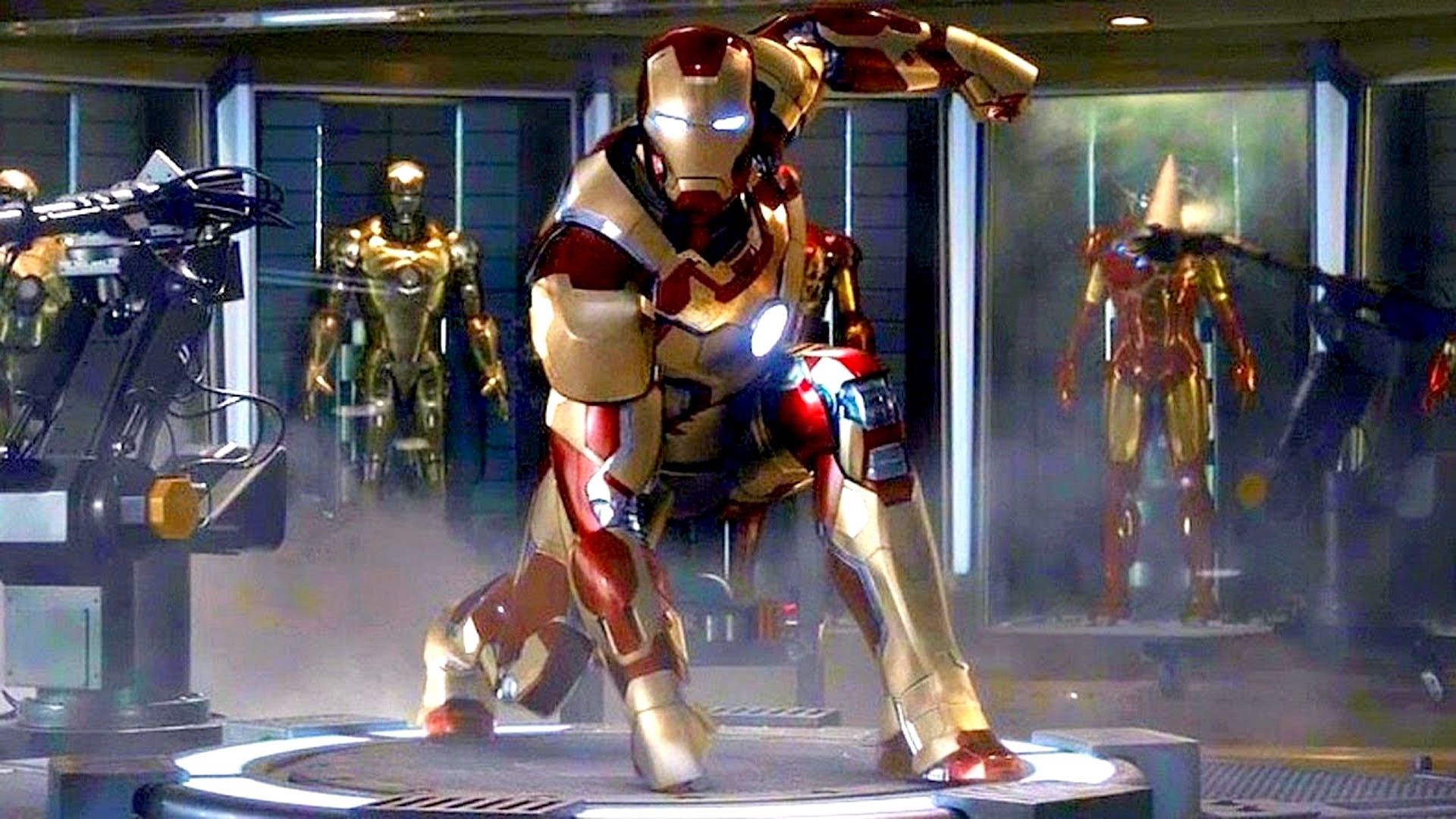
The soldier of the future doesn’t carry his weapon into battle — he simply wears it.
In Robert Heinlein’s beloved 1959 novel Starship Troopers, Johnny Rico’s powered battlesuit is a second skin of servos and armor that makes him faster, stronger, and more lethal than any warrior in the history of warfare. Standard-issue for members of the Mobile Infantry, the suit enables Rico to leap across a battlefield in a single bound, shrug off small-arms fire like a predator swatting at errant gnats, and haul enough ordnance to level entire city blocks. This ultimate military exoskeleton, Heinlein wrote, was so seamlessly intuitive that “you don’t have to control it; you just wear it, like your clothes, like skin.” No intensive training or complex interface required — you step in and become something more than human.
Within two years of Starship Troopers’ publication, the US Defense Department was soliciting the US defense industrial base for a real version: a “servo-soldier” wrapped in a suit of powered armor that will enable him to “run faster, stop quicker, and lift bigger loads than ordinary mortals,” as Armor magazine put it the time. By the time Marvel Comics introduced Tony Stark and his Iron Man suit in 1963, the US military-industrial complex was already racing to beat the fiction to market.
Now, after decades of research and development, the Pentagon’s exoskeleton dreams are coming true — just not in the way it imagined.
The vision of a performance-enhancing exoskeleton is actually older than Starship Troopers. The first patent for a spring-powered exosuit was granted to Russian engineer Nicholas Yagn in 1890; another, for a “power operated running device” that ran on steam, was granted to American inventor Leslie Kelly in 1919. In 1951, Serge J. Zaroodny, a scientist at the US Army’s Ballistic Research Laboratory (now part of the Army Research Laboratory), initiated research into the biomechanical augmentation of American service members that culminated in a 1963 report “describing the results of an informal evaluation of a pneumatically powered prototype device — possibly the first powered performance-augmenting exoskeleton ever created,” according to wearable robotics pioneers Aaron Dollar and Hugh Herr in their seminal 2008 overview of the technology. While Zaroodny did not succeed in securing Pentagon funding to further pursue his project, his research was among the first to identify and attempt to address many of the fundamental challenges that would plague future exoskeleton efforts, from portable power supply to the human-machine interface itself.
The history of the powered armor R&D that followed (at least, for the US military) is defined by the gulf between what military planners envisioned and what engineering and physics permitted. As I previously reported, General Electric’s “Hardiman” suit, developed in the 1960s under a dual US Army-US Navy effort, was a colossal apparatus driven by hydromechanical servos. Hardiman was supposed to let a soldier haul a thousand pounds across inhospitable terrain; unfortunately, the system was incapable of advancing above two miles per hour due to what testers described as “violent and uncontrollable motion by the machine,” according to a 1971 report — useless in any potential combat scenario. In the 1980s, Los Alamos National Laboratory engineer Jeffery Moore proposed the “Pitman suit,” a vision of robot armor so advanced it remained a concept without ever producing a prototype.

In 2001, the Defense Advanced Research Projects Agency awarded $50 million in grants to the Berkeley Robotics and Human Engineering Laboratory and Sarcos Research Corp. to develop prototypes under the agency’s Exoskeletons for Human Performance Augmentation (EHPA) program. Development of the former’s Berkeley Lower Extremity Exoskeleton (BLEEX) was taken over by Lockheed Martin through a licensing agreement in 2009, and the system became the basis for the Human Universal Load Carrier (HULC), a hydraulic exoskeleton that enabled operators to carry up to 200 points with minimal effort. Sarcos was acquired by Raytheon in 2007 and went on to showcase a full-body Guardian XO powered exosuit for industrial applications in 2020. Both efforts failed to produce a system suited for operations in the field, let alone high-intensity combat.
The US military’s most recent attempt at powered armor was the Tactical Assault Light Operator Suit (TALOS) launched by US Special Operations Command in 2013 with an ambitious promotional vision of an armor-plated super-soldier capable of withstanding direct fire from small arms. Known colloquially by military planners as the “Iron Man suit,” SOCOM confirmed in early 2019 that, after five years and the participation of over 100 companies and universities, it had “no intent to field the TALOS Mk 5 combat suit prototype” beyond a demonstration; the suit itself, per a SOCOM spokesman, is now quite literally collecting dust in a box somewhere. TALOS failed not by lack of ambition, but by what its overseers diagnosed as the fatal flaw of every powered exoskeleton before it: “complex subsystem interdependencies.” Too many disparate and complex systems simply couldn’t operate seamlessly together in a way that felt, as Heinlein promised, like simply wearing clothes.
As of today, the servo-soldier remains out of reach: decade after decade, the Pentagon stands up a new program, pours in money and engineering talent, and watches each effort collapse under the same recurring challenges. And yet, on battlefields and in logistics depots around the world, the dream of military exoskeletons lives on — just in a more limited and considered form.
Over the last decade, the US military’s exoskeleton efforts have slowly but surely moving forward once again. The Army’s Robotics and Autonomous Systems strategy released in March 2017, stated that the service would pursue exoskeleton research primarily “to lighten the soldier load in the future” as a near-term priority as the Pentagon began its pivot from counter-insurgency operations in the Middle East to “great power competition” with technologically-advanced “near-peer” adversaries like Russia and China. The following October, in a letter to senior officials laying out the Army’s core modernization priorities for the coming decades, then-Army Chief of Staff (and later chairman of the Joint Chiefs of Staff) Gen. Mark Milley declared that the service would eventually field “load-bearing exoskeletons” as part of a renewed emphasis on “soldier lethality. The next year, Milley directed DEVCOM to undertake “a detailed engineering analysis of existing and emerging exoskeleton products” for their potential military applications.
This push appears to have yielded a series of fresh technology experiments in recent years. In 2022, the Army conducted field testing of the Soldier Assistive Bionic Exosuit for Resupply (SABER) to prevent back injuries. In early 2024, the Army and Baylor University were conducting biomechanical analysis of medical tasks at combat medic training sites to understand how exoskeleton technology could reduce musculoskeletal injuries. Later that year, soldiers tested commercial off-the-shelf systems while hauling artillery shells to and from howitzers at Fort Sill, Oklahoma. In December 2025, US Air Force personnel were actively testing exoskeletons from Roam Robotics for loading cargo onto transport aircraft in the US Central Command area of operations. And as recently as May, the Army Medical Research and Development Command showed off its Intrepid Battlefield Exoskeleton (IBEX), a collapsible seven-pound lower-leg stabilizer designed to let wounded soldiers stand, walk, and self-evacuate without waiting for a litter team. The Army’s fiscal year 2027 budget request even includes (modest) funding for R&D to examine exoskeleton technologies to reduce rate of injury experienced by litter bearers tasked with transporting wounded troops from the battlefield.

The US military isn’t the only fighting force currently testing exoskeletons. In March, Ukraine’s 7th Air Assault Corps posted video of soldiers using Hypershell exoskeletons on the Pokrovsk front to help artillery crews lug shells around the battlefield. Separately, Ukrainian troops have also been testing the “Gyurza-1,” a domestically developed passive exoskeleton that has no electronics or batteries that purportedly enables users to carry loads of up to 150 pounds while significantly reducing spinal stress..
China has been moving in a similar direction. In August 2025, state broadcaster CCTV-7 aired footage of People’s Liberation Army soldiers conducting exercises in rugged highland terrain, with one trooper visibly equipped with a rudimentary unpowered exoskeleton frame intended to reduce back strain during long marches. In recent years, the PLA has been selectively deploying exoskeletons to units operating in physically demanding conditions, like the high-altitude mountain brigades and border defense regiments in Tibet and Xinjiang where soldiers regularly conduct long foot patrols and supply missions at high elevations.1 (Also: France.)

To be clear, these exoskeletons are the products of incremental pilots and trials, with demos and testing that are as much tools of military propaganda as they are science and technology efforts — they do not necessarily represent meaningful progress towards the technology’s widespread adoption. Indeed, the only fighting force to actually procure and deploy such systems at scale is the Royal Australian Air Force (RAAF), which purchased 470 HeroWear Apex 2 exosuits, based on the SABER system, to lighten the load for aerial porters tasked with hauling cargo and building pallets.
But more importantly, none of these fledgling systems, whether prototype or production model, resemble the Pentagon’s long-sought powered armor — and that’s precisely the point.
The current exoskeleton applications that appear successful share four traits: they target a specific part of the body, like the back or knees; they are passive or minimally powered; they solve a specific and unglamorous logistics problem; and they are light and simple enough that a soldier will actually wear them. These are not the descendants of TALOS; they will not allow you to launch H.E. bombs from your Y-rack every couple of hundred yards. As military planners and defense contractors spent decades fixating on a powered battlesuit that transforms a single soldier into a one-man army, they consistently overlooked other promising applications — like, say, preventing the musculoskeletal injuries that make up 95 percent of all US military injuries, mostly from overuse. The problem for ground forces has never really been “how do we make one soldier fight like ten”; instead, it’s “how do we stop breaking soldiers’ bodies before the war is over.”
The broader lesson of the exoskeleton’s slow emergence on the battlefield may be about the nature of defense technology hype cycles and how they distort procurement. TALOS failed in part because it was conceived as a single unified system — every subsystem had to work, all the time, seamlessly, or the whole thing was useless. (As I reported in 2019, at least 10 TALOS subsystems were identified’ for “further maturation and testing” despite the effort’s conclusion.) The exoskeletons succeeding today don’t promise to transform warfare — just let an artilleryman come home from a deployment with their knees and back (somewhat) intact.
The dream of powered armor, from the mobile infantryman from Starship Troopers to Iron Man, was always a fantasy: an endlessly alluring but wildly unrealistic vision of mechanized combat that obscured more enduring applications. Militaries may believe they need super-soldiers to win the next big war, but they also need their conventional troops to still b functional after months lugging ammunition through difficult terrain and getting wounded personnel back on their feet. The exoskeleton that serves those needs weighs less than a rifle, has no batteries, and fits in a briefcase. It will likely never appear in a Marvel movie — but it will, however, appear on a battlefield near you.2
There is a geopolitical dimension worth noting: while China’s military-civil fusion model is generating what may be the most robust exoskeleton R&D ecosystem in the world by drawing on state defense conglomerates, private venture capital, and university programs simultaneously, the US Army told me in 2024 that the service has not determined what the primary purpose of a “military exoskeleton” even is, a striking admission for a country that has been funding such research since 1961.
Thanks to Vanderbilt University’s Dr. Karl Zelik for his insights.


I think you article is overly negative - existence and real world testing of armored exosuits like EXOM disproves most of your points. Power armor will come to battlefield some day but probably in a highly specialized role like urban fighting units, where battery life is less of an issue.