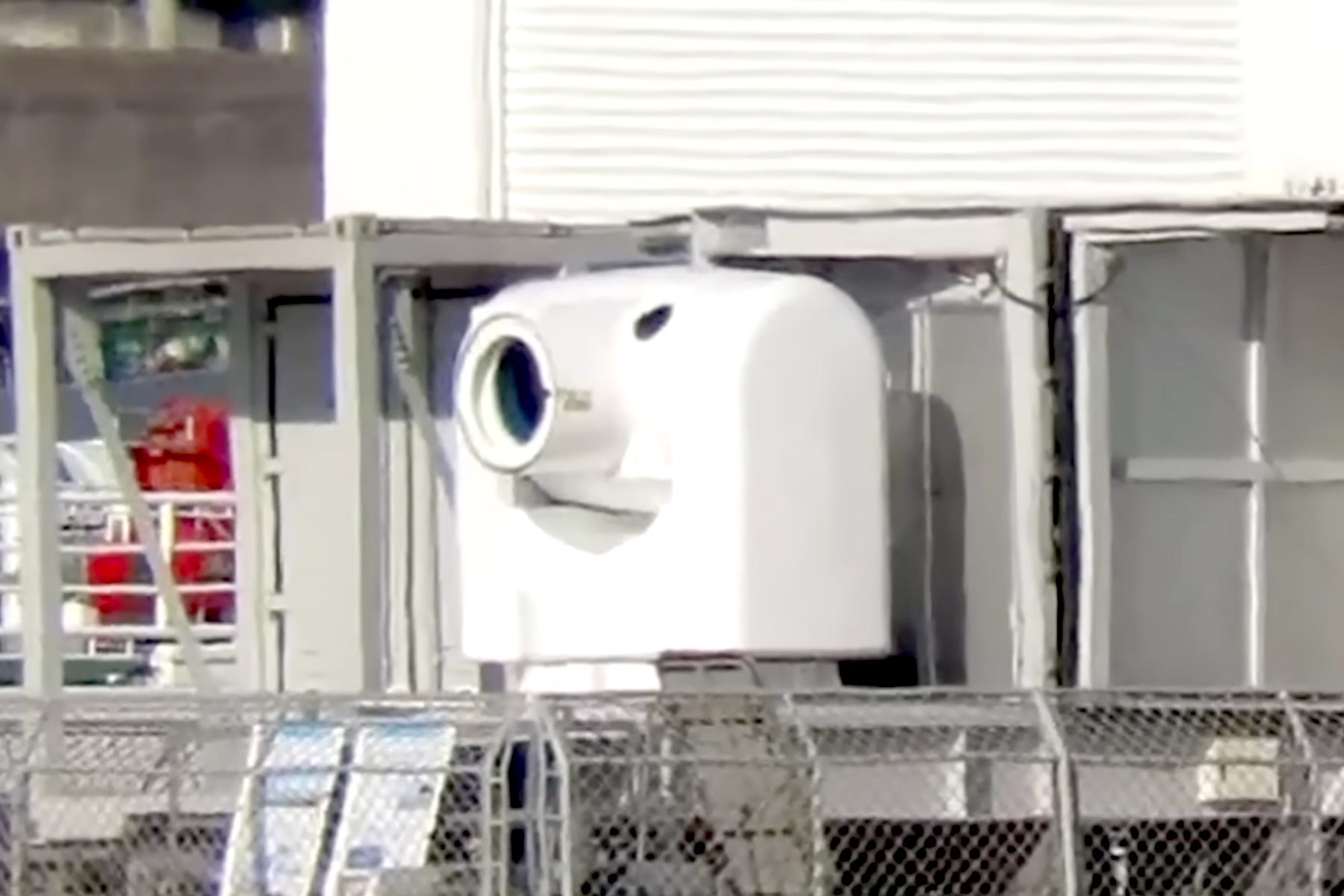
Japan Is Testing a Laser Weapon on a Warship for the First Time
A prototype high-energy laser weapon was spotted on the deck of an experimental testbed ship.

The Japanese military appears to have installed a high-energy laser weapon aboard a warship for testing, according to new footage of the system.
A YouTube video published on December 3 by defense observer @agcdetk shows a prototype laser weapon system developed by the Japan Ministry of Defense’s Acquisition, Technology & Logistics Agency (ATLA) on the deck of the Japan Maritime Self-Defense Force (JMSDF) experimental testbed ship JS Asuka, a floating laboratory for advanced weapons that recently played host to the service’s much-hyped electromagnetic railgun earlier this year.
The system, designed to defeat incoming drones and mortar rounds, fuses ten 10 kilowatt fiber lasers into a single 100 kw array, according to ALTA. The weapon appears housed in two 40-foot containers that include a beam director mounted on a sleek white turret along with the requisite power and cooling subsystems.
Japan’s interest in high-energy lasers is not new, but the pace of development has accelerated in recent years. A 2023 ALTA report notes that the MOD initiated research into chemical lasers in 2010 to determine the feasibility of a system capable of tracking and destroying targets before eventually pivoting to more practical, electrically-powered fiber lasers architectures. In 2021, ALTA awarded contracts to Japanese manufacturers Kawasaki Heavy Industries (KHI) and Mitsubishi Heavy Industries (MHI) to develop 10 kw and 100 kw demonstrators.
These investments quickly paid off. KHI’s demonstrator successfully defeated 81mm mortar shells and small trials during trials in February 2023, according to the ALTA report. In November 2024, ALTA unveiled a 10 kw laser weapon mounted to a command station on an 8x8 truck chassis developed in partnership with MHI.
The weapon that appeared on the deck of the Asuka appears to be an evolution (or perhaps even a repackaging) of the existing KHI demonstrator. Based on the containerized configuration, the system looks virtually identical to the unit used in the 2023 trials. This aligns with KHI’s messaging: at DSEI 2025 this past May, company officials emphasized that its naval variant was “still a concept,” as Naval News put it at the time, suggesting that the version aboard Asuka is more of a test article than a near-term operational model.

That prototype sits within a much larger, long-term investment push. The MoD requested ¥18.3 billion ($118.4 million) in R&D funding related to shipboard laser weapons in fiscal year 2025, slightly below the ¥19.1 billion ($123.6 million) requested the previous year, according to government budget documents. This past July, ALTA issued a solicitation to prospective defense contractors regarding the “Research and Prototyping of Shipborne Laser Systems,” per media reports, with R&D scheduled from fiscal 2025 to 2029 and testing to validate the system slated to conclude by 2030.
Taken together, those timelines suggest that Japan’s laser efforts are maturing just in time for integration into its future surface combatants. An MOD spokesman told Jane’s in July 2024 that the JMSDF was studying the integration of laser weapons into the 13DDX air defense destroyers, a next-generation class that could represent Japan’s first warships built from the keel up with directed energy weapons in mind. This continues an effort dating back at least to 2015 to arm warships with both kinetic and energy-based interceptors.
While the system aboard Asuka is almost certainly a prototype, Japan’s move to test a high-energy laser system at sea marks a significant milestone in its slow but steady march toward operational directed energy weapons. And with the global pursuit of naval laser weapons only accelerating amid the rising threat of low-cost weaponized drones, Japan clearly isn’t content to watch the race unfold from the pier.