Indonesia Has a Laser Rifle
The Indonesian Navy is entering the laser wars.

Indonesia has joined one of the strangest arms races of the modern battlefield: the global sprint to build counter-drone laser rifles.
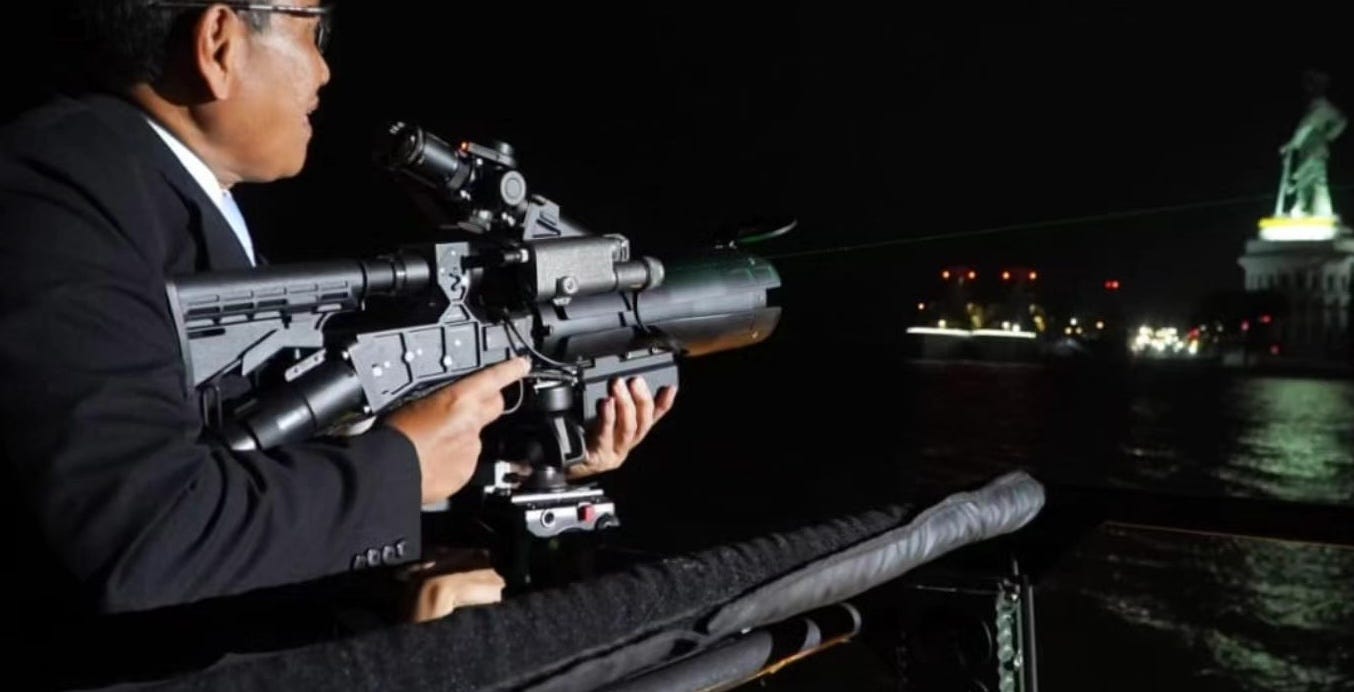
At the naming and launch of the warship KRI Balaputradewa — the Indonesian Navy’s first domestically built frigate and namesake of the new class of surface combatants — in the city of Surabaya on December 18, state-owned shipbuilder PAL Indonesia conducted a live-fire demonstration of a 2 kilowatt handheld laser weapon before high-ranking military officials, Radio Republik Indonesia (RRI) first reported.
Photos posted to social media that day show Indonesian Deputy Defense Minister Donny Ermawan Taufanto and PAL Indonesia President Director Kaharuddin Djenod operating the unnamed system, which appears outfitted with rifle-style ergonomics like an AR-style grip and buttstock.

PAL Indonesia first unveiled the laser rifle, designed to dazzle and blind the optical systems of incoming drones, at the Indo Defence 2025 military and defense expo in Jakarta in June, Army Recognition reported at the time. Weighing roughly 4.5 kg (nearly 10 pounds), the system’s separate backpack-mounted battery purportedly packs enough juice to disrupt the cameras on small drones at an effective range of up to 500 meters.
The Indonesian Navy plans on equipping its future Balaputradewa-class frigates with the system, according to RRI. If deployed at sea, the system could offer Indonesian sailors a low-cost option for dealing with small drones in crowded maritime environments where missiles and gunfire carry significant risk.

Handheld laser systems, primarily non-lethal dazzlers, have been a fixture of military (and law enforcement) operations around the world for decades.1 As recently as 2022, US Navy sailors used B.E. Meyers Glare LA-9/P dazzlers to ward off an Iranian patrol boat that harassed a group of American warships as they transited the Strait of Hormuz, while teams of Ukrainian service members were employing military-grade lasers to illuminate incoming Russian drones for gunners on the ground to target. While the 1995 UN Protocol on Blinding Laser Weapons bans systems designed to cause permanent blindness to humans, most modern dazzlers (including Indonesia’s) are intended to produce temporary, reversible effects, particularly against sensors rather than people.2
In recent years, several countries have increasingly pursued higher-power handheld laser systems that go beyond the typical dazzler in terms of potential damage. In 2018, China unveiled its ZKZM-500 laser rifle which, described as a “laser AK-47,” could purportedly induce “‘instant carbonization’ of human skin and tissues.”3 French laser giant CILAS debuted its High Energy Laser for Multiple Applications - Low Power (HELMA-LP) system in late 2024, although that weapon is designed to destroy static targets rather than engage airborne threats. This past March, an unspecified Russian defense group showed off a laser rifle explicitly intended to shoot down drones at ranges of up to 500 meters; South Korean arms manufacturer LIG Nex1 debuted its own system the following August. Even India is reportedly working on a handheld directed energy weapon to deal with hostile drones.

At 2 kw maximum power output, Indonesia’s laser rifle is far from a drone-killing death ray. But in the age of first-person view (FPV) drones laden with explosives taking out million-dollar military assets, degrading a system’s ability to see by blinding its cameras can prove just as valuable as shooting it down, especially in comparison to more expensive countermeasures like missiles and less reliable ones like standard-issue firearms. The War Zone’s Tyler Rogoway and Joseph Trevithick laid out the case for laser dazzlers as an overlooked drone countermeasure in July 2024:
Fully disrupting a drone operator’s video feed, or even just heavily degrading it, can negate their effectiveness. FPV drones, in particular, can be moving so fast that just a brief loss of situational awareness can lead to them going well off course and/or crashing as a result. This is especially true when making their terminal attack runs. This has already been observed when it comes to the use of radio-frequency jamming to disrupt camera feeds and control links between drones and their controllers.
In addition, whether a drone is armed or not, being able to blind its cameras impedes its ability to perform reconnaissance and surveillance tasks.
A laser rifle is, of course, far from a silver bullet. Like other laser weapons, atmospheric obscurants pose a significant challenge for beam coherence, one that’s especially pronounced when faced with the fog, sea spray, and general humidity of maritime settings like the ones the Indonesian Navy reportedly envisions for the system’s future operational employment.
But there’s also a fundamental problem specific to handheld laser weapons: their human operators. Identifying, acquiring, tracking, and disabling a fast-moving drone’s camera or sensor array amid the chaos of the battlefield requires a level of precision that may prove beyond even the most experienced military marksman, even despite the reduced dwell time required compared to higher-energy laser systems. Indeed, a growing number of modern laser weapons are integrating artificial intelligence to ensure they can engage targets at machine speed — that is, faster and better than the average infantryman armed with an assault rifle4 or manning a remote weapon station. It’s unclear if PAL Indonesia’s system offers this capability.
Whether Indonesia’s new laser rifle can overcome these limitations in real-world conditions — especially against fast, low-flying FPV drones — remains an open question. Still, the new system underscores how the brutal economics of unmanned warfare are pulling even mid-tier militaries into the directed energy arms race. And on a battlefield flooded with cheap drones, blinding them may be good enough.
The delayed fielding of laser dazzlers to US Marines deployed to Iraq was the focus of one of the earliest US military whistleblower incidents of the Global War on Terrorism.
The UN protocol did not stop China from purportedly using its crew-served ZM-87 Portable Laser Disturber to laze a Canadian military CH-124 helicopter surveilling a suspected Russian spy vessel in the Strait of Juan de Fuca between the United States and Canada in 1997, which resulted in ocular injuries to the Canadian pilot and his US Navy passenger. Five years later, North Korean troops allegedly used the system to laze a pair of US Army Apache helicopters flying along the Korean Demilitarized Zone.
Nobody has seen or heard from the ZKZM-500 since, suggesting it is likely another piece of high-tech military vaporware.