
How to Power a Laser Weapon
Chariot Defense founder and CEO Adam Warmoth talks directed energy, expeditionary power, and what your Tesla has in common with a laser weapon.
Welcome to In Focus, an occasional interview series with subject matter experts in the directed energy space.
Adam Warmoth is the founder and CEO of Chariot Defense, a San Francisco-based start-up building battlefield power systems to bridge expeditionary forces’ energy gap at the tactical edge. The company’s Amphora battery system provides modular voltage and low-signature power for everything from radios and drones to sensors and directed energy systems.
This interview has been edited for length and clarity.
LASER WARS: How did you end up here? Was there an “aha!” moment for you where a light bulb went off over your head? What was the genesis of Chariot Defense?
ADAM WARMOTH: It was almost exactly two years ago, at SOF Week 2024, that I had this light bulb moment. I realized that the core commercial technology around high voltage batteries and silicon carbide power electronics that I had been working with and getting exposed to at Archer, Uber Elevate, and Kitty Hawk, and what was coming out of companies like Tesla and Rivian — there was this incredible breakthrough driven by the electric vehicle and electric aircraft industries, and the technology just wasn’t making its way into defense.
Half of my career was spent on electric aircraft, and the other half was spent at Anduril, where I was a program manager for counter-drone systems and air defense systems. We were deploying counter-drone systems into contested expeditionary environments, and one of the biggest problems we had was that these passive systems needed a high active draw when making an intercept. Our solution was these big diesel generators that we ran inefficiently 24/7, created a targetable signature, and had serious reliability issues. There was no product available that could solve these problems that could actually deploy in a military environment, had a secure non-Chinese supply chain, and was designed to be interoperable with all the US military’s existing equipment around power generation and mobility.
I had looked into something that I could buy and didn’t see it, and then I had this light bulb moment: all of this incredible Electric Vertical Take-Off and Landing (eVTOL) technology is now mature and ready for employment at a time when the battlefield was becoming much more decentralized, distributed, and reliant on electronic systems like drones and counter-drone systems. So that the light bulb moment: to bring this commercially validated breakthrough technology amid increasing demand.
What do people not understand about power and laser weapons?
People think about something you plug into the wall, and that’s how they think about power. That’s how they interact with power. What they don’t realize until they turn the microwave and the toaster on at the same time and pop a circuit breaker is there’s a maximum amount of power you can pull from the grid at any time. To go up to these higher power levels that laser weapons require, from 10 kilowatt to megawatt-class systems, you have to fundamentally rethink your power architecture, and that’s where you have to go to high voltage
This is where the EV and eVTOL breakthroughs make what we do possible: Tesla, Rivian, Archer, Joby — all of these platforms have 400V battery architectures. The simple math of power is that power equals current times voltage, so if you want to go to high power, you either have to have high current or high voltage. All military systems today are built around this low voltage architecture, but that means if you set a certain max current, you need a certain size cable — the higher the current, the more thermal loss that you have, and the more you have to deal with getting rid of that waste heat that’s generated. By going to high voltage, you can actually deliver a lot of power while keeping the current low. The problem is that, at these higher power levels and voltages, traditional solid state electronics transistors break down, and so there was no real way to do this kind of power conversion and management without massive transformers and substations.
The breakthrough that makes it possible now is silicon carbide, which allows you to apply the same digital control and solid state control of data to larger flows of power at higher voltages where traditional electronics would break down. Tesla, from the Model S in 2012 to the Model 3 in 2018, was able to cut the size and weight of their drive inverter — the component that takes a battery’s high voltage DC power and converts it into AC power that drives the motor — by a factor of 10. This is an order-of-magnitude, game-changing breakthrough in material science that allows you to get up to those higher power levels, those 10 kw, 50 kw levels, without needing massive transformers that make mobile employment of a laser weapon impossible. All of that innovation and commercialization of that technology was happening at EV and eVTOL companies, and all of our engineering talent comes from that world.

What are the unique power and battery requirements of laser weapons, and how does Chariot approach this problem?
Laser weapons are unique in power profile, but what we see is people often conflating the concepts of power and energy. Power is energy over time: just like how position and velocity have this relationship as a rate of flow, you have to think about power as how fast is energy delivered. And so laser systems and directed energy systems have a high demand for power and need a lot of energy in a very short amount of time, but the overall aggregate amount of energy is actually quite low because of the rate: it’s a lot of energy demanded for a couple seconds, and then the laser is done firing and power demand drops to zero. The aggregate energy used by a laser shot to take down a drone is actually very small, even though the demand for power is very high.
This dynamic creates challenges that traditional kinds of power generation are not well suited to. Engines are happy running at one happy speed: they’re designed and optimized for a specific RPM and run inefficiently when they’re operating outside of that. If you want to be able to employ these laser and directed energy systems at the edge, you really need to take a hybrid approach that takes the best of burning fuel with traditional generators and pairs that with batteries, which much better at delivering those surges of power
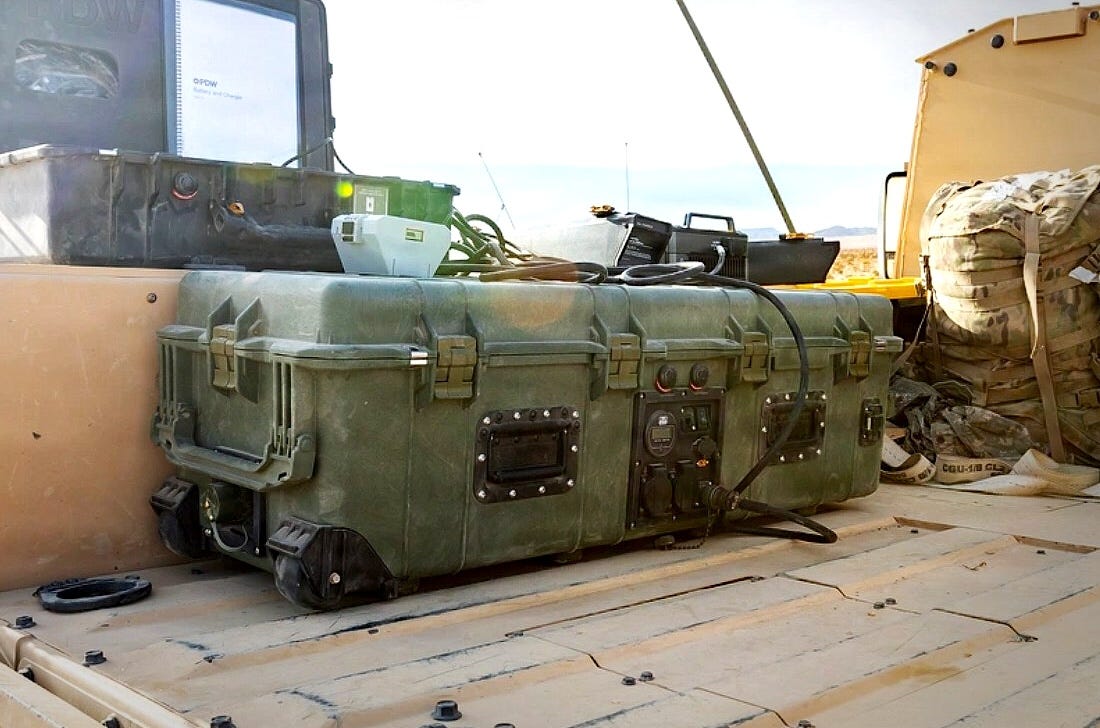
Our 30 kw power system is about a third of the size of a traditional 30 kw generator. If your peak power demand is that 30 kw, we can deliver you that peak power in a system that’s a third of the size of the equivalent generator. Pair that with a generator that’s sized for your average load, and you can use the energy density of fuel to deploy energy forward to the edge and generate the power at a time and place of your choosing. With an appropriately sized generator for your average demand, you can use that to charge up a battery and have that battery handle those big surges of power when you need to be able to take a laser shot. This is Chariot’s core reason for existence: to build hybrid architectures that harness the best of traditional power generation.
The other challenge of a pure generator-based solution is that you’re running your engine really inefficiently, because most of the time you’re not drawing much power. You’re also generating a targetable signature — the heat and noise of the system that’s detectable by enemy sensors. That targetable signature is always on because you have to be ready to provide power to that laser system at any moment. So you have efficiency challenges, signature management challenges, and then mobility problems, where you have to bring the generator sized to your peak demand, which is three to five times larger than the equivalent battery system. And there are a lot of reliability problems as well. Traditional generators fail a lot: they have a lot of moving parts and need constant maintenance and oil changes. Battery systems and solid state electronics do not.
What applications do you see beyond directed energy? Where do you see that system deployed in the long term?
Amphora can be a platform that can support all of the future electronic systems on the battlefield. We’re seeing a massive transition towards an electronically defined battlefield, with directed energy being the most power-intensive version of this and having the highest power demand. But lots of things that are being deployed on the battlefield today need distributed, reliable, low-signature, high-efficiency power. That includes charging drone batteries: when that drone lands, you need to charge that battery as fast as possible to get it back out into the air. That includes to power the sensors that are detecting the drones to be able to give your counter-drone capabilities something to shoot at, such as radars, camera systems, RF sensors, and electronic warfare systems.
Then you need to be able to charge other batteries for other drones and robots that rely on edge compute. There’s all this stuff in the news about how hard it is for us to provide power for all these data centers, and then now we’re trying to take all that same compute capability and push it to the off-grid, to the edge, where that compute is even more important because you don’t necessarily always have assured communications. So we’re throwing a bunch of edge compute on these platforms, at the point where the data is actually being generated and consumed, and seeing a lot of challenges keeping those systems powered. These systems all need high-quality power, but they’ve been designed on the assumption that they’re plugged into the grid, and the power sources that they’re plugging into in the field often have a lot of spikes, brownouts, or blackouts. Our systems provide a clean, consistent power for all of those sensitive electronic compute communications systems.
One common benefit military officials and defense contractors talk about with regards to directed energy is the “infinite magazine”: the assumption is that a laser weapon can keep shooting as long as it’s there’s power available. What is the real world architecture of this, and does Chariot allow for something like this?
This is where the math of the hybrid system really makes sense. The battery in our larger system is 15,000 watt hours, so it can power a 10 kw laser shot for an hour and a half. The math scales proportionally up and down based on how much power your laser needs, and that provides you that magazine depth. And what’s really important here is that it allows you to provide all of that completely silently, so you’re not running a generator on idle 24/7 just ready to take that shot. You can have the battery just sitting, waiting, ready 24/7 for whenever that shot is required. If you have a small drone flying at you, you’re going to have five seconds to respond, so you need to have that always ready with available power without creating all these challenges around poor fuel efficiency and detectable and targetable signature.
Now, eventually that magazine is going to be consumed, especially if your battery is not just powering your laser but also communications and compute systems and sensors and all the other loads that are required to run a node in the field. That’s where the hybrid configuration really matters. If you have to bring all of your energy forward in batteries, you have to bring 12 pounds of batteries to match one pound of fuel in terms of usable energy, but if you can bring some of that flexible power conversion, either by pulling power off of vehicles or small generators, you can bring your energy forward as fuel to backfill and recharge that battery. That’s how you achieve infinite magazine depth. You don’t want to be driving a dead battery back to the rear, charging it off the wall, and then driving it back forward, right? That’s not realistic in a contested environment. So you need that ability to recharge on the edge off of vehicles and generators. That’s really one of the unique aspects of our approach to this: yes, we have a battery in the system, and yes, we are big believers in the benefits of batteries, but you have to think about how you use fuel to recharge it, because deploying that energy forward as fuel is a much more efficient way than to deploy it as batteries.
This ties into our core thesis, which is focused on batteries as power, not batteries as energy. What the battery provides in this hybrid setup is the instant power delivery capability decoupled from your power generation. The energy of the battery is almost as small as we can make it while still being able to manage power demands, and then the fuel provides that energy reserve for magazine depth.
How has your outlook for the directed energy industry changed recently? In the last six months, we’ve had officials declaring we’re going to field laser weapons at scale in three years, and President Donald Trump posts memes of lasers all the time to Truth Social. The laser hype is real — do you see all this progress going in a direction where the next administration is going to come in and just kneecap it all?
We are certainly building a business that is robust to any timelines there. We have stuff to drop in and provide value today without directed energy, but we still see directed energy as that like platonic ideal, the most valuable use case of where this hybrid system is most impactful. We are very excited about the progress in directed energy, because it creates such a clear demand for our system as complementary product, and even though we’re not dependent on it for what we see as our growth over the next couple of years, the maturation of those technologies and their deployment is something that we’re very excited for our business and for the country.
There’s so much talk about the cost of these munitions and the asymmetric cost delta of shooting down a $20,000 drone with a $3 million missile, and that only increased with Operation Epic Fury — if that wasn’t already a topic at the front of everyone’s minds, it certainly is now. There’s a chart floating around about the falling cost of the watt, or of fiber laser components. There’s some big cost reductions happening in the core technologies and components behind laser weapons, from what I’ve been reading, and then you’re going to combine that with the growing operational demand for a low-cost down capability, so we very much see that trend accelerating.
Critically, these systems are going to need to be deployed on mobile platforms. Power is not really a problem when you’re fighting from a static position. You can bring massive diesel generators, you’re not worried about mobility or signature management or even logistics really. You may even have some kind of shore power or grid power you can tap into. But it’s really when you fight in a distributed, decentralized, contested environment where you really need advanced, miniaturized, edge-deployable, mobile systems. That’s where we see the battlefield going, and that’s where our products really shine as an enabler in that mobile, distributed, contested environment where efficiency matters, mobility matters, and signature management matters to bring maneuver back to the battlefield.
What we’ve seen in Ukraine over the last several years is a very static kind of trench warfare. That is not a fight we want to be in. If we want to be able to maneuver, we need systems on vehicle platforms, and that means we need modern power distribution and power management on those platforms as well.
Are you working closely with any laser companies?
So we’ve now done three demos with Aurelius Systems. We just got back from an exercise called Technology Readiness Experiment (T-REX) — I was in Indiana last week at Camp Atterbury, powering live shootdowns of drones with their systems, all powered completely silently off of our Amphora system. They’ve been our main partner in the directed energy space.
You had a significant raise in recent months — a $34 million Series A led by Andreessen Horowitz. What does the company roadmap look like over the next few years?
A lot of that funding is going right into scaling our production. So, with our Amphora system, we have significant demand for that. We’ve sold systems to multiple US Army units, we’ve sold systems to B2B partners for counter-drone applications that are currently deployed downrange in theater. So we are powering air defense systems in contested environments today with that product, and we’re looking to scale up the production of Amphora 24 and take Amphora 400 from its early pilot stage right now into production as well.
We’re also exploring more integrations onto different platforms, taking the same core technology we’ve developed. Our current products are bolt-on and meant to be as adaptable as possible to the current platforms and power generation sources, so we’re really going to be building out more of our platform integrations, working with other OEMs, and building out our software and microgrid control software platform as well.
I’d be remiss if I didn’t ask about supply chain challenges. Have there been many issues that you’ve faced in developing your products?
The great thing that we have about our position in this industry, in this ecosystem is, as I like to say, we are delivering the most valuable kw hour in the world. If you held an auction and you said, “I can magically deliver one kw hour of energy to anyone in the world, and it will be in a usable form, and it will just magically appear in this usable form that you can consume for whatever you need it for” … if you ran that auction today, I think the winning bid would probably be someone on the front lines in Ukraine who is actively being targeted by drones and needs to keep their electronic warfare jammer and counter-drone systems online. They would win that auction of the 8 billion people in the world — I think that person would find the most value in that kw hour.
This allows us to pay a little bit of a premium for a secure supply chain for high-performance components. And we actually see this as an exciting opportunity for us to help companies who are reshoring and doing domestic and allied production of some of these core battery and power technology components, to say, “We will actually help you get down your cost curve, because we have a customer who’s willing to pay for that performance, who’s willing to pay for that secure supply chain, so we can actually be a customer of you, because we have a customer that we can then sell that to.” We can help them get down their cost curve at the same time we’re getting down our cost curve, then they can actually start serving more industries at a commercially competitive price point.
One last thing: What’s your favorite fictional laser weapon and why?
I mean, the one that immediately comes to mind is definitely the Death Star from Star Wars, but you probably get that one a lot. I guess I’d have to say the flash memory-clearing thing from Men in Black. Think about it like a dazzler, right? It’s light that messes with your brain. That was my unconventional thing, but if you want the conventional answer, it’s the Death Star.
✉️ Are you a directed energy subject matter expert or enthusiast with a spicy take you’re desperate to share? Drop me a line:


