


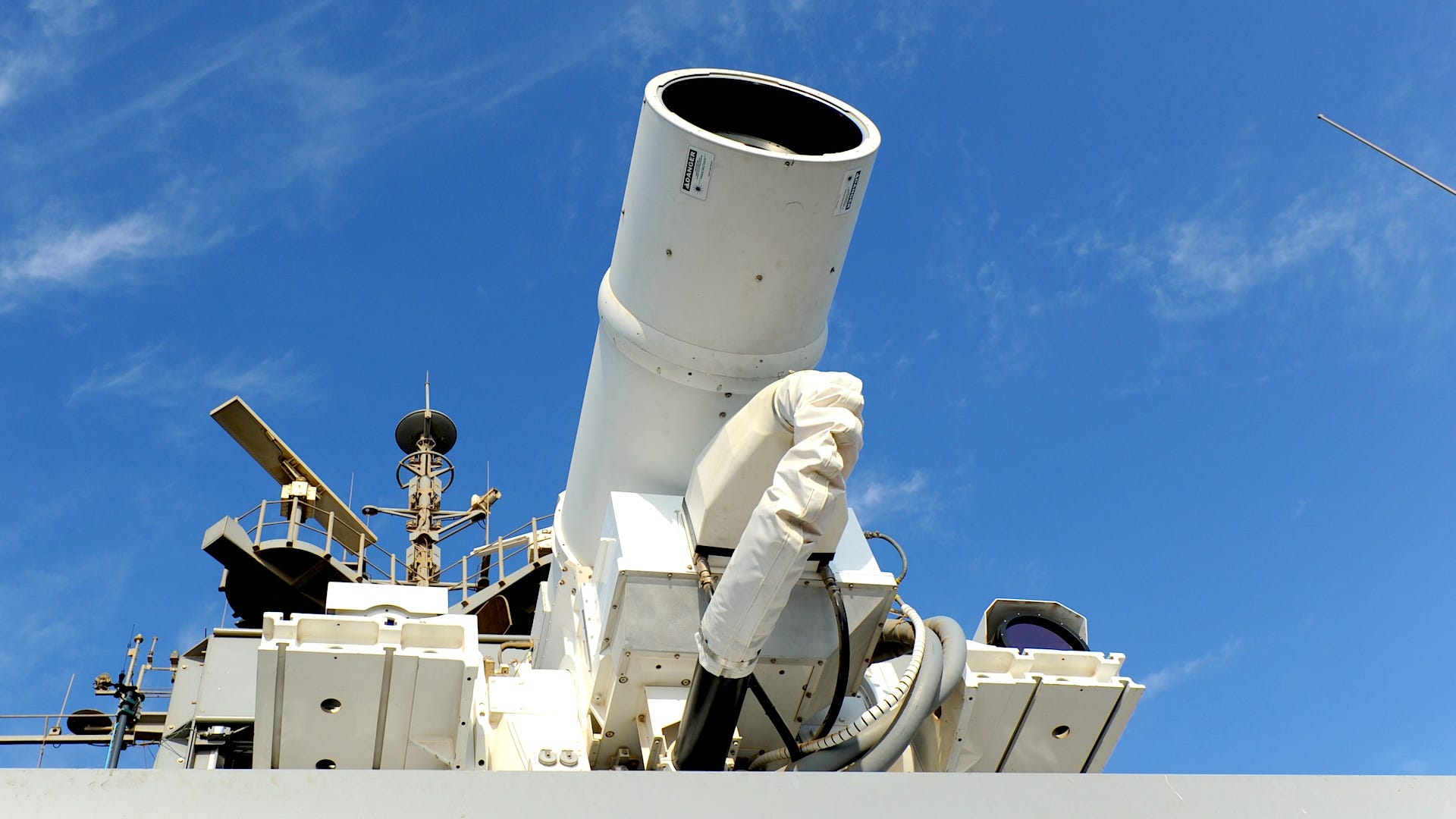
The US Navy has awarded a modest contract to America’s largest shipbuilder for a new high-energy laser weapon for maritime operations.
Huntington Ingalls Industries (HII) and defense contractor EO Solutions — not to be confused with Australian laser weapon provider Electro Optic Systems — received a $3.8 million Other Transaction Agreement (OTA) for a ‘Counter-Group 3 Marinized MOSA Laser for Navy’ (Gr3MMLN) in June through the Naval Surface Technology & Innovation Consortium (NSTIC), a public-private partnership that develops advanced surface warfare capabilities in collaboration with academia and non-traditional defense contractors.
The Gr3MMLN OTA emerged from a 2024 Navy solicitation for a prototype counter-drone laser weapon dubbed the Adaptable Transportable Laser Weapon System (ATLAS), a US defense official familiar with the project told Laser Wars. The ATLAS solicitation called for a containerized laser weapon with a baseline output between 30 and 100 kilowatts that can operate from the flight deck of a surface combatant “in a stressing naval environment for an extended period without degradation or damage,” according to a statement of need obtained by Laser Wars.
While the statement of need detailed anticipated funding of $50 million for ATLAS, the defense official said that the $3.8 million Gr3MMLN OTA was likely just to support experimentation and testing with an existing system. Funding for that contract came from a $5 million congressional addition to the Navy’s fiscal year 2026 budget for an ‘enduring high energy laser,’ according to budget documents. (Not to be confused with the US Army program by the same name.)
Gr3MMLN is the newest laser weapon initiative to break cover as part of the Navy’s renewed pursuit of “a laser on every ship.” The fiscal year 2027 National Defense Authorization Act (NDAA) that the House passed in late July contained $5 million in funding for a containerized version of the service’s 60 kw High Energy Laser with Integrated Optical Dazzler and Surveillance (HELIOS) system, as well as an additional $2.5 million for a separate ‘Containerized Maritime High Energy Laser Weapon System.’ Meanwhile, the Office of Naval Research recently awarded defense contractor Attalon a $17.1 million contract modification to continue work on a 400 kw laser weapon under the SONGBOW program the service initiated in 2025. (The status of the unnamed laser system that Lockheed Martin’s CEO claimed the company was testing with the Navy in the Red Sea remains unclear.)
The Gr3MMLN OTA marks HII’s first known contract for a naval laser weapon. The company’s only previous publicly known laser work was with the Army under a $14.82 million contract awarded in February 2025 for design, development, integration, and systems engineering work on the service’s Enduring High Energy Laser (E-HEL) effort. The following September, the company announced a significant capital investment in a new integration, production, and test facility to support E-HEL development. While E-HEL isn’t exclusively a land-based program — the Navy has experimented with palletized laser weapons on aircraft carriers and is eyeing a marinized version of the system for potential shipboard applications — a full focus on naval laser integration is arguably a more intuitive lane for a defense contractor like HII whose business is building warships.
HII’s Gr3MMLN calculus appears straightforward: with defense contractor AV’s operationally proven LOCUST Laser Weapon System having clinched the Army’s much-awaited E-HEL production contract, the company seems to be pursuing a separate naval laser effort as a more natural extension of its core shipbuilding business. With Gr3MMLN, HII appears focused on the marinization and integration of an existing EO Solutions-derived capability rather than a directed energy system built in-house for the E-HEL effort. Whether Gr3MMLN turns into something more than a technology experiment will depend on whether HII and EO Solutions can capitalize on previous marinization efforts enough to successfully slot a system onto the bow of a surface combatant.
At just a few million dollars, the Gr3MMLN OTA isn’t as big a deal as, say, the Navy’s original $150 million HELIOS contract, or even the initial $29.9 million SONGBOW award. But with the US Defense Department firmly committed to finally transitioning laser weapons out of the laboratory and into combat formations, the new initiative might yield insights into the marinization and containerization that could potentially lay the foundation for future shipboard directed energy capabilities. Just don’t let it get wet.
