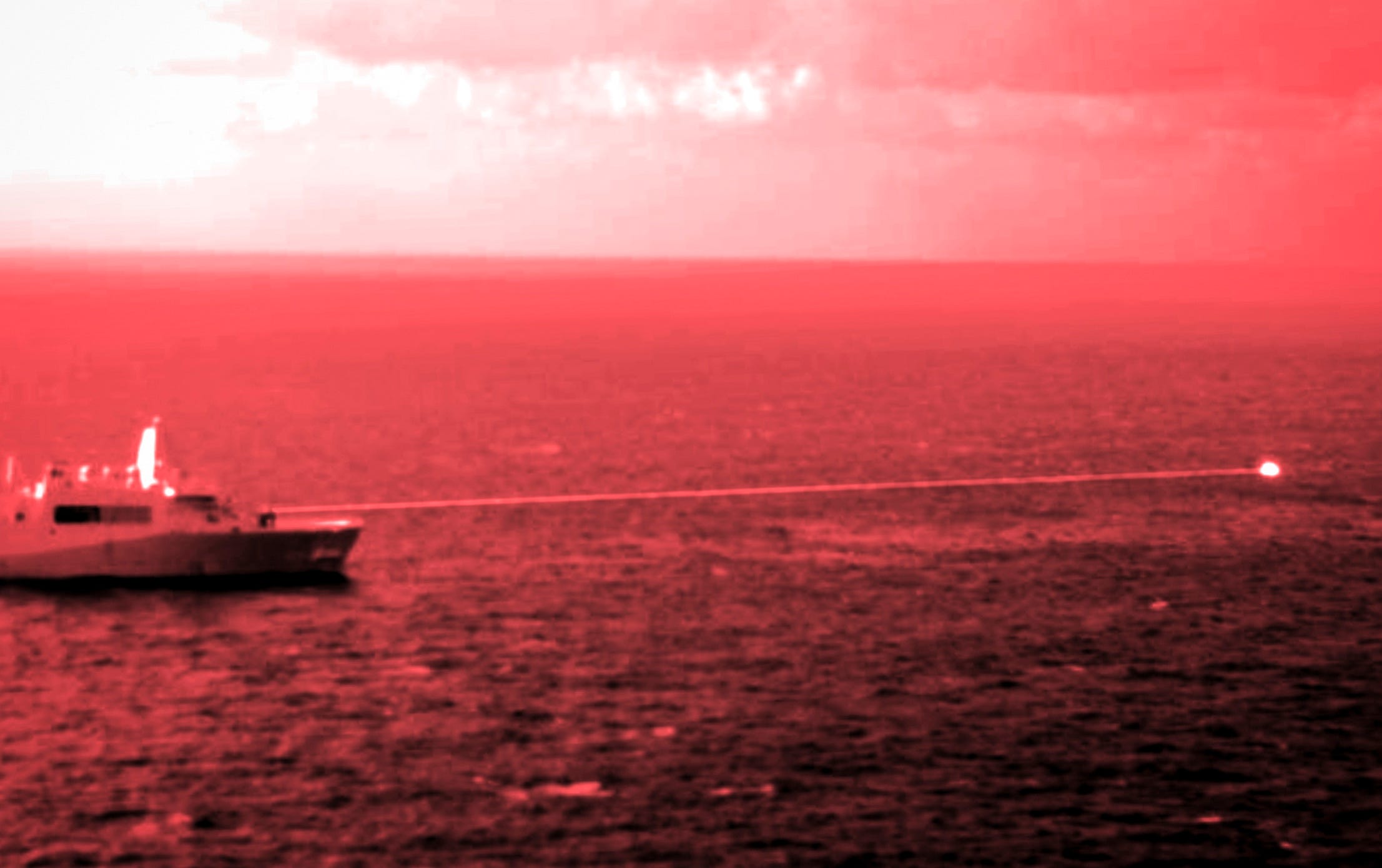
How to Counter a Laser Weapon
High-energy laser weapons are spreading across the world. The US military is developing a playbook to fight back.

The US military has spent billions of dollars over decades building high-energy laser weapons capable of burning drones out of the sky, but it has spent considerably less money and time exploring what happens when an adversary does the same thing. With China fielding a growing arsenal of laser weapons capable of killing drones at ranges up to 25 kilometers, Russia’s Peresvet reportedly in active service, and various laser systems now spreading across the world through indigenous development, proliferation, and a burgeoning export market, that oversight is becoming harder to ignore.
The US military’s answer to this problem has a name: counter-directed energy weapons (CDEW). It’s a nascent field — no dedicated CDEW system is publicly known to have been fielded, and most related research and development remains conceptual. But a 2023 study published in the Journal of Directed Energy by researchers at the US Naval Postgraduate School (NPS) offers the clearest public picture yet of what defending against a laser weapon looks like.
The NPS study — which draws on a comprehensive 2020 NPS systems engineering capstone report by the same team of researchers — is focused specifically on naval unmanned aerial vehicles, and with good reason. Drones are arguably the most exposed military asset in the world: increasingly designed for expendability, they operate in lethal proximity to adversaries and, unlike a destroyer or a tank, carry no meaningful armor. The same principles that makes drones attractive as delivery mechanisms for attritable mass also makes them highly susceptible to a weapon optimized for persistent energy delivery. And while the laser threat calculus the NPS researchers present also applies to manned aircraft, surface ships, missiles, satellites, and ground vehicles, naval drones just happen to sit at the acute end of the vulnerability spectrum.
To understand this vulnerability, the NPS researchers evaluated four representative drones of various sizes: a large Group 5 broad-area maritime surveillance (BAMS) drone (the MQ-4C Triton); a large Group 5 combat drone (Northrop Grumman’s X-47B demonstrator); a rotary-wing Group 4 ISR and fire support drone (the MQ-8C Fire Scout); and a small Group 2 ISR drone (a Small Tactical Unmanned Aerial System from ScanEagle). When faced with a 100 kilowatt laser with no countermeasures in place, three of the four drones were assessed as destroyed after just a few seconds of irradiation. Only the large BAMS drone, operating at extreme altitude and ranges exceeding 8,000 nautical miles from a potential threat, survived thanks to distance alone.
Since lasers bleed energy over distance and through atmospheric interference, altitude and range matter just as much as size. Fast-moving drones are harder to track and target with a sustained beam. Material composition is arguably the most significant factor: a thin composite airframe melts far faster than a thick aluminum one. And in terms of mission profile, a drone loitering at low altitude in a contested littoral is more exposed than one cruising at 60,000 feet over open ocean. To wit, the small Group 2 ISR drone ranked as the most vulnerable of the four drones evaluated in the NPS research, while the BAMS was the safest — but only until it came down to land.
No naval drone (or, for that matter, US military platform) is currently known to be equipped with systems to detect a high-energy laser attack as it occurs; in many cases, the first sign that a laser is being used against you might arrive only during battle damage assessment. That detection gap is the foundational CDEW problem, and everything else flows from it.
The NPS researchers identified five broad categories of CDEW solutions:
Use the weather: This is the most immediately actionable laser countermeasure, and it costs nothing. Fog, rain, haze, dust, and smoke can all absorb and scatter laser beam photons, reducing the energy that reaches the target. At higher power levels (above 100 kw), even clear air can work against a laser through thermal blooming, where the laser heats the air it passes through and defocuses the beam. The operational takeaway is straightforward: plan missions to exploit bad weather and adverse atmospheric conditions wherever possible. The catch is that you need reasonably good intelligence on where a laser threat is located and what its capabilities are to accurately calculate how much protection the atmosphere actually buys you.
Warning systems: Sensors like the AN/AVR-2B Laser Detection System (LDS) are already used on some military aircraft to detect laser rangefinders, target designators, and beam-riding missiles. Integrating those systems directly into drone payloads to detect and identify high-energy laser threats could produce something of an early warning system: a drone detects that it is being irradiated, alerts operators and nearby platforms, and triggers either active countermeasures or evasive maneuvers. The challenge is that warning systems have to be matched to the laser’s wavelength to work reliably — and they need to be designed into the platform from the start, not bolted on after the fact.
Active countermeasures: This category covers four distinct approaches, according to the NPS research. Smoke and aerosol screens — essentially cloudbursts of fine particles dispensed around a drone — absorb and scatter the beam, buying time. Laser jammers analyze the incoming beam, identify the source location and intensity, and fire back a disrupting signal to break the adversary system’s targeting lock. Basic counterfire deploys weapons against the laser system itself if its position is confirmed. Finally, decoy drones acan ct as false targets, drawing the beam away from more mission-critical assets. These approaches range from immediately feasible to technically demanding, and all of them share one requirement: you have to know you’re being lased before you can respond.
Armor up: Passive shielding is the most engineering-intensive solution, with three distinct materials yielding the most dramatic results in the NPS simulation. Bragg mirrors — dielectric mirrors constructed from alternating layers of two optical materials — can reflect up to 99.99% of laser energy for a specific wavelength, essentially making the beam bounce off. Reflective coatings work on a similar principle and can be applied directly to an airframe, even as a temporary pre-mission treatment matched to a known threat wavelength. Ablative coatings take a different approach: rather than deflecting energy, they absorb it and burn away in a controlled fashion to buy a drone time to escape. In the NPS analysis, Bragg mirror coatings were the single most effective CDEW method tested, protecting all four drone types under the simulated 100 kw threat. But there’s a critical caveat: the mirrors only work at the specific wavelength they’re built for. Use the wrong coating against the wrong laser and you’ve wasted weight.
Evasive maneuvers: Maneuvering and swarm tactics round out the playbook. Continuous wave laser weapons require sustained contact with a target to inflict damage — break that contact by banking hard, diving, or flying erratically and the required dwell time resets. Swarm tactics extend this principle by flooding the adversary’s engagement capacity: a single laser system can only engage one target at a time, and a swarm forces it to choose and re-engage sequentially. In the NPS simulations, swarm tactics proved the second most reliable CDEW method, protecting drones in roughly three to four out of every five simulated engagements. Evasive maneuvering alone was less reliable, limited in part by the latency inherent in remote control. Onboard autonomous maneuvering, where a drone detects irradiation and evades without waiting for a human command, is a promising direction, and one that applies equally to any remotely operated platform facing a laser threat.
When the NPS team ran their CDEW analysis against the four drone archetypes, the results illustrated both the promise and the limits of each approach. Under cloudy atmospheric conditions, only the BAMS drone (already safe without countermeasures) gained enough protection from the weather alone to be considered survivable. Bragg mirrors theoretically protected everything, but only by assuming the laser’s wavelength was already known. Swarms worked most of the time, but evasive maneuvers alone failed more often than they succeeded for three of the four drone types.
The primary lesson of the NPS research will be familiar to anyone who has followed directed energy weapons development on the offensive side: there is no silver bullet. The most reliable CDEW strategy combines atmospheric awareness, passive shielding, warning systems, and active countermeasures into a layered defense.
The NPS research itself is not a solution. No CDEW payload has been fielded on a US military drone, the detection gap remains unsolved, and the shielding solutions that perform best in simulation are the ones most dependent on intelligence that the US military may not always have. There’s also an architectural challenge that mirrors offensive laser weapons: CDEW solutions can’t simply be bolted onto existing platforms. Laser warning receivers, countermeasure dispensers, and specialized shielding materials need to be integrated at the design stage as a platform requirement
Laser weapons are spreading around the world, and the adversarial laser weapon threat grows more urgent with each passing day. The question now is whether the US military will start building the CDEW playbook before it actually needs to use it.
Read the Naval Postgraduate School research below:


:: Laughs in black body radiation armor ::
A mirror? Reflect the laser right back at its point of origin?