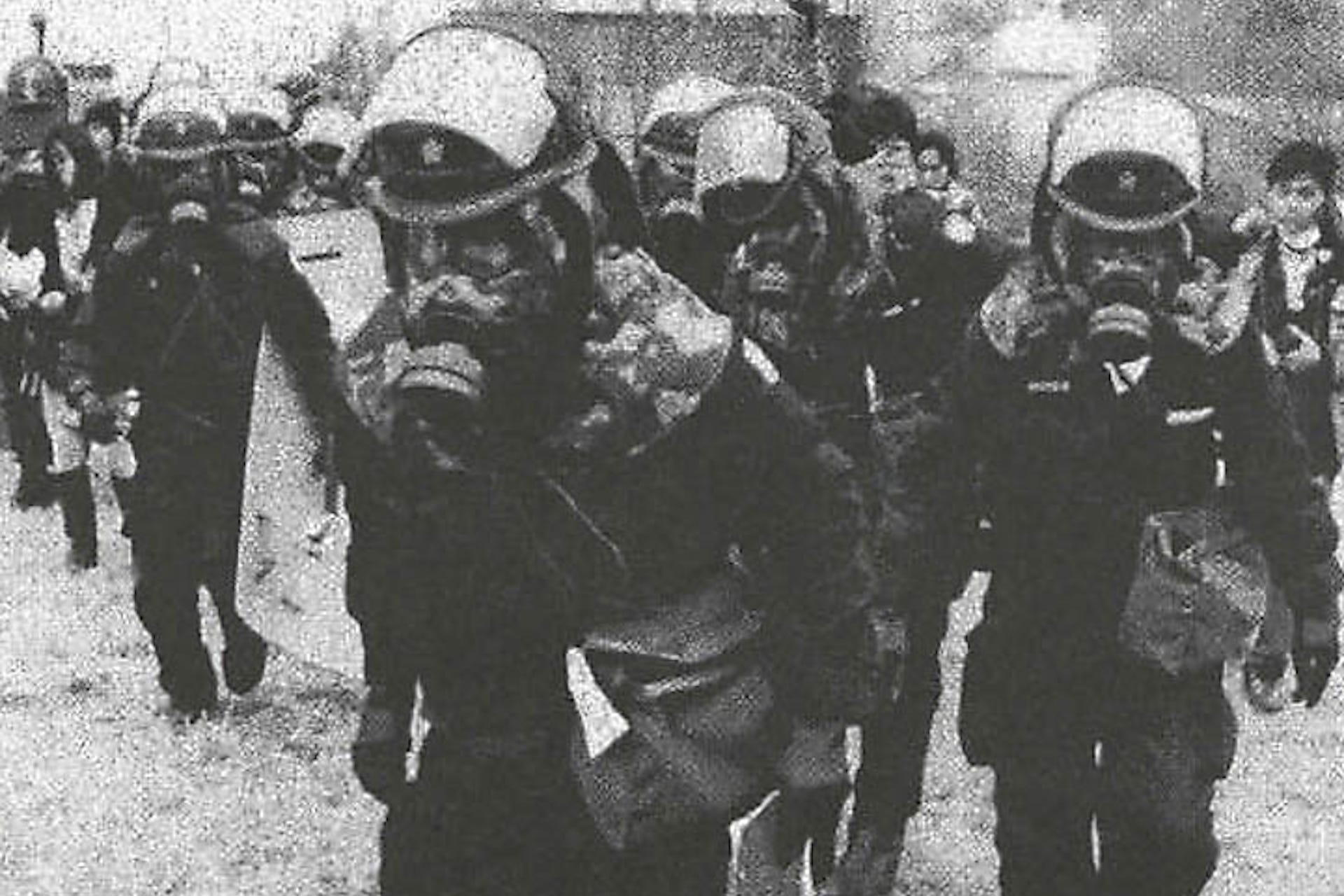
A Japanese Doomsday Cult’s Secret Search for Laser Weapons
The Aum Shinrikyo sect behind the 1995 Tokyo subway sarin gas attack also undertook a years-long global quest to acquire laser technology.

Just days before the March 20, 1995 sarin gas attack on the Tokyo subway system, an agent for Aum Shinrikyo — the Japanese apocalyptic cult that would go on to kill fourteen people and injure thousands in one of the most notorious terrorist attacks in history — was on the phone with an American laser manufacturer.
For roughly two weeks, Aum operative Yasuo Hiramatsu had been negotiating with sales and technical representatives at Hobart Laser Products in Livermore, California for the purchase of a 3 kilowatt industrial laser welder worth approximately $400,000. The discussions grew detailed enough that Hobart’s representatives eventually patched in Aum’s Minister of Science and Technology in Japan to clarify the system’s intended use. The responses, according to an expansive 1995 US Senate Permanent Subcommittee on Investigations hearing held the following October, raised more questions than they answered.
The cult wanted the laser operable from inside a glove box — a sealed environment in which an operator manipulates equipment through thick rubber gloves, useful when biological toxins, contact poisons, or nuclear emissions are a concern. It planned to use the welder on canisters made of aluminum oxide, a material more resistant to chemical corrosion than stainless steel, including, Hiramatsu specified, “canisters within canisters.” Cash was available, and delivery was needed immediately.
The laser was never delivered. The system had to be custom-built and would have taken weeks to complete and ship, Hobart reps explained on March 18, after which the Aum reps abruptly broke off communications. The Tokyo subway attack unfolded two days later.
The Hobart negotiation was not an isolated incident. It was the culmination of a years-long effort by Aum Shinrikyo to acquire laser technology, one that spanned three continents and stretched from a Nobel Prize winner’s living room to the research laboratories of some of Japan’s largest defense contractors — a cautionary tale of how terrorists might someday attempt to turn laser technology into a tool of their evil aspirations.
Aum Shinrikyo became infamous for sarin, but the group’s founder and self-proclaimed messiah, Shoko Asahara, had grander ambitions than nerve gas. Born Chizuo Matsumoto, Asahara built the cult around an apocalyptic ideology that blended Buddhism with millenarian prophecy, centered on his prediction that nuclear war would bring about Armageddon and that Aum’s members would be among the sole survivors. After the group’s humiliating defeat in Japan’s 1990 parliamentary elections — in which Asahara received only 1,783 votes out of half a million cast — he accused the government of fraud and shifted the cult’s mission entirely from surviving the apocalypse to starting it.
What set Aum apart from other violent extremist groups of the era was not just the scale of its ambitions, but the resources available to pursue them. At its peak of nearly 65,000 members, the cult held more than $1 billion in assets and counted more than 300 scientists and engineers recruited from some of Japan’s leading universities among its ranks. It organized itself into government-style ministries — Science and Technology, Construction, Health and Welfare, Intelligence — and set each to work on a weapons program. According to the 1995 Senate investigation, a 2005 RAND Corporation report, and a 2016 analysis in the Journal of Strategic Security, those programs extended well beyond chemical and biological weapons to include nuclear, seismological, plasma, and laser capabilities.
The Ministry of Science and Technology was run by Hideo Murai, a former Kobe Steel researcher who had abandoned a career in astrophysics to become one of Asahara’s most trusted lieutenants. Murai was a science fiction enthusiast who, along with Asahara’s inner circle, was “consumed with the idea that spiritual experiences could be verified, explained, tested and proved scientifically,” according to a 2012 Center for a New American Security (CNAS) analysis of the Aum. The analysis, drawing on interviews with imprisoned Aum members, describes leadership discussions of “plasma weapons that could atomize human bodies, mirrors several miles across that would float in space reflecting the sun’s rays so that they destroyed all life,” as well as “vast laser guns and other imagined means of destruction.” It was, the CNAS researchers found, “presumed that many such weapons had been developed by the United States.”
Asahara’s leadership style fed these sprawling ambitions. He was, by multiple accounts, an impulsive decision-maker — his senior physician Tomomasa Nakagawa, later interviewed by the CNAS research team from his prison cell, said plainly that “our activities depended simply on the mood of Asahara. There is no logical reason or explanation.” According to the CNAS report, Asahara was even known to turn on Japanese television animation shows and have someone describe the scenes to him; many of his weapons concepts were drawn directly from science fiction. Senior members competed for his approval by pitching increasingly exotic technologies, and laser weapons — invisible, silent, and capable of sudden, vivid destruction at a distance — fit his imagination perfectly. (Japan executed Asahara in 2018.)
In 1992, Aum launched its most ambitious overseas push, establishing a major organizational presence in Russia that would eventually grow to become the cult’s largest operation in the world with an estimated 30,000 to 50,000 members, according to the Senate investigation. The driving force behind this expansion was Construction Minister Kiyohide Hayakawa, a former civil engineering consultant considered the mastermind of the group’s growth and militarization who traveled to Russia 21 times between 1992 and 1995 for a total of 180 days there.
Hayakawa was shopping for catastrophe. His notebooks, later seized by Japanese police following the Tokyo subway attack, contain references to nuclear weapons — including the question “how much is a nuclear warhead?” and a list of prices — alongside notes on a Russian city described as hosting a “weapons market” and explicit references to gas laser weapons. According to the Senate investigation, documents seized from Hayakawa also indicated the cult’s interest in obtaining a Proton rocket capable of carrying a satellite into orbit. (Like Murai, Hayakawa “liked science fiction and books about supernatural powers, and was constantly reading them,” according to the CNAS report).
Perhaps the most striking entry in Hayakawa’s laser dossier concerns a meeting that Aum’s senior leaders, including Asahara himself, arranged in Moscow in February 1992 with Dr. Nikolay Basov, the 1964 Nobel Prize laureate whose foundational work on the principles of laser technology helped produce the modern laser. (Aum even published brochures with photographs purporting to show Basov alongside Asahara.) According to the Senate investigation, Basov was one of several Russian scientists Aum leaders approached specifically regarding laser and nuclear technologies. What Basov made of the encounter is unknown, but the cult reportedly treated the meeting as a significant milestone in its pursuit of an ultimate weapon.
Back in Japan, Aum’s Intelligence Ministry opted for a more direct approach to acquiring laser technology: stealing it. In November 1994, Japanese police arrested Masanobu Iwao, believed to work for the ministry, on suspicion of breaking into the offices of Nippon Electronics Co. (NEC) in Sagamihara, Kanagawa prefecture to steal technology from its laser beam laboratory. When investigators searched Iwao’s belongings, they found sketches and detailed maps of the interior layouts of facilities at six major Japanese electronics firms, along with a list of names of Aum members employed at those same companies.
The following month, at the end of December 1994, other Aum members were arrested on suspicion of burglary at the Mitsubishi Heavy Industries Research Center in Hiroshima prefecture, which they had reportedly broken into on multiple occasions in an effort to steal documents and data on laser beam research.
Then, in March 1995 — the same month as the Tokyo subway attack — Japanese police confiscated documents on laser technology from a cult member, including blueprints for a laser gun, during a raid on Aum facilities, while additional laser-related documents were found buried on the grounds of the cult’s facilities in Fujinomiya, Yamanashi prefecture. An official Japanese document reviewed by the Senate subcommittee confirmed all of this, and also noted that Aum’s US operatives were simultaneously seeking laser technology on American soil.
Which brings us back to Livermore and those two weeks of negotiations with Hobart Laser Products. In the Senate’s account of the Hobart negotiations, Hiramatsu’s initial contact was followed by a meeting on March 8, during which Hobart representatives sat across from Aum’s representative and tried (without success) to determine what the cult actually intended to do with a $400,000 industrial laser welder. The technical parameters provided by Aum’s Science and Technology Minister in Japan — the glove box requirement, the aluminum oxide canisters, the “canisters within canisters” — led Hobart’s engineers to draw the conclusion that whoever was buying this laser was worried about handling highly dangerous substances. Within days, the Tokyo subway attack made the entire negotiation moot.
To be clear: the Hobart laser was not itself intended as an offensive weapon. The glove box requirement and the aluminum oxide canisters point toward using an industrial-grade laser welder to fabricate sealed delivery vessels for chemical or biological agents. The laser was infrastructure for a mass casualty attack rather than the attack itself, a distinction that captures the essence of Aum’s laser efforts: not a unified program designed to field a death ray, but a sprawling, opportunistic campaign that treated lasers as tools for multiple purposes. The Basov meeting, the NEC break-in, the laser gun blueprints, and the Hobart negotiation weren’t pointing in the same direction – just whatever direction the quixotic Asahara’s imagination happened to move at any given moment.

Aum Shinrikyo’s laser program ultimately went nowhere, the cult’s Tokyo subway attack carried out with sarin dispersed through punctured plastic bags — a conspicuously low-tech delivery method after years chasing high-tech horror. The failure wasn’t for lack of trying, but it was, as with the nuclear program, a product of the same internal dysfunctions that plagued every Aum weapons initiative: fantastical goals set by an impulsive leader and scientific roster long on credentials and short on specific expertise.
But the CNAS researchers who spent years interviewing imprisoned Aum members offered a noteworthy caution in their 2012 report: “Significant failures preceded or accompanied Aum successes. When we encounter terrorist pursuit of these weapons the failures may be less a source of comfort than a warning of activity that, if persistently pursued, may result in success.” They compared terrorist groups like Aum to Russian roulette: many chambers prove harmless, but the blank one belie the destructive power the gun can produce. Their laser program misfired, but the sarin didn’t — and it doesn’t take much to imagine how the terror fomented by the attack could have been (and one day may be) multiplied by the technology’s successful use.