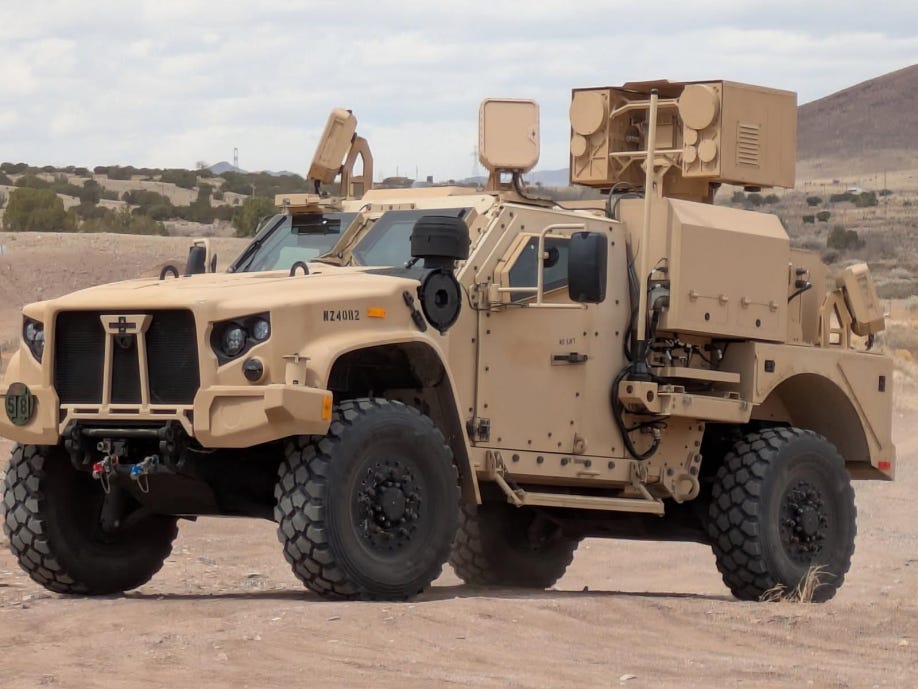
Here’s Your First Look at the Army’s Laser-Armed JLTV
The service's new laser truck breaks cover.

The US Army can officially count high-energy laser trucks as part of its arsenal.
The Army took delivery of two Joint Light Tactical Vehicles (JLTVs) outfitted with 20 kilowatt LOCUST Laser Weapon Systems developed by defense contractor AV (formerly formerly AeroVironment and Blue Halo) as part of the second increment of the service’s Army Multi-Purpose High Energy Laser (AMP-HEL) prototyping effort, the company announced on Thursday.
The JLTVs comes on the heels of the September delivery of a pair of M1301 Infantry Squad Vehicles (ISV) equipped with LOCUST laser weapons under the first increment of the AMP-HEL effort. One of those vehicles had previously appeared in a static display during the annual Fires Symposium near Fort Sill, Oklahoma in early April before subsequently showing up during a training exercise near the US southern border in July, as Laser Wars reported at the time.
Delivered to the Army’s Rapid Capabilities and Critical Technologies Office (RCCTO), which oversees the service’s directed energy portfolio, the JLTVs feature the same LOCUST laser weapons as the ISVs but “with a larger aperture beam director, improving lethality performance,” according to AV.
The Army had also previously received of a pair of LOCUST laser weapons as part of its Palletized High Energy Laser (P-HEL) program in 2022, with those systems operationally deployed to an undisclosed location overseas (likely the US Central Command area of operations) that same year to defend US troops against the expanding threat of low-cost weaponized drones.
AV “continues to deliver proven, efficient, modular laser weapon systems that perform and protect in real-world threat environments,” said Mary Clum, the company’s directed energy chief, in a statement. “Integrated as part of these AMP-HEL systems, LOCUST is a cost-effective, rugged, precise, and scalable solution that is addressing the ever-evolving UAS threats our warfighters are facing on frontlines today. With the technology proven, we remain focused on advancing capabilities while scaling manufacturing to meet the growing demand.”
The new JLTVs offer a clear picture of what the Army’s future laser fleet might look like. The service is currently pursuing a new laser weapon that could potentially integrate into a JLTV or operate in a palletized configuration under its Enduring High Energy Laser (E-HEL) effort, which, if successful, could become the ground branch’s first official directed energy program of record. (The Army’s fiscal year 2026 budget request included $49.75 million for the procurement of “up to two” E-HEL systems and $11.13 million in related research and development funding.)
The Army’s new E-HEL push followed the publication of a brutal Government Accountability Office (GAO) assessment of the service’s 50 kw Stryker-mounted Directed Energy Maneuver-Short Range Air Defense (DE M-SHORAD) effort in June, which determined that system “was not mature enough to support the transition” to a program of record, as Laser Wars reported at the time.
The Army isn’t the only service pursuing laser-armed JLTVs. In November 2023, BlueHalo announced that it had been awarded a contract from the US Navy’s Office of Naval Research to develop a laser weapon based on LOCUST and integrate it into a US Marine Corps JLTV. The Navy’s fiscal year 2026 budget documents show an increase of $4 million requested over the previous year under its Marine Corps Advanced Technology Demo program “due to the initiation of research to integrate [a] provided tactical laser and beam director into a tactical vehicle for military utility experiments.”
For now, the Army’s laser-armed JLTVs are still prototypes, but they likely won’t stay that way amid the US Defense Department’s new focus on directed energy as one of its pared down critical technology areas. Indeed, the Army’s emphasis on modular, palletized systems under its E-HEL push is a sign that the service is investing in laser weapons that can move fast and scale incrementally rather than exquisite systems too complex and fragile to survive contact with real-world operations.
Whether this approach finally delivers a durable directed energy program of record remains an open question. The collapse of DE M-SHORAD looms large, and E-HEL will have little patience to burn if performance or reliability falters. But if laser weapons are going to earn a permanent place on the battlefield, this is likely what they’ll look like: truck-mounted, modest in power, and purpose-built to fight cheap drones.